
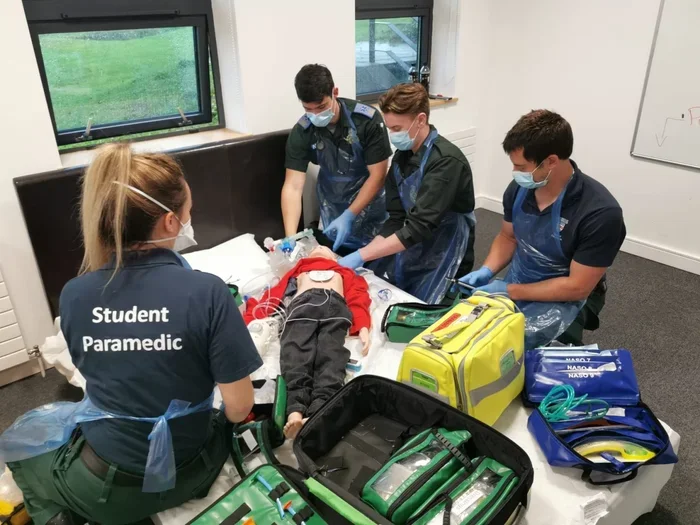
Becoming a paramedic requires specific education, including a high school diploma, EMT certification, and a paramedic degree or diploma program. You will need to complete classroom learning, hands-on clinical training, and pass national licensing exams. This guide walks you through every step of the education journey to help you start a rewarding career in emergency medical services.
Key Takeaways
- High school diploma or GED: This is the minimum starting point for all paramedic education paths.
- EMT-Basic certification: You must complete this foundational step before advancing to paramedic-level training.
- Paramedic degree or diploma: Most programs take 1 to 2 years and cover advanced medical skills.
- Clinical rotations: Real-world experience in hospitals and ambulances is a core part of every paramedic program.
- National licensing exam: Passing the NREMT exam is required to work as a certified paramedic in most states.
- Continuing education: Paramedics must complete ongoing training to maintain their credentials and stay current.
📑 Table of Contents
- What Education Do You Need to Be a Successful Paramedic
- Understanding the Role of a Paramedic
- Basic Education Requirements
- Step-by-Step Education Path to Becoming a Paramedic
- Types of Paramedic Education Programs
- What to Expect in Paramedic School
- Costs and Financial Aid for Paramedic Education
- Continuing Education and Career Growth
- Common Mistakes to Avoid
- Quick Tips for Success
- Conclusion
What Education Do You Need to Be a Successful Paramedic
Choosing a career as a paramedic is a big decision. It takes dedication, hard work, and the right education. Many people wonder exactly what education do you need to be a paramedic. The answer is not as simple as one single degree. It is a step-by-step journey that builds your skills from the ground up.
First, you need a solid foundation. Then you move through levels of training that get more advanced. Each step prepares you for the next. Think of it like building a house. You need a strong base before you add walls and a roof. The same idea applies to paramedic education. You start small and grow your knowledge over time.
This guide will walk you through every stage of the process. We will cover everything from basic requirements to advanced degrees. You will learn about certifications, training programs, and what to expect along the way. By the end, you will have a clear picture of your path forward. Let us get started.
Understanding the Role of a Paramedic
Before diving into education, it helps to understand what a paramedic does. A paramedic is a highly trained healthcare professional. They provide emergency medical care in the field. This can include treating injuries, administering medications, and performing life-saving procedures. Paramedics often work on ambulances, in hospitals, or at emergency scenes.
The role is demanding but incredibly rewarding. You get to help people during their most vulnerable moments. That is why the education requirements are so important. You must be ready to handle high-pressure situations with confidence and skill. The right training gives you that confidence.
Why Education Matters in Emergency Medical Services
Education is the backbone of emergency medical services (EMS). Without proper training, you cannot make the split-second decisions that save lives. Every protocol, every medication, and every procedure you learn comes from a structured education. This is not something you can figure out on the fly.
Think about the common phrases we use when talking about learning. You might hear someone say knowledge is power in education circles. In fact, if you explore similes for education, you will find many colorful ways to describe the learning journey. Similarly, metaphors for education paint vivid pictures of how learning shapes our paths. These expressions remind us that education is a journey, not a destination.
In paramedicine, this journey is very real. Your education directly impacts patient outcomes. The more you know, the better you can care for those in need.
Basic Education Requirements
Every paramedic path starts with the basics. You cannot skip these steps. Here is what you need to have before you begin advanced training.
High School Diploma or GED
The very first requirement is a high school diploma or a General Educational Development (GED) certificate. This is the absolute minimum. Without it, you will not be accepted into any paramedic program. Focus on doing well in science and math classes during high school. These subjects will help you later in your training.
Some students also choose to take advanced courses in biology or anatomy. This gives them a head start. It is never too early to begin preparing for a career in healthcare.
Recommended High School Courses
While in high school, certain classes can give you a strong foundation. Consider taking the following courses:
- Biology: Learn about the human body and how it works.
- Chemistry: Understand how medications and substances interact.
- Anatomy: Study the structure of the body and its systems.
- Mathematics: Build strong skills for dosing calculations.
- English: Develop clear communication skills, which are vital in emergencies.
- Physical Education: Stay physically fit, as the job demands stamina.
Age and Physical Requirements
Most paramedic programs require you to be at least 18 years old. You must also have a valid driver’s license. Physical fitness is important too. Paramedics need to lift heavy patients, run on uneven ground, and work long shifts. Meeting these basic requirements early will make your journey smoother.
Step-by-Step Education Path to Becoming a Paramedic
The path to becoming a paramedic is a series of steps. Each one builds on the last. Let us break it down so you know exactly what to expect.
Step 1: Become an EMT-Basic
The first major step is becoming an Emergency Medical Technician (EMT) at the basic level. This is often called EMT-Basic or EMT-B. It is a foundational certification that all paramedics must hold. You cannot skip this step.
EMT-Basic programs typically take about 120 to 150 hours to complete. They cover essential skills like CPR, bandaging, splinting, and patient assessment. You will also learn how to handle emergencies such as cardiac arrest, choking, and allergic reactions.
After completing the program, you must pass the National Registry of Emergency Medical Technicians (NREMT) exam. This exam tests both your knowledge and your practical skills. Once you pass, you are a certified EMT-Basic.
Step 2: Gain Field Experience
Once you are a certified EMT-Basic, it is time to get real-world experience. Most paramedic programs require you to work as an EMT for at least six months to two years. This experience is invaluable. It teaches you how to stay calm under pressure and work as part of a team.
During this time, you will encounter many different situations. You will see how emergency response works in real life. This hands-on experience prepares you for the advanced training that comes next.
Step 3: Complete a Paramedic Training Program
This is the most important step in your education. Paramedic training programs are offered at community colleges, technical schools, and some universities. There are two main types of programs you can choose from.
Paramedic Diploma or Certificate: These programs usually take about 1 to 2 years. They focus heavily on hands-on training and clinical experience. You will learn advanced airway management, IV insertion, medication administration, and cardiac care.
Paramedic Associate Degree: This is a two-year program that includes both classroom instruction and general education courses. An associate degree gives you a broader education. It can also make it easier to transfer credits if you decide to pursue a bachelor’s degree later.
Both paths lead to eligibility for the NREMT paramedic exam. Choose the one that fits your goals and timeline best.
Step 4: Pass the NREMT Paramedic Exam
After completing your paramedic training program, you must pass the NREMT paramedic certification exam. This is a national exam that tests your knowledge and skills. It has two parts: a written or computer-based exam and a practical skills test.
The written exam covers topics like cardiology, respiratory emergencies, trauma care, and medical emergencies. The practical test requires you to demonstrate real-world skills on simulated patients. Passing both parts earns you the title of Certified Paramedic.
Step 5: State Licensure
In addition to the national NREMT certification, most states require you to obtain a state license. The process varies by state. Some states accept the NREMT certification directly. Others may have additional requirements such as a state-specific exam or background check.
Make sure you check your state’s specific requirements. Staying organized during this process will save you time and stress.
Types of Paramedic Education Programs
Not all paramedic programs are the same. Understanding the differences helps you choose the right one for your needs.
Community College Programs
Community colleges are the most common choice for paramedic education. They offer affordable tuition and flexible schedules. Many programs are designed to be completed in 1 to 2 years. You will get a mix of classroom learning and hands-on clinical experience.
Community college programs also often have partnerships with local hospitals and ambulance services. This means you may get priority for clinical rotations and even job placements after graduation.
Technical and Vocational Schools
Technical schools focus heavily on career-ready skills. Their programs are often shorter and more intensive. You may complete training in as little as 12 months. These schools are a great option if you want to enter the workforce quickly.
The downside is that technical programs may not offer general education courses. If you plan to pursue a bachelor’s degree later, this could be a consideration.
University-Based Paramedic Programs
Some universities offer bachelor’s degree programs in paramedic science or emergency medical services. These programs are more comprehensive. They include advanced coursework in leadership, research, and healthcare management.
A bachelor’s degree can open doors to advanced career opportunities. It may also be required if you want to move into management or teaching roles in EMS.
Online vs. In-Person Programs
Many students wonder if they can complete paramedic training online. The short answer is no, not entirely. Paramedicine is a hands-on profession. You must practice skills in person and complete clinical rotations at real healthcare facilities.
Some programs do offer online coursework for the classroom portion. But the clinical and skills training must be done in person. Be wary of any program that claims you can become a paramedic entirely online.
What to Expect in Paramedic School
Paramedic school is challenging but incredibly rewarding. Here is a glimpse of what your education will look like.
Classroom Learning
In the classroom, you will study subjects like anatomy, physiology, pharmacology, and emergency medicine. You will learn about the human body in great detail. You will also study how different medications work and when to use them.
Classroom instruction typically makes up about half of your training time. The other half is spent in clinical settings and field internships.
Clinical Rotations
Clinical rotations are where your education comes to life. You will work alongside experienced paramedics and nurses in hospitals and on ambulances. You will treat real patients under supervision.
These rotations expose you to a wide range of medical situations. You might assist in an emergency room, work in an intensive care unit, or ride along on ambulance calls. Every rotation teaches you something new and valuable.
Field Internships
Field internships are the final phase of most paramedic programs. You will work as part of a crew on active ambulance calls. This is your chance to put everything you have learned into practice.
Field internships are intense. They require long hours and a lot of responsibility. But they are the best preparation for a career as a paramedic. By the end, you will feel confident and ready to handle real emergencies on your own.
Skills You Will Master
During your education, you will develop a wide range of critical skills. These include:
- Advanced airway management and intubation
- Cardiac monitoring and defibrillation
- IV insertion and medication administration
- Trauma assessment and treatment
- Patient communication and empathy
- Teamwork and decision-making under pressure
Costs and Financial Aid for Paramedic Education
Education costs are a real concern for many students. The good news is that there are several ways to manage these expenses.
Community college programs are often the most affordable option. Tuition can range from a few thousand dollars to around $10,000 depending on the program and your location. University-based programs tend to cost more, sometimes $20,000 or more.
Financial aid is available for eligible students. Fill out the Free Application for Federal Student Aid (FAFSA) to explore grants, loans, and work-study options. Many ambulance services and hospitals also offer tuition reimbursement programs. Some even pay for your training in exchange for a commitment to work for them after graduation.
Scholarships specifically for EMS students are another great resource. Check with local organizations, professional associations, and your school’s financial aid office. Every little bit helps.
Continuing Education and Career Growth
Your education does not end when you earn your paramedic certification. The field of emergency medicine is always evolving. New techniques, medications, and technologies emerge regularly. To stay current, paramedics must complete continuing education courses.
Most states require paramedics to renew their licenses every two to three years. Renewal typically involves completing a set number of continuing education hours. These courses might cover topics like pediatric emergencies, stroke care, or new cardiac protocols.
Beyond renewal, many paramedics pursue advanced certifications. Some choose to become Critical Care Paramedics or Flight Paramedics. Others go back to school to earn a bachelor’s or even a master’s degree in healthcare. The opportunities for growth are plentiful.
If you are interested in the broader world of education and how learning shapes careers, you might enjoy exploring idioms for education. These expressions capture the spirit of learning and growth that drives professionals like paramedics every day.
Common Mistakes to Avoid
As you plan your education journey, watch out for these common pitfalls.
- Skipping EMT-Basic training: You cannot become a paramedic without first earning your EMT-Basic certification.
- Choosing a program solely based on cost: Make sure the program is accredited and has a strong reputation.
- Neglecting clinical experience: Hands-on practice is just as important as classroom learning.
- Waiting too long to gain field experience: The longer you wait, the harder it is to retain what you learned.
- Ignoring state-specific requirements: Every state has different rules. Research your state early.
Quick Tips for Success
Here are some practical tips to help you thrive in your paramedic education:
- Stay organized with a study schedule and stick to it.
- Practice your skills whenever you get the chance.
- Build strong relationships with your instructors and peers.
- Ask questions and never be afraid to seek help.
- Stay physically fit to handle the demands of the job.
- Read about current trends in emergency medicine regularly.
Conclusion
The journey to becoming a paramedic starts with education. You need a high school diploma, EMT-Basic certification, and a paramedic training program. Each step brings you closer to a career that truly makes a difference. The education required is challenging, but it is also deeply meaningful. You are investing in skills that save lives every single day.
Remember that paramedic education is not just about passing exams. It is about growing as a healthcare professional and a compassionate human being. The knowledge you gain will serve you throughout your entire career. Stay committed, stay curious, and never stop learning. Your journey starts now.
Frequently Asked Questions
How long does it take to become a paramedic?
Most people complete the entire process in about 2 to 4 years. This includes EMT-Basic training, field experience, and a paramedic program. Some accelerated programs can be completed faster.
Can I become a paramedic without a college degree?
Yes, you can. Many paramedics complete a diploma or certificate program at a community college or technical school. A degree is not always required, though it can help with career advancement.
Is paramedic school harder than EMT school?
Paramedic school is generally more advanced and demanding. It covers more complex medical topics and requires deeper knowledge. However, your EMT experience gives you a strong foundation to build on.
Do I need to be physically fit to become a paramedic?
Yes, physical fitness is very important. Paramedics lift patients, carry heavy equipment, and work long shifts. Staying in good shape helps you perform your duties safely and effectively.
What is the difference between a paramedic and an EMT?
An EMT-Basic provides basic emergency care. A paramedic has advanced training and can perform more complex procedures like administering medications and interpreting EKGs. Paramedics have a broader scope of practice.
How much does paramedic education cost?
Costs vary widely. Community college programs may cost $2,000 to $10,000. University programs can be $15,000 or more. Financial aid, scholarships, and employer reimbursement can help reduce these costs.


