
CPI in education refers to the Consumer Price Index as it applies to schooling costs, tuition, and academic expenses. Understanding this metric helps students, families, and educators make smarter financial decisions. CPI in education reveals how inflation directly impacts classroom resources, school funding, and the overall cost of learning.
Have you ever wondered why college keeps getting more expensive every year? You are not imagining things. The rising cost of education is real, and there is a specific tool that measures exactly how fast those costs are climbing. That tool is called the Consumer Price Index, or CPI. When we talk about CPI in education, we are looking at how inflation hits schools, universities, and students’ wallets. This guide will walk you through everything you need to know about this important economic measure and why it matters so much for anyone involved in learning.
Whether you are a student saving for college, a parent planning for tuition, or a teacher curious about school budgets, understanding CPI in education gives you a powerful advantage. It turns confusing numbers into clear, actionable insights. Let us dive in and break it all down together.
Key Takeaways
- CPI in education tracks how the cost of schooling changes over time due to inflation.
- Understanding CPI helps families plan for tuition, books, and living expenses during college.
- Schools and governments use CPI data to set budgets and adjust funding allocations.
- CPI influences financial aid packages, scholarship amounts, and student loan interest rates.
- Comparing CPI to education-specific inflation gives a clearer picture of real costs.
- Teachers can use similes for education to explain CPI concepts in a relatable way.
- Staying informed about CPI in education empowers better personal finance decisions for students.
📑 Table of Contents
- What Is CPI in Education?
- How CPI Affects Tuition and Student Costs
- Why Understanding CPI Matters for Students and Families
- How Schools and Governments Use CPI
- CPI in Education vs. Other Education Metrics
- Tips for Staying Ahead of Education Inflation
- Common Mistakes People Make with CPI in Education
- Expert Insights on CPI in Education
- Key Takeaways
- Conclusion
What Is CPI in Education?
The Consumer Price Index is a government-tracked number that measures how the price of everyday goods and services changes over time. When we apply this concept to CPI in education, we focus specifically on the items and services tied to learning. Think of tuition, textbooks, dorm rooms, meal plans, and even school supplies. All of these fall under the education category of the CPI basket.
Here is a simple way to think about it. Imagine you bought a college textbook for $50 in 2015. Today, that same textbook might cost $80 or more. The CPI tracks that jump. It tells us the average price change for a fixed set of goods over time. In education, this helps everyone — from policymakers to individual families — understand the true cost of education in real dollars.
How Is CPI Calculated for Education?
The Bureau of Labor Statistics collects price data from thousands of stores, universities, and service providers. For the education category, they look at things like:
- College tuition and fees
- Textbooks and course materials
- Room and board at universities
- School supplies and technology
- Childcare and preschool costs
Each of these items gets a weight based on how much people typically spend on them. Tuition might carry more weight than, say, a pack of pencils. The final number gives us a percentage that shows how much prices have risen compared to a base year. That percentage is the inflation rate for education, and it is a key part of CPI in education.
How CPI Affects Tuition and Student Costs
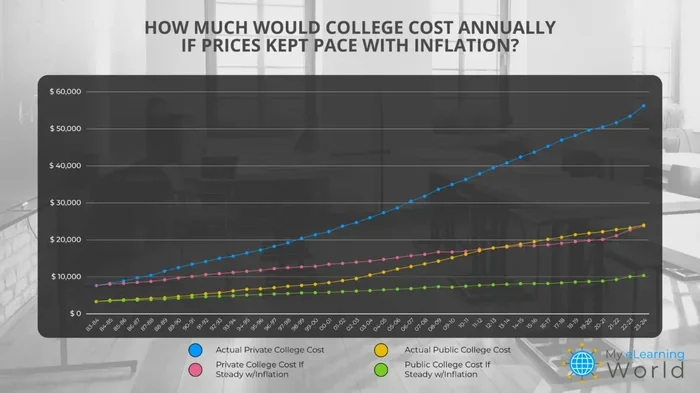
Now that you know what CPI in education measures, let us talk about what it actually means for students. Tuition inflation is one of the biggest concerns in higher education today. While general inflation might run around 3% per year, education costs have historically outpaced that rate. This means the price of attending college grows faster than most other expenses in daily life.
Tuition Inflation vs. General Inflation
Here is a comparison to make this clear:
- General CPI Inflation: Averages around 2% to 4% per year.
- Education CPI Inflation: Often runs between 4% and 8% per year for higher education.
- Textbook Price Inflation: Has historically exceeded 5% annually in many years.
When you see these numbers side by side, it is easy to spot the problem. Education costs are climbing faster than almost everything else. This is why CPI in education is such an important topic. It shows the gap between general living costs and the specific costs families face when sending a student to school.
Real-World Examples of CPI Impact
Let us look at a practical example. Say a public university charged $10,000 in tuition in 2010. If education-specific inflation ran at 5% per year, that same tuition would be roughly $16,300 by 2020. That is a 63% increase in just ten years. Meanwhile, average wages grew at a much slower rate. This gap is exactly what CPI in education helps us measure and understand.
For students relying on student loans, this gap is especially painful. A loan that seemed manageable a decade ago may now feel crushing when tuition has jumped so dramatically. This is why tracking CPI in education matters for everyone who cares about affordable learning.
Why Understanding CPI Matters for Students and Families
Knowledge is power, and that is especially true when it comes to CPI in education. When families understand how inflation affects schooling costs, they can plan better. They can save more strategically, choose schools wisely, and apply for the right kind of financial aid.
Budgeting with CPI Data
Here are some practical tips for using CPI information in your planning:
- Track historical trends. Look at how education CPI has changed over the last 10 to 20 years. This gives you a sense of how fast costs might rise in the future.
- Compare schools by real cost. Use CPI adjustments to compare the true cost of attending different universities, not just their sticker prices.
- Factor in cost of living. CPI also covers housing and food. A school in a high-cost city will have a bigger overall expense than its tuition alone suggests.
- Adjust your savings plan. If education CPI runs at 6% per year, make sure your savings grow at least as fast.
These steps might sound small, but they add up to big differences over time. Families who understand CPI in education enter the college planning process with their eyes wide open.
The Emotional Side of Education Inflation
Let us be honest. Talking about numbers and inflation can feel dry and distant. But for real families, the impact is deeply personal. A parent who saves for years might still fall short if education costs rise faster than expected. A student who takes on too much debt might spend decades paying it off. Understanding CPI in education helps us have honest conversations about these realities. It removes the guesswork and replaces it with facts.
How Schools and Governments Use CPI
CPI in education is not just a student concern. Schools, universities, and government agencies rely on CPI data every single day. It shapes decisions about budgets, funding, and policy.
School Budgeting and Resource Allocation
School districts use CPI to plan their annual budgets. When the education CPI rises, districts know they need more money to maintain the same level of service. This includes paying teachers fairly, buying updated materials, and keeping buildings safe and functional. Without accounting for CPI in education, schools risk cutting programs or letting facilities fall behind.
Teachers often explain these concepts using metaphors for education to help students visualize how money flows through the system. A metaphor like “the school budget is a garden that needs more water each year” makes the idea of rising costs feel tangible and real.
Government Policy and Funding Formulas
Federal and state governments use CPI to set education funding levels. Many grant programs and financial aid formulas adjust their amounts based on inflation data. When the education CPI goes up, governments may increase funding for Pell Grants, subsidized loans, and other support programs. However, if funding does not keep pace with CPI in education, students feel the squeeze.
Some policymakers argue that the standard CPI does not fully capture education-specific costs. Items like technology upgrades, mental health services, and online learning infrastructure are newer expenses that the traditional CPI basket may not weight heavily enough. This ongoing debate shows why CPI in education remains a hot topic in education policy circles.
CPI in Education vs. Other Education Metrics
CPI is just one tool for measuring the economics of education. Let us compare it to a few other common metrics so you can see where it fits in the bigger picture.
| Metric | What It Measures | How It Differs from CPI |
|---|---|---|
| Consumer Price Index (CPI) | Average price change for a basket of goods including education | Broad measure; includes all consumer spending categories |
| Education Price Index (EPI) | Price changes specific to education services | Narrower focus; only tracks education-related costs |
| Tuition Inflation Rate | Year-over-year change in tuition and fees | School-specific; does not include living expenses |
| Student Debt Growth Rate | Increase in total student loan balances | Tracks borrowing, not direct costs |
As you can see, CPI in education gives us a broad but useful view. For a deeper dive into education-specific pricing, the Education Price Index is more precise. But CPI remains the most widely reported and understood measure. It is the number you will hear on the news, in policy discussions, and in financial planning conversations.
When educators explain these differences, they sometimes turn to idioms for education to make the concepts stick. Phrases like “the big picture” or “the tip of the iceberg” help learners grasp why one metric tells a different story than another.
Tips for Staying Ahead of Education Inflation
So what can you actually do with all this information? Here are some practical steps to stay ahead of rising education costs:
- Start saving early. Even small contributions grow over time, especially in tax-advantaged accounts like 529 plans.
- Apply for scholarships aggressively. Many scholarships are tied to financial need, which CPI data helps determine.
- Consider community college first. Lower tuition costs can significantly reduce your overall education debt.
- Work while studying. Part-time jobs help offset living expenses that rise with the CPI.
- Stay informed. Follow reports from the Bureau of Labor Statistics and your school’s financial aid office.
Each of these steps uses CPI in education data in some way. The more you know about inflation trends, the better decisions you can make. And better decisions lead to less financial stress and more focus on what really matters — learning and growing.
A Quick Tip for Teachers
If you are an educator, consider weaving CPI in education into your lessons. When students understand how inflation works, they gain a lifelong skill. You might use similes for change in life to explain how costs shift over time. Saying “prices are like a growing plant — they keep going up if you do not watch them” makes the concept stick with young learners.
Common Mistakes People Make with CPI in Education
Even well-informed people sometimes stumble when interpreting CPI data. Here are a few pitfalls to avoid:
- Confusing CPI with tuition rates. CPI measures average price changes across many items. A single school’s tuition may rise faster or slower than the CPI suggests.
- Ignoring regional differences. CPI varies by location. Education costs in New York City are very different from those in rural Kansas.
- Assuming CPI is perfectly accurate. The CPI basket may not fully capture newer education expenses like online learning platforms or mental health services.
- Using old data. CPI is updated regularly. Always use the most recent figures for accurate planning.
Avoiding these mistakes helps you get the most out of CPI in education data. It keeps your planning grounded in reality rather than assumptions.
Expert Insights on CPI in Education
Economists and education researchers agree that tracking CPI in education is essential for long-term planning. Dr. Robert Archibald, an economics professor, has noted that education costs have consistently outpaced general inflation for decades. This trend shows no signs of slowing down. Families who ignore this reality risk being caught off guard by rising expenses.
Financial advisors also stress the importance of using CPI data when building education savings plans. A plan based on yesterday’s costs will not hold up against tomorrow’s reality. The key is to build flexibility into your strategy and adjust as CPI in education numbers change year after year.
Government analysts point out that when education CPI rises faster than wages, it creates a affordability crisis. More families struggle to pay for schooling without taking on heavy debt. This is why policymakers closely watch CPI in education when crafting new laws and funding programs.
Key Takeaways
- CPI in education measures how the cost of schooling changes over time due to inflation.
- Education costs have historically risen faster than general inflation, making this metric especially important.
- Families who understand CPI in education can budget, save, and plan with greater confidence.
- Schools and governments use CPI data to set budgets, adjust funding, and shape policy decisions.
- Comparing CPI to other education metrics like the Education Price Index gives a fuller picture of real costs.
- Simple steps like early saving, scholarship applications, and staying informed can help you stay ahead of rising costs.
- Teachers can use metaphors for education to make CPI concepts more accessible and engaging for students.
Conclusion
CPI in education is more than just a number in a government report. It is a window into the real cost of learning and a tool that empowers students, families, and educators to make smarter choices. When you understand how inflation affects tuition, textbooks, and living expenses, you are no longer guessing about the future. You are planning with purpose.
The world of education economics can feel overwhelming at first. But the core idea is simple. Prices rise over time, and CPI in education tells us exactly how fast that happens in the schooling world. Use that knowledge. Share it with others. Let it guide your decisions about saving, borrowing, and choosing the right school.
Education is one of the most valuable investments anyone can make. And like any smart investment, it pays to understand the numbers behind it. CPI in education gives you those numbers. Now it is up to you to put them to work.
Frequently Asked Questions
What does CPI stand for in education?
CPI stands for Consumer Price Index. In the education context, it measures how the prices of schooling-related goods and services change over time. This includes tuition, textbooks, housing, and other student expenses. Tracking CPI in education helps everyone understand the true cost of learning.
How does CPI affect student loan amounts?
When education CPI rises, the cost of attending college goes up. This often leads students to borrow more money. Lenders and government programs also use CPI data to adjust interest rates and loan limits. Understanding CPI in education helps students borrow wisely and plan repayment.
Is CPI the same as tuition inflation?
Not exactly. Tuition inflation focuses only on the cost of tuition and fees. CPI in education covers a broader basket that includes room and board, textbooks, supplies, and other school-related expenses. CPI gives you a wider view of the total cost of education.
How often is CPI data updated?
The Bureau of Labor Statistics releases CPI data monthly. Education-specific CPI figures are included in these reports. For the most accurate picture of CPI in education, always check the latest available data when making financial plans.
Can CPI help me choose the right college?
Yes, absolutely. By comparing how each school’s costs have changed over time relative to CPI, you can identify which institutions are keeping tuition more affordable. Using CPI in education as a benchmark helps you make a smarter, data-driven choice.
Why do education costs rise faster than general inflation?
Several factors drive this trend. Universities face rising costs for faculty salaries, facility maintenance, technology, and administrative services. Additionally, demand for higher education remains strong, which pushes prices up. CPI in education captures these dynamics and shows why education costs outpace general inflation year after year.


