
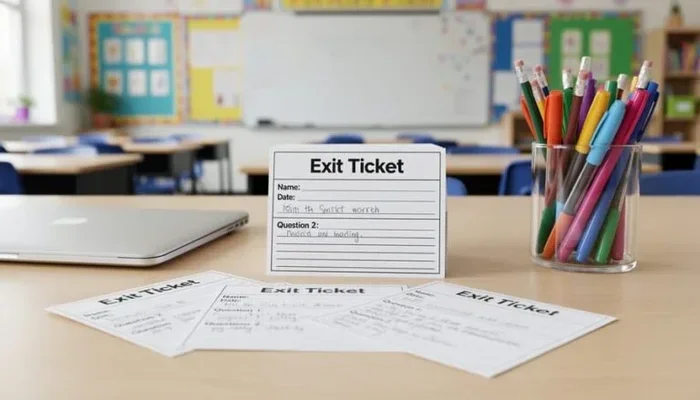
An exit slip in education is a short, end-of-lesson activity that helps teachers check student understanding and guide future instruction. These quick formative assessment tools take just minutes but provide powerful insights into what students learned and what needs review. Whether you are a new teacher or a seasoned educator, using exit slips can transform your classroom practice and deepen student engagement.
Have you ever finished a lesson and wondered, “Did my students actually get this?” You are not alone. Every teacher faces that moment of uncertainty at the end of class. This is where the exit slip in education comes in handy. It is a simple, powerful tool that gives you a window into your students’ minds without taking up much class time.
An exit slip is a brief activity students complete just before leaving the classroom. Think of it as a quick snapshot of what they learned that day. Teachers use these slips to gather feedback, check understanding, and plan better lessons. The beauty of this approach lies in its simplicity. You do not need fancy technology or hours of prep work. Just a few minutes and a piece of paper can make a huge difference.
In this article, we will explore everything you need to know about exit slips. We will cover what they are, why they work, the different types you can use, and how to create them effectively. By the end, you will have all the tools you need to start using exit slips in your classroom right away.
Key Takeaways
- Exit slips are quick assessment tools: They take only a few minutes but give teachers valuable insight into student learning.
- They support formative assessment: Exit slips help teachers adjust instruction based on real-time student feedback.
- Multiple types exist: From recall questions to reflection prompts, there is an exit slip style for every lesson.
- They boost student engagement: Students stay focused knowing they will be asked to reflect on the lesson.
- Easy to implement: You do not need special tools or training to start using exit slips tomorrow.
- They build metacognition: Exit slips teach students to think about their own learning process.
📑 Table of Contents
What Is an Exit Slip in Education?
An exit slip in education is a short written response students complete at the end of a lesson or class period. It is a formative assessment technique that helps teachers understand what students learned and where they might be struggling. The term “exit slip” comes from the idea that students “exit” the classroom after completing the quick task.
These slips usually take just two to five minutes. Students write a brief answer to a question or prompt the teacher provides. The teacher then reviews the responses to gauge understanding. Some exit slips ask students to recall facts. Others ask them to reflect on their learning or apply new concepts.
Exit slips fall under the broader category of formative assessment. This means they are not graded for marks but used to guide instruction. They give teachers real-time data about student progress. You can use them daily, weekly, or whenever you feel a quick check would be helpful. Many teachers find that using a simile for education helps them explain the concept to new educators, comparing exit slips to a quick health check for your lesson.
How Exit Slips Differ from Other Assessment Tools
Exit slips are not the same as tests or quizzes. Those are summative assessments. They measure what students have learned over a longer period. Exit slips, on the other hand, are formative. They happen during the learning process. They are meant to inform your next lesson, not assign a grade.
Another key difference is length. A test might take an entire class period. An exit slip takes just a few minutes. This makes it easy to use without disrupting the flow of your lesson. You can also use them alongside other tools like metaphors for education activities to create a rich, layered learning experience.
Why Exit Slips Matter in the Classroom
You might wonder why something so simple could matter so much. The answer lies in how exit slips support both teaching and learning. They create a feedback loop that benefits everyone in the classroom.
First, exit slips give teachers immediate feedback. You do not have to wait for test results to know if your lesson worked. You can see right away which students understood the material and which ones need more help. This allows you to adjust your instruction on the fly.
Second, exit slips encourage students to reflect on their learning. When students write about what they learned, they process the information more deeply. This student reflection builds metacognitive skills. Students start to understand how they learn best. Over time, they become more independent and self-aware learners.
Third, exit slips increase student engagement. When students know they will be asked to share their thoughts at the end of class, they stay more focused during the lesson. It creates a sense of accountability. They pay attention because they know they will need to recall or apply what they learned.
Many teachers also use an idiom for education when explaining the value of exit slips to colleagues. They say it is like “checking the pulse” of your classroom. It gives you a quick reading of the overall health of your lesson.
The Science Behind Exit Slips
Exit slips are backed by research in cognitive science. When students retrieve information at the end of a lesson, it strengthens their memory. This process is called retrieval practice. It is one of the most effective learning strategies available.
Studies show that frequent, low-stakes assessments improve long-term retention. Exit slips fit this model perfectly. They are low-stakes because they are not graded heavily. They are frequent because you can use them every day. Together, these qualities make exit slips a powerful instructional strategy for any classroom.
Exit slips also align with Bloom’s taxonomy, a framework for categorizing levels of thinking. You can design prompts that target different levels, from basic recall to higher-order analysis. This flexibility makes exit slips useful across all subjects and grade levels.
Types of Exit Slips You Can Use
Not all exit slips look the same. In fact, variety is one of the strengths of this tool. Different types serve different purposes. Let us look at the most common categories.
1. Recall-Based Exit Slips
These ask students to remember key facts from the lesson. Examples include:
- “Write down three things you learned today.”
- “What is the main idea of our lesson?”
- “List two vocabulary words we covered.”
Recall-based slips are great for checking basic understanding. They work well in subjects like math, science, and history where factual knowledge is important.
2. Reflection-Based Exit Slips
These prompts ask students to think about their learning process. Examples include:
- “What was the most confusing part of today’s lesson?”
- “How did you feel about your participation today?”
- “What strategy helped you learn this topic?”
Reflection slips build self-awareness and help teachers understand the emotional side of learning. They show you not just what students know but how they feel about their learning journey.
3. Application-Based Exit Slips
These ask students to use what they learned in a new context. Examples include:
- “Write one question you still have about today’s topic.”
- “How would you use this concept in real life?”
- “Draw a quick diagram showing how these ideas connect.”
Application slips push students to think at a deeper level. They encourage active learning and help you see who can transfer knowledge to new situations.
4. Feedback-Based Exit Slips
These focus on the teaching itself. Examples include:
- “What part of the lesson was most helpful?”
- “What could I do differently next time?”
- “Rate today’s lesson on a scale of 1 to 5.”
Feedback slips give students a voice in their education. They also help you improve your instructional design over time. Students feel heard and respected when their feedback matters.
How to Create Effective Exit Slips
Creating exit slips is simple, but doing it well takes a bit of thought. Here are some practical steps to get started.
Start with Your Learning Objective
Before you write any prompt, know what you want to assess. What is the main goal of your lesson? Your exit slip should directly connect to that goal. If your objective is for students to understand fractions, your prompt should ask about fractions. Do not ask about something unrelated.
Keep your learning outcomes clear and specific. The better you define what students should know, the easier it is to write a targeted exit slip.
Keep It Short and Focused
One of the best things about exit slips is their brevity. A good exit slip should take no more than three to five minutes. If it takes longer, students will lose focus and the tool loses its value.
Write prompts that are clear and easy to understand. Avoid vague questions like “What did you think of the lesson?” Instead, try “What was one new thing you learned about today?” Specific prompts get specific answers.
Vary Your Prompts Regularly
Using the same type of exit slip every day can get stale. Mix it up. Use recall prompts on Monday, reflection prompts on Wednesday, and application prompts on Friday. This variety keeps students engaged and gives you a fuller picture of their learning.
You can also tie exit slips to broader classroom activities. For instance, after a discussion about literary devices, you might ask students to identify a simile for change in life from the text. This connects the exit slip to deeper analytical thinking.
Use a Consistent Format
While the prompts should vary, the format can stay the same. Use the same slip of paper or digital form each time. This reduces confusion and saves time. Students know exactly what to expect and can jump right in.
Some teachers use index cards. Others use half-sheets of paper. Digital tools like Google Forms also work well. Choose what fits your classroom best and stick with it.
Review and Act on Responses
An exit slip is only useful if you use the data. Set aside a few minutes after class to review the responses. Look for patterns. Are most students struggling with the same concept? Do you need to reteach part of the lesson?
Use this information to shape your next class. If many students got the wrong answer, start the next lesson with a quick review. If most students understood, you can move forward confidently. This assessment technique keeps your instruction responsive and effective.
Best Practices for Using Exit Slips
To get the most out of exit slips, follow these proven best practices. They will help you avoid common pitfalls and maximize the impact of this tool.
Make It a Routine
Consistency is key. When exit slips become a regular part of your class routine, students take them seriously. They know that their responses matter and that you will use the feedback to improve instruction.
Try to use exit slips at least two or three times a week. Daily use is even better if your schedule allows. The more consistent you are, the more data you collect, and the better you can tailor your teaching.
Keep It Low-Stakes
Exit slips should never feel like a test. Students need to feel safe sharing what they do and do not understand. If they fear being judged, they will not be honest in their responses.
Grade exit slips lightly or not at all. Use them purely as a teaching tool. You can give completion points, but avoid penalizing wrong answers. The goal is honest feedback, not perfect responses.
Differentiate Your Prompts
Not all students are at the same level. Consider offering different prompts for different groups. Advanced learners might get a more challenging question. Struggling students might get a simpler recall prompt.
This differentiated instruction approach ensures that every student can succeed with the exit slip. It also gives you more accurate data about each group’s understanding.
Use Exit Slips to Spark Discussion
You can use exit slip responses to start the next class. Share a few anonymous responses with the class and discuss them. This creates a culture of open learning where mistakes are celebrated as part of growth.
For example, you might say, “I noticed several of you had great questions about fractions. Let us tackle those together today.” This shows students that their voices matter and that their learning drives the class direction.
Common Mistakes to Avoid
Even with a great tool, mistakes can happen. Here are some common pitfalls and how to avoid them.
Making Prompts Too Vague
A vague prompt leads to vague answers. If you ask “What did you learn?” some students will struggle to respond. Be specific. Ask “What is one fact you learned about the water cycle today?” Clear prompts produce clear answers.
Ignoring the Data
Collecting exit slips but never reviewing them defeats the purpose. Set a system in place to track and analyze responses. You might keep a simple spreadsheet or use a digital dashboard. The data is only valuable if you act on it.
Making Exit Slips Too Long
If students need more than five minutes to complete an exit slip, it is no longer an exit slip. Keep it brief. Focus on one key question or prompt. Quality matters more than quantity here.
Using the Same Format Every Time
Repetition kills engagement. If every exit slip is the same, students will stop putting thought into their responses. Rotate between different types regularly to keep things fresh and meaningful.
Forgetting to Close the Loop
Students need to see that their exit slip responses lead to real changes in instruction. If you collect slips but never mention the feedback, students will stop taking them seriously. Close the loop by referencing their responses in future lessons.
Conclusion
The exit slip in education is one of the simplest and most effective tools a teacher can use. It takes just a few minutes, requires no special equipment, and provides valuable insights into student learning. From checking recall to sparking reflection, exit slips serve multiple purposes in any classroom.
When you use exit slips consistently, you build a culture of continuous improvement. You show students that their learning matters and that you care about their progress. You also give yourself the data you need to teach smarter, not harder.
Start small. Try one exit slip this week and see how it goes. You might be surprised by what your students tell you. The exit slip in education is not just a tool. It is a conversation between you and your students about their learning journey. And that conversation is always worth having.
Remember, every great lesson deserves a strong closing. Exit slips give your lessons that strong finish. They help you celebrate what worked, identify what did not, and plan for what comes next. So grab a stack of index cards, write your first prompt, and start today. Your students will thank you for it.
Frequently Asked Questions
What is an exit slip in education used for?
An exit slip is used to check student understanding at the end of a lesson. It helps teachers gather quick feedback and adjust their instruction. It also encourages students to reflect on what they learned during the class.
How long should an exit slip take to complete?
An exit slip should take no more than three to five minutes. The whole point is to keep it brief and focused. If it takes longer, students lose interest and the data becomes less reliable.
Are exit slips graded?
Most exit slips are not graded for accuracy. They are formative assessment tools, not summative ones. Some teachers give completion points, but the goal is to encourage honest responses, not perfect answers.
Can exit slips be used in all subjects?
Yes, exit slips work in every subject. You can use them in math, science, English, history, art, and more. The prompts simply need to match the learning objective of that particular lesson.
How often should I use exit slips?
Using exit slips two to three times per week is a great starting point. Daily use is ideal if your schedule allows. The key is consistency so students build the habit of reflecting on their learning.
What is the difference between an exit slip and a bellringer?
An exit slip happens at the end of a lesson, while a bellringer happens at the beginning. Both are quick assessment tools. Exit slips check what was learned; bellringers activate prior knowledge and set the tone for the class.
=== META TITLE ===
Exit Slips in Education: What They Are and Why They Matter
=== URL SLUG ===
/exit-slip-in-education
=== SEO TITLE ===
Exit Slips in Education: What They Are and Why They Matter


