
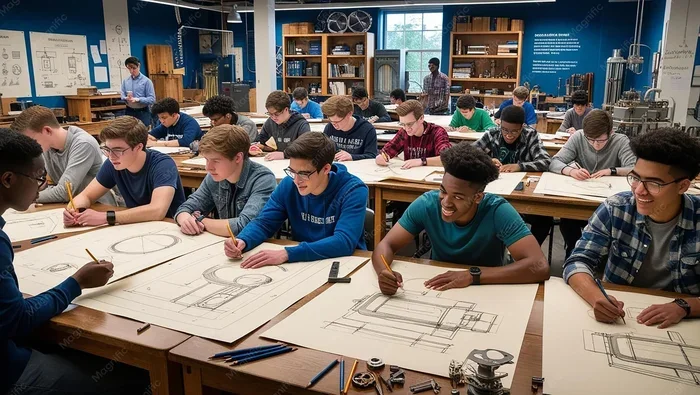
To become a successful engineer, you typically need at least a bachelor’s degree in engineering from an accredited program. The right education to be an engineer opens doors to high-paying careers, hands-on problem-solving, and real-world impact. Whether you dream of designing bridges, writing code, or building machines, your engineering education will give you the skills and knowledge you need to thrive.
Key Takeaways
- A bachelor’s degree is the standard: Most engineering jobs require at least a four-year bachelor’s degree in engineering from an accredited school.
- STEM education matters early: Strong foundations in math, physics, and science start in high school and set you up for success.
- Multiple degree paths exist: From online engineering courses to master’s and PhD programs, you have options to match your goals.
- Licensing boosts your career: A professional engineering license can unlock higher-paying roles and more responsibility.
- Internships build real skills: Engineering internships give you practical experience that classrooms alone cannot provide.
- Soft skills count too: Communication, teamwork, and creative thinking are just as important as technical knowledge.
📑 Table of Contents
- What Education Do You Need To Be A Successful Engineer
- Why Education Matters for Engineering
- Types of Engineering Degrees
- What You Will Study in Engineering Programs
- Certifications and Licenses That Boost Your Career
- Alternative Paths to Becoming an Engineer
- Soft Skills That Complement Your Engineering Education
- How to Choose the Right Engineering School
- Engineering Career Outlook and Salary Expectations
- Conclusion
What Education Do You Need To Be A Successful Engineer
So, you are thinking about becoming an engineer. That is a fantastic choice. Engineering is one of the most rewarding careers you can pursue. But before you dive in, you probably have one big question: what education do you need to be an engineer? The answer is not as simple as “get a degree.” There are many paths, many options, and many ways to reach your goal.
In this guide, we will walk you through everything you need to know about engineering education. We will cover the types of degrees, the subjects you will study, alternative routes, and tips to make your journey smoother. By the end, you will have a clear picture of your engineering career path ahead.
Let us start with the basics. Education to be an engineer usually begins with a strong foundation in math and science. From there, you move into specialized engineering programs that teach you how to solve real problems. Whether you want to build roads, design software, or create new machines, the right education gives you the tools to succeed.
Why Education Matters for Engineering
Engineering is not just a job. It is a profession that shapes the world around us. Engineers design the bridges we drive on, the phones we use, and the buildings we live in. Because of this, society demands a high level of knowledge and skill from engineers. That is why formal education is so important.
Here is why your engineering degree matters:
- It builds your foundation: You learn the core engineering fundamentals that every engineer needs.
- It opens doors: Many employers will not even look at your resume without a recognized degree.
- It teaches problem-solving: Engineering school trains your brain to think logically and creatively.
- It leads to licensing: In many countries, you need a degree to sit for the professional engineering license exam.
- It boosts your earning potential: Engineers with proper education tend to earn higher engineering salaries than those without.
Think of it this way. You would not want a doctor who learned medicine from a blog post. The same logic applies to engineering. Your education proves you have the knowledge and discipline to handle complex challenges.
Types of Engineering Degrees
Not all engineering paths are the same. Different jobs require different levels of education. Let us break down the most common options so you can find what fits your goals.
Associate Degree in Engineering
An associate degree usually takes two years to complete. It gives you a basic introduction to engineering concepts and math. Some students use this as a stepping stone. They finish the first two years at a community college and then transfer to a four-year university.
With an associate degree alone, your options are limited. You might qualify for technician roles or lab assistant positions. But if you want to call yourself a full engineer, you will need to keep studying.
Bachelor’s Degree in Engineering
This is the gold standard. A bachelor’s degree in engineering typically takes four years to complete. It covers everything from engineering fundamentals to hands-on design projects. Most entry-level engineering jobs require this degree.
During your bachelor’s program, you will choose a major or specialization. Popular choices include:
- Civil engineering: Focuses on buildings, roads, and infrastructure.
- Mechanical engineering: Covers machines, engines, and manufacturing.
- Electrical engineering: Deals with electronics, power systems, and circuits.
- Computer engineering: Combines hardware and software design.
- Software engineering: Focuses on building applications and systems.
- Chemical engineering: Works with chemicals, materials, and processes.
Each major has its own set of engineering prerequisites. But they all share a strong emphasis on math, physics, and critical thinking.
Master’s Degree in Engineering
A master’s degree adds one to two years of study beyond your bachelor’s. It allows you to go deeper into a specific area. Some engineers pursue a master’s to move into management or research roles. Others do it to increase their engineering salary and stand out in a competitive job market.
If you already have a bachelor’s in a related field, you might be able to earn a master’s in engineering faster. Many schools offer accelerated programs for motivated students.
PhD in Engineering
A PhD is for those who want to push the boundaries of knowledge. This path is ideal for aspiring researchers, professors, or lead scientists. A PhD in engineering can take four to seven years after your bachelor’s. It involves original research, writing a dissertation, and defending your work.
Most engineers do not need a PhD. But if you dream of teaching at a university or leading cutting-edge research, this level of education can be incredibly rewarding.
What You Will Study in Engineering Programs
Every engineering program has a core set of subjects. These courses build the skills you need to succeed. Here is a look at what a typical engineering curriculum includes.
Math and Science Foundations
Math is the language of engineering. You will spend a lot of time studying calculus, differential equations, and linear algebra. Physics is equally important. It helps you understand how the natural world works, which is essential for designing real systems.
Chemistry also plays a role, especially if you choose chemical or materials engineering. Biology matters if you are interested in biomedical engineering. The point is, STEM education in high school gives you a real head start.
Engineering Core Courses
Once you build your foundation, you move into specialized classes. These might include:
- Statics and dynamics: How forces affect structures and motion.
- Thermodynamics: Heat, energy, and work in mechanical systems.
- Circuit analysis: How electrical currents flow through components.
- Materials science: The properties of metals, polymers, and composites.
- Fluid mechanics: How liquids and gases behave under pressure.
- Engineering design: The process of creating and testing solutions.
These classes can be tough. But they are also incredibly satisfying. There is nothing quite like seeing a design you built in class work in real life.
Hands-On Projects and Labs
Good engineering programs do not just lecture. They give you real-world experience. Labs, design projects, and team assignments let you apply what you learn. Many schools also encourage students to join engineering clubs or compete in design challenges.
These experiences are invaluable. They teach you engineering skills that no textbook can fully convey. You learn to collaborate, troubleshoot, and think on your feet.
Certifications and Licenses That Boost Your Career
A degree gets you in the door. But certifications and licenses can take your engineering career to the next level. Here are the most important ones to know about.
Professional Engineering License (PE)
The professional engineering license is the gold standard for practicing engineers. In the United States, you must pass two exams to earn it. The first is the Fundamentals of Engineering (FE) exam, which you can take right after your bachelor’s degree. The second is the Principles and Practice of Engineering (PE) exam, which you take after gaining several years of work experience.
Having a PE license means you can sign off on engineering plans and take legal responsibility for your work. It also signals to employers that you are a trusted, qualified professional.
Industry-Specific Certifications
Beyond the PE license, many industries have their own certifications. For example:
- Certified Software Development Professional (CSDP): For software engineers.
- Project Management Professional (PMP): Useful for engineering managers.
- Six Sigma certification: Focuses on quality improvement and process optimization.
These certifications show employers you are serious about your craft. They can also lead to higher pay and better job opportunities.
Alternative Paths to Becoming an Engineer
Not everyone follows the traditional route. The good news is that there are alternative paths to a career in engineering. Let us explore some of them.
Online Engineering Courses and Bootcamps
The rise of online learning has opened new doors. Many reputable platforms now offer online engineering courses that teach in-demand skills. These are especially popular in software engineering and data science.
Bootcamps are short, intensive programs that focus on practical skills. They can be a great option if you want to switch careers quickly. However, keep in mind that most employers still prefer candidates with formal degrees for traditional engineering roles.
Self-Taught Engineers
Some engineers are entirely self-taught. They learn through books, videos, and personal projects. This path works best in fields like software development, where you can build a portfolio that proves your abilities.
If you take this route, be prepared to work harder to prove yourself. You may need to start in a junior role and work your way up. But with enough engineering skills and determination, it is absolutely possible.
Engineering Apprenticeships and Co-op Programs
Some schools offer co-op programs that alternate classroom learning with paid work. These engineering internships give you real experience while you study. They also help you build a professional network before you graduate.
Apprenticeships are another great option. They let you learn directly from experienced engineers on the job. This hands-on approach can be especially valuable if you learn better by doing than by reading.
Soft Skills That Complement Your Engineering Education
Technical knowledge is essential. But soft skills can set you apart from other candidates. Employers increasingly look for engineers who can communicate, collaborate, and adapt.
Here are the soft skills that matter most in engineering:
- Communication: You need to explain complex ideas in simple terms to clients, managers, and team members.
- Teamwork: Almost every engineering project involves a group effort. Being a good team player is non-negotiable.
- Problem-solving: Engineers spend most of their time finding solutions. A sharp, analytical mind is your best tool.
- Creativity: The best solutions often come from thinking outside the box. Do not be afraid to experiment.
- Time management: Engineering projects have tight deadlines. Learning to prioritize and manage your time is critical.
Interestingly, the way you express ideas and learn new concepts can be enhanced by studying language and creative expression. For instance, exploring similes for education can sharpen your ability to describe complex ideas in vivid, simple ways. Similarly, understanding metaphors for education can deepen how you connect abstract engineering concepts to everyday experiences. Even studying idioms for education can boost your communication fluency, which is a huge asset in team settings and client meetings.
These language skills may seem unrelated to engineering fundamentals, but they are more connected than you might think. Engineers who communicate well lead projects more effectively, pitch ideas more persuasively, and collaborate more smoothly with diverse teams.
How to Choose the Right Engineering School
Not all engineering schools are created equal. Choosing the right one can make a big difference in your education and your future career. Here are some factors to consider.
Accreditation
Always check that the school is properly accredited. In the United States, look for ABET accreditation for engineering programs. This seal of approval ensures the program meets high standards and that your degree will be recognized by employers and licensing boards.
Specializations Offered
Different schools excel in different areas. Some are known for civil engineering. Others are strong in computer or electrical engineering. Research which engineering specializations each school offers and how they align with your interests.
Internship and Co-op Opportunities
A school that partners with local companies for internships gives you a real advantage. These connections can lead to job offers after graduation. Ask about co-op programs and career services when you visit campuses.
Location and Cost
Engineering school can be expensive. Consider in-state public universities, which often offer the best value. Also think about location. Being near a hub of engineering companies can make it easier to find internships and jobs after graduation.
Engineering Career Outlook and Salary Expectations
Now for the part everyone cares about: money and job prospects. The good news is that engineering is a strong career choice with solid growth and competitive pay.
According to the U.S. Bureau of Labor Statistics, engineering jobs are projected to grow steadily over the next decade. The median engineering salary in the United States is well above the national average for all occupations. Of course, your exact pay will depend on your engineering degree, your specialization, your experience level, and where you live.
Here is a quick look at average salaries by engineering field:
- Software engineering: One of the highest-paying fields, especially in tech hubs.
- Petroleum engineering: Consistently among the top earners in engineering.
- Computer hardware engineering: Strong demand and competitive pay.
- Electrical engineering: Wide range of industries and solid compensation.
- Civil engineering: Stable demand with good benefits and job security.
- Mechanical engineering: Versatile and reliable career path.
Remember, your education is the foundation. The more you invest in learning, the more you will earn over your lifetime. Engineers with advanced degrees or specialized certifications often climb to senior roles faster than those with only a basic degree.
Conclusion
So, what is the final answer to the question, what education do you need to be a successful engineer? The short answer is a solid bachelor’s degree from an accredited program. But the full picture is much richer. It includes the right high school preparation, a chosen specialization, hands-on experience through internships, and possibly a professional license or advanced degree.
Your journey into engineering starts with a single step. That step might be choosing the right high school classes, researching engineering programs, or signing up for an introductory online course. Whatever you do, make sure it moves you closer to your goal.
The world needs engineers. It needs creative problem-solvers, innovative thinkers, and dedicated professionals. With the right education to be an engineer, you can join their ranks and make a real difference. Start today, stay curious, and never stop learning.
Frequently Asked Questions
What is the minimum education required to become an engineer?
A bachelor’s degree in engineering from an accredited program is the minimum requirement for most engineering jobs. Some technician roles may accept an associate degree, but for full engineering positions, a four-year degree is the standard. This level of education gives you the foundational knowledge and skills employers expect.
Can I become an engineer without a degree?
It is very difficult but not impossible. In some fields, especially software engineering, self-taught professionals and bootcamp graduates can find work. However, most traditional engineering roles require a formal degree for licensing and credibility. Without a degree, you will need an exceptional portfolio and significant hands-on experience to compete.
How long does engineering education take?
A bachelor’s degree typically takes four years of full-time study. Master’s programs add one to two years. PhD programs can take four to seven additional years beyond the bachelor’s. The length depends on your chosen engineering specialization and whether you study full-time or part-time.
Do I need a professional engineering license?
It depends on your role. If you work on public projects, sign engineering plans, or take legal responsibility for designs, you will likely need a license. For many private-sector roles, a license is not required. However, having one can significantly boost your career prospects and engineering salary.
Are online engineering degrees respected by employers?
Yes, as long as the program is from an accredited institution. Many reputable universities now offer online engineering courses and full degree programs. Employers value the degree itself and the accreditation of the school, not whether the classes were online or in person.
What engineering field has the best job outlook?
Software engineering and computer engineering currently have some of the strongest job outlooks. Renewable energy engineering and biomedical engineering are also growing rapidly. The best field for you depends on your interests, skills, and engineering career goals. Research each field to find the best fit for your passions.


