
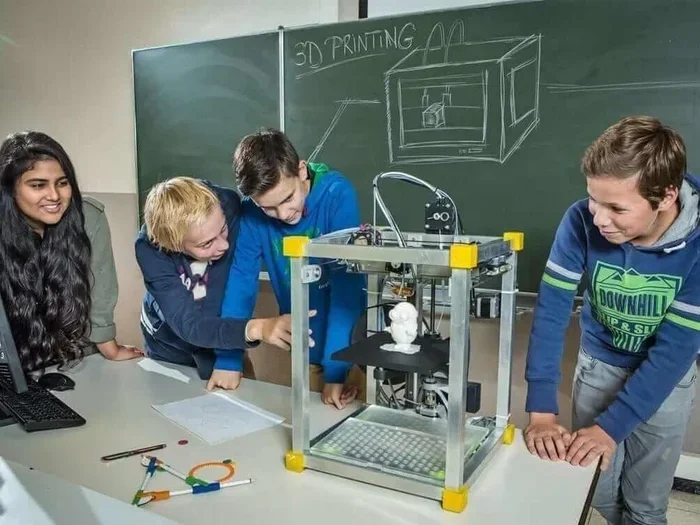
3D printing in education is revolutionizing how students learn by turning abstract ideas into tangible objects. From STEM classrooms to art studios, additive manufacturing helps students grasp complex concepts through hands-on learning and project-based learning. Teachers are using 3D printers to boost student engagement, spark design thinking, and prepare young minds for tomorrow’s workforce.
Imagine a classroom where students don’t just read about a concept—they hold it in their hands. That is the power of 3D printing in education. Over the past decade, additive manufacturing has moved from factory floors to school rooms. Today, teachers use 3D printers to bring lessons to life in ways textbooks never could.
Why does this matter? Because hands-on learning sticks. When a student designs a model and watches it come to life layer by layer, something clicks. The learning becomes personal. It becomes memorable. And that is exactly what educational innovation is all about.
In this article, we will explore how 3D printing in education works, why schools are adopting it, and what the future holds. Whether you are a teacher, parent, or student, you will find practical ideas you can use right away.
Key Takeaways
- Hands-On Learning: 3D printing turns abstract lessons into real objects students can touch and explore.
- STEM Engagement: Schools using 3D printers see higher interest in science, technology, engineering, and math.
- Cost-Effective Prototyping: Students can iterate designs quickly without expensive materials.
- Cross-Subject Integration: 3D printing works in art, history, language, and more.
- Future Career Prep: Students gain real-world skills in digital fabrication and design thinking.
- Accessibility: Prices for classroom-ready printers have dropped, making adoption easier than ever.
📑 Table of Contents
What Is 3D Printing in Education?
3D printing is a process that creates three-dimensional objects from digital files. A printer builds the object one thin layer at a time. This method is called additive manufacturing. In schools, students use 3D modeling software to design objects, then send those designs to a printer.
The magic happens when a student sees an idea go from screen to solid object. It bridges the gap between theory and practice. A math concept becomes a shape you can hold. A science idea becomes a model you can examine from every angle.
How It Works in a Classroom
Here is a simple breakdown of the process:
- Design: Students use software like Tinkercad or Fusion 360 to create a 3D model.
- Slice: The model is sliced into thin layers using slicing software.
- Print: The printer deposits material—usually plastic filament—layer by layer.
- Finish: Students remove the object and clean it up.
That is it. Four steps from idea to object. And students learn so much along the way.
Why Schools Are Embracing 3D Printing
3D printing in education is not just a cool gadget. It solves real problems in teaching and learning. Schools across the world are adopting this technology for several key reasons.
Boosting Student Engagement
Let us face it. Sitting and listening for hours is hard for most learners. Active learning keeps students awake and interested. When a student prints their own design, they feel ownership over the work. That ownership drives motivation.
Teachers report that students who struggle with traditional methods often thrive with hands-on learning. A student who finds reading boring might light up when designing a 3D model. The technology meets them where they are.
Supporting STEM Education
STEM learning—science, technology, engineering, and math—needs every tool it can get. 3D printers give students a way to test ideas, build prototypes, and solve problems. It is the heart of project-based learning.
For example, a physics class might print custom gears to study mechanical advantage. A biology class could print models of cells or organs. A chemistry class might design molecular structures. The possibilities are vast.
Making Learning Inclusive
3D printing in education also supports diverse learners. Visual learners benefit from seeing and touching models. Kinesthetic learners thrive when building physical objects. Even students with learning differences find that tactile projects help them understand better.
Teachers can create custom tools for students with special needs. Need a tactile map for a visually impaired student? Print one. Require a custom grip for a pencil? Print that too. The technology adapts to the learner.
Real-World Examples of 3D Printing in Schools
Theory is great, but real examples make the case stronger. Let us look at how 3D printing in education is being used right now.
Elementary Schools: Building Creativity
Young students are natural creators. In elementary schools, teachers use 3D printers to bring stories and lessons to life. A class reading a book about animals might print models of the creatures they studied. Students design characters from their favorite stories and hold them in their hands.
Some teachers even tie 3D printing into language arts. When students learn idioms for education like “building blocks” or “putting the pieces together,” they can print literal models that represent those phrases. This helps young learners connect abstract language to physical meaning. Similarly, exploring similes for education and metaphors for education through printed objects gives students a tactile way to understand figurative language concepts that can otherwise feel vague and disconnected.
These creative projects build vocabulary, comprehension, and design skills all at once.
Middle Schools: Engineering Challenges
Middle school is the perfect time for design thinking. Students at this age love challenges and competition. Many schools run 3D printing design contests where students solve real problems.
Popular projects include:
- Designing phone holders for the classroom.
- Creating bridge models that can hold weight.
- Building prosthetic hand prototypes for toy animals.
- Engineering wind-powered cars from printed parts.
These projects teach more than engineering. Students learn teamwork, problem-solving, and how to handle failure. Each failed print is a lesson in iteration and resilience.
High Schools: Advanced Applications
High school students can tackle serious additive manufacturing projects. Some schools offer courses in digital fabrication where students learn professional-grade software and printing techniques.
In vocational programs, students print functional parts for robotics teams. Art students create sculptures and installations. History classes print replicas of artifacts to study them up close. The technology blends with every subject in meaningful ways.
Some students even start small businesses, selling printed items and learning entrepreneurship along the way. That is real-world learning at its finest.
Universities: Research and Innovation
At the college level, 3D printing in education goes even deeper. Engineering students prototype inventions. Medical students print anatomical models for study. Architecture students build scale models of their designs.
Universities also use printers for research. Scientists create custom lab equipment on demand. This saves money and speeds up the research process. It is educational innovation at its most advanced.
Benefits of 3D Printing for Students and Teachers
The advantages of bringing 3D printers into classrooms go beyond just “cool factor.” Here are the key benefits that make 3D printing in education worth the investment.
| Benefit | How It Helps |
|---|---|
| Deeper Understanding | Students grasp abstract concepts by making them physical. |
| Creative Confidence | Designing and printing builds self-esteem and creative risk-taking. |
| Collaboration Skills | Group projects teach communication and teamwork. |
| Problem-Solving | Iterative design teaches students to learn from failure. |
| Career Readiness | Students gain skills in digital fabrication and 3D modeling that employers want. |
| Cost Savings | Schools can print replacement parts, lab tools, and teaching aids instead of buying them. |
Each of these benefits supports the bigger goal: preparing students for a world that demands creativity, technical skill, and adaptability.
How to Get Started with 3D Printing in Your School
Ready to bring 3D printing into your classroom? Here is a practical roadmap.
Step 1: Start Small
You do not need a room full of printers. One 3D printer can serve an entire grade level. Start with simple projects and build from there. Let students design keychains or nameplates before tackling complex engineering projects.
Step 2: Choose the Right Software
For beginners, Tinkercad is free and browser-based. It works on any computer. For more advanced students, Fusion 360 offers professional tools. Both options are excellent starting points for 3D modeling.
Step 3: Pick the Right Printer
Look for printers that are:
- Easy to set up and use.
- Safe for classroom environments.
- Affordable for school budgets.
- Able to handle common filaments like PLA.
PLA filament is the best choice for schools. It is non-toxic, biodegradable, and smells pleasant when printing. No harsh fumes, no worries.
Step 4: Connect to the Curriculum
The best 3D printing in education happens when projects align with learning goals. Tie every print job to a curriculum standard. Ask yourself: what will students learn from this project? If the answer is clear, you are on the right track.
Step 5: Build a Community
Connect with other teachers who use 3D printers. Online communities share lesson plans, project ideas, and troubleshooting tips. You do not have to figure it all out alone.
Common Mistakes to Avoid
Even excited schools can stumble. Here are pitfalls to watch out for:
- Skipping the design phase: Letting students jump straight to printing without planning leads to wasted time and material.
- Overcomplicating early projects: Start simple. Master the basics before attempting complex builds.
- Ignoring safety: Always supervise printer use. Keep the area ventilated and teach proper handling.
- Forgetting reflection: After each print, have students discuss what worked and what did not. This reflection is where the real learning happens.
- Treating it as a toy: 3D printing in education is a tool, not a gimmick. Keep the focus on learning outcomes.
Avoid these mistakes, and your program will thrive from day one.
The Future of 3D Printing in Education
What comes next for 3D printing in education? The future is bright and full of possibility.
Printer prices continue to drop. Software becomes more intuitive every year. Schools that once could not afford a single printer now have access to entire labs. This trend will only accelerate.
We can expect to see more maker education programs where 3D printing sits alongside woodworking, robotics, and coding. The lines between subjects will blur. A single project might combine math, art, engineering, and language arts—all through the lens of additive manufacturing.
Some experts predict that every classroom will have a printer within the next decade. Just as computers became standard in schools, 3D printers may become as common as whiteboards. When that happens, the way students learn will change forever.
Imagine a world where every student can turn their imagination into reality with a few clicks. That world is not far away. And 3D printing in education is leading the way.
Final Thoughts
3D printing in education is more than a trend. It is a fundamental shift in how students interact with knowledge. From elementary schools to universities, this technology empowers learners to create, experiment, and grow.
Teachers who embrace hands-on learning through 3D printing give their students an unfair advantage. Students learn to think critically, design creatively, and solve problems persistently. These are skills that no textbook alone can teach.
If you have not yet explored 3D printing in your school or classroom, now is the time. Start small, stay curious, and watch your students transform. The future of learning is tangible, and it is being printed one layer at a time.
Frequently Asked Questions
What age group can start learning with 3D printers?
Children as young as five can begin with simple designs using tools like Tinkercad. Most schools introduce 3D printing in education around elementary level and scale up as students grow older and more skilled.
Is 3D printing expensive for schools?
Not anymore. Entry-level 3D printers cost between $200 and $500, making them affordable for most school budgets. PLA filament is also inexpensive, typically under $25 per kilogram.
Do teachers need special training to use 3D printers?
Basic training goes a long way. Many online courses and tutorials teach teachers how to set up and operate 3D printers in just a few hours. Most modern printers are designed to be user-friendly right out of the box.
What subjects benefit most from 3D printing?
While STEM subjects benefit greatly, 3D printing crosses all subjects. Art classes use it for sculpture, history classes print artifacts, and even language arts teachers use it to bring figurative language concepts to life through tangible models.
Can 3D printing help students with special needs?
Absolutely. 3D printing in education allows teachers to create customized tactile tools, adaptive devices, and visual aids. These personalized resources make learning more accessible and effective for students with diverse needs.
What skills do students gain from 3D printing?
Students develop design thinking, 3D modeling, problem-solving, spatial reasoning, and digital fabrication skills. These competencies are highly valued in today’s workforce and prepare students for careers in engineering, architecture, healthcare, and more.


