
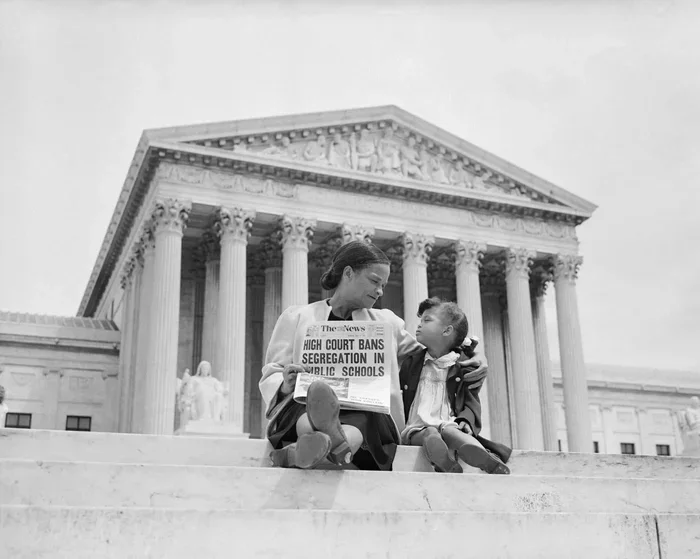
The Brown v Board of Education case began in Topeka, Kansas, when Oliver Brown challenged racial segregation in public schools. This landmark Supreme Court decision overturned the “separate but equal” doctrine from Plessy v Ferguson and became a turning point in the civil rights movement. The case was built on the idea that segregated schools violated the Equal Protection Clause of the Fourteenth Amendment. Thurgood Marshall and the NAACP led the legal charge. Understanding how Brown v Board of Education started helps us appreciate the courage of families who fought for educational equality.
Key Takeaways
- The case started in Topeka, Kansas: Oliver Brown joined other parents in challenging segregation in public schools after his daughter Linda had to travel far to attend a Black-only school.
- Plessy v Ferguson set the stage: The 1896 “separate but equal” ruling allowed segregation for decades until Brown v Board of Education overturned it in 1954.
- The NAACP and Thurgood Marshall led the legal strategy: Their careful legal approach built the strongest possible case for ending school segregation.
- The Supreme Court ruled unanimously: The 9-0 decision declared that segregated schools were inherently unequal, which was a massive victory for the civil rights movement.
- The decision sparked massive change: Brown v Board of Education ignited desegregation efforts and reshaped American education and society.
- Families were the heart of the case: Ordinary parents like Oliver Brown took extraordinary risks to fight for their children’s rights.
📑 Table of Contents
How Did the Brown v Board of Education Start
The story of Brown v Board of Education begins in the quiet streets of Topeka, Kansas. It was a small city where families lived their daily lives under a system that separated people by race. Public schools were no exception. Black children and white children attended different schools. The law said they were “separate but equal.” But everyone knew that was not true.
Oliver Brown was a ordinary man with an extraordinary goal. He wanted his daughter Linda to attend a school close to their home. Instead, she had to ride a bus to a segregated Black school far away. So Oliver joined a group of parents who decided to challenge the system. Their fight would become one of the most important legal cases in American history.
But how did this case actually begin? What events led to the Supreme Court stepping in? And why does it still matter today? Let us walk through the full story of how Brown v Board of Education started and why it changed everything.
The Segregated School System in America
To understand how the case started, you need to understand the world Oliver Brown lived in. After the Civil War, many Southern states passed laws called Jim Crow laws. These laws enforced racial segregation in nearly every part of public life. Schools, restaurants, buses, and drinking fountains were all separated by race.
The legal foundation for this separation came from a case called Plessy v Ferguson in 1896. The Supreme Court ruled that “separate but equal” facilities were constitutional. This decision gave states the green light to keep Black and white Americans apart for nearly 60 years. In reality, the facilities for Black Americans were almost always worse. Schools received less funding. Teachers earned lower salaries. Textbooks were old and worn.
By the 1950s, many Black families in Topeka and across the country were tired of this inequality. They wanted change. And they were willing to fight for it.
Oliver Brown and the Parents Who Started It All
Oliver Brown was a welder and an assistant pastor at a local church in Topeka. His daughter Linda Brown had to walk several blocks to a bus stop and ride a long way to attend Monroe Elementary, a segregated Black school. Their neighborhood had a white school, Sumner Elementary, just a few blocks away. But Linda could not attend it because of her race.
Oliver was not alone. The National Association for the Advancement of Colored People, better known as the NAACP, had been looking for families willing to challenge school segregation. They had a plan. The NAACP wanted to file a lawsuit that would go all the way to the Supreme Court. They believed the time was right to challenge the “separate but equal” doctrine.
Thirteen parents in Topeka agreed to be part of the lawsuit. Oliver Brown was the first name on the list, which is why the case carries his name. Together, they represented 20 children, including Linda Brown. The case was filed in 1951 in the U.S. District Court for the District of Kansas.
The district court ruled against the parents. The judges followed the Plessy v Ferguson precedent. They said that since the schools were “separate but equal,” segregation was legal. But the parents did not give up. They appealed the decision to the Supreme Court.
The Role of Thurgood Marshall and the NAACP Legal Team
Behind the scenes, a brilliant legal team was working to make the case airtight. The lead attorney was Thurgood Marshall, who would later become the first Black Supreme Court Justice. Marshall was the head of the NAACP Legal Defense Fund. He had spent years fighting against racial discrimination in the courtrooms of America.
Marshall and his team did not just argue that segregation was unfair. They argued that it was unconstitutional. They pointed to the Equal Protection Clause of the Fourteenth Amendment. This part of the Constitution says that no state can deny any person equal protection under the law. Marshall argued that segregated schools violated this fundamental right.
The legal team also brought in social science research. They cited studies showing that segregation harmed Black children’s sense of self-worth. One famous study by psychologists Kenneth and Mamie Clark used dolls to show how segregation affected children’s identity. These findings helped the court see that segregation was not just a legal issue. It was a human issue.
Marshall compared the fight to the struggle for freedom described in the scriptures. Just as similes for the Bible often use light and darkness to describe moral struggles, Marshall used the language of justice and equality to describe the case. He framed segregation as a moral failing, not just a legal technicality.
The Supreme Court Decision: A Landmark Moment
On May 17, 1954, the Supreme Court delivered its ruling in Brown v Board of Education. The decision was unanimous. All nine justices agreed that segregation in public schools was unconstitutional. Chief Justice Earl Warren wrote the opinion. He stated clearly that “separate educational facilities are inherently unequal.”
This ruling overturned Plessy v Ferguson. It declared that the “separate but equal” doctrine had no place in American education. The court understood that segregation sent a message of inferiority to Black children. And that message had a real, damaging effect on their lives.
The decision was a huge win for the civil rights movement. It gave hope to millions of Americans who had long endured racial discrimination. But the road ahead was not easy. Many states resisted the ruling. Some governors shut down public schools rather than integrate them. It took years of continued effort to make desegregation a reality.
Why the Case Still Matters Today
The story of how Brown v Board of Education started is a story about ordinary people standing up for what is right. Oliver Brown was not a politician or a famous lawyer. He was a father who wanted a better future for his daughter. His courage inspired others to join the fight.
Today, the case is still studied in classrooms across America. It is a reminder that the law can be a powerful tool for change. It also shows that justice does not come easily. It requires persistence, courage, and the willingness to stand together.
The case also connects to the broader language of education. Think about how we describe learning and growth. We often use metaphors for education like “building a foundation” or “opening doors.” These phrases remind us that education is about more than just facts and figures. It is about opportunity, growth, and dignity.
Similarly, similes for education help us compare learning to other experiences. Saying “learning is like planting a seed” captures the idea that education takes time, care, and the right conditions to grow. These figurative expressions show how deeply we value education in our culture.
The families who started Brown v Board of Education understood this deeply. They knew that education was not just about classrooms and textbooks. It was about giving their children the chance to reach their full potential. And that is a lesson that still resonates today.
Key Players in the Brown v Board of Education Case
Every great story has heroes. The story of Brown v Board of Education is no different. Several key people played essential roles in making the case a success.
- Oliver Brown: The lead plaintiff and a father who wanted his daughter to have equal access to education.
- Linda Brown: The young girl whose experience of walking miles to school sparked the legal challenge.
- Thurgood Marshall: The brilliant NAACP lawyer who argued the case before the Supreme Court.
- Earl Warren: The Chief Justice who led the unanimous decision.
- The 13 Topeka Parents: Ordinary families who risked everything to fight for their children’s rights.
These individuals came from different backgrounds. But they shared one common goal: to end racial segregation in schools. Their collective action proved that ordinary people can create extraordinary change.
The Legal Strategy Behind the Case
The NAACP did not just file a lawsuit and hope for the best. They had a carefully planned legal strategy. The approach was methodical and brilliant.
First, they chose Topeka, Kansas, as the location for the case. Topeka was a moderate city. It was not in the Deep South, where resistance to change was strongest. This strategic choice helped the case gain sympathy from judges.
Second, the legal team built their argument around the Fourteenth Amendment. They focused on the idea that segregation violated the Equal Protection Clause. They did not just argue that segregated schools were unequal in quality. They argued that segregation itself was inherently harmful.
Third, they used social science evidence to support their claims. The doll studies by the Clarks showed that segregation damaged children’s self-esteem. This evidence was groundbreaking. It helped the court see the real-world impact of segregation on real children.
The legal team also drew inspiration from broader civil rights efforts. They understood that education was at the heart of racial equality. As the saying goes, idioms for education like “the key to success” or “opening doors” capture the power of learning. The NAACP knew that changing the education system was the key to unlocking a more just society.
Common Misconceptions About the Case
There are several myths about Brown v Board of Education that are worth addressing.
Myth 1: Oliver Brown was a random plaintiff. In reality, the NAACP carefully selected him. They wanted a believable, relatable figure. Oliver was a respected member of the community.
Myth 2: The case was only about Topeka. The Supreme Court actually combined several cases from different states under the Brown v Board of Education name. The Topeka case was the lead case, but it represented a national struggle.
Myth 3: The ruling immediately ended segregation. The decision was a huge step forward, but it did not solve everything. Many states resisted integration for years. The fight for educational equality continued long after 1954.
Myth 4: The case was only about schools. While the case focused on education, its impact reached far beyond classrooms. It set a legal precedent that helped end segregation in other areas of public life.
Quick Tips for Understanding the Case
- Remember that Plessy v Ferguson came before Brown v Board of Education. The first case created the “separate but equal” rule. The second case destroyed it.
- Think of Oliver Brown as an everyday hero. He was not a celebrity or a politician. He was a father who refused to accept inequality.
- The Supreme Court ruling was unanimous. This was rare and shows how strongly the justices believed in the decision.
- The case is part of a larger civil rights movement. It did not happen in isolation. Other events, like the Montgomery Bus Boycott, followed closely.
- Desegregation was a slow process. The court did not set a specific timeline for integration, which allowed resistance to continue.
Expert Insights on the Legacy of Brown v Board of Education
Historians and legal experts agree that Brown v Board of Education was one of the most important Supreme Court decisions ever made. It reshaped American law and society in profound ways.
Legal scholars often compare the case to other landmark decisions. Just as metaphors for the Bible use powerful imagery to convey deep truths, the Brown decision used clear, powerful language to declare that segregation was wrong. The phrase “separate educational facilities are inherently unequal” is one of the most quoted lines in American legal history.
Education experts also point to the case as a turning point. Before Brown, Black children were often denied quality education. After Brown, the legal framework began to shift toward equality. Of course, progress was slow and uneven. But the direction of travel was clear.
Civil rights leaders like Martin Luther King Jr. drew strength from the Brown decision. It showed that the courts could be a force for justice. This encouraged more activism and more legal challenges to segregation.
Conclusion
The story of how Brown v Board of Education started is a story of courage, determination, and hope. It began with a father in Topeka, Kansas, who simply wanted his daughter to have the same educational opportunities as every other child. From that simple act of courage grew a legal battle that would change America forever.
The case overturned the “separate but equal” doctrine. It declared that segregation in public schools was unconstitutional. And it became a cornerstone of the civil rights movement. Oliver Brown and the other parents who joined the lawsuit were not seeking fame. They were seeking justice. And they found it.
Today, when we talk about educational equality, we owe a debt of gratitude to those brave families. Their fight reminds us that change is possible when people stand together and refuse to accept injustice. The legacy of Brown v Board of Education lives on in every classroom where every child has the chance to learn and grow.
We can honor their legacy by continuing to fight for equal opportunities in education. By understanding where we have been, we can better navigate where we are going. And by sharing these stories, we keep the spirit of courage and justice alive for future generations.
Frequently Asked Questions
What was the Brown v Board of Education case about?
The case was about racial segregation in public schools. Oliver Brown and other parents challenged the “separate but equal” doctrine that allowed Black and white children to attend different schools. They argued that segregation violated the Equal Protection Clause of the Fourteenth Amendment.
Why was the Brown v Board of Education decision so important?
The decision was important because it overturned Plessy v Ferguson and declared that segregated schools were inherently unequal. It was a major victory for the civil rights movement and set a legal precedent for ending racial discrimination in education and other areas of public life.
Who was Oliver Brown in the Brown v Board of Education case?
Oliver Brown was a welder and assistant pastor in Topeka, Kansas. He became the lead plaintiff because his daughter Linda had to travel far to attend a segregated Black school while a white school was just blocks away. His name came first on the lawsuit, which is why the case carries his name.
What role did Thurgood Marshall play in the case?
Thurgood Marshall was the lead attorney for the NAACP Legal Defense Fund. He argued the case before the Supreme Court and built the legal strategy that led to the unanimous ruling. Marshall later became the first Black Supreme Court Justice, continuing his legacy of fighting for equal rights.
How did the Brown v Board of Education ruling affect schools?
The ruling declared that segregation in public schools was unconstitutional. However, implementation was slow and met with resistance. Many states delayed integration for years. It took additional legislation and court orders to fully desegregate schools across the country.
What was the “separate but equal” doctrine that Brown v Board of Education overturned?
The “separate but equal” doctrine came from the 1896 Plessy v Ferguson case. It allowed states to maintain separate facilities for Black and white Americans as long as they were supposedly equal. In practice, facilities for Black Americans were almost always inferior. The Brown v Board of Education ruling proved that separate could never truly be equal, especially in education.
=== INTERNAL LINKS ===
Just as people use similes for education to describe the learning journey in colorful ways, the families in Topeka used their own powerful words to describe the inequality they faced every day.
The legal arguments in the case drew on deep American values, much like metaphors for education capture the essence of learning through vivid imagery. Marshall and his team understood that education was not just a right. It was the foundation of a fair society.
Many people also drew on the language of idioms for education to explain why the case mattered. Phrases like “the key to success” and “a sound education” were not just clichés. They reflected the real stakes of the fight for equality.


