
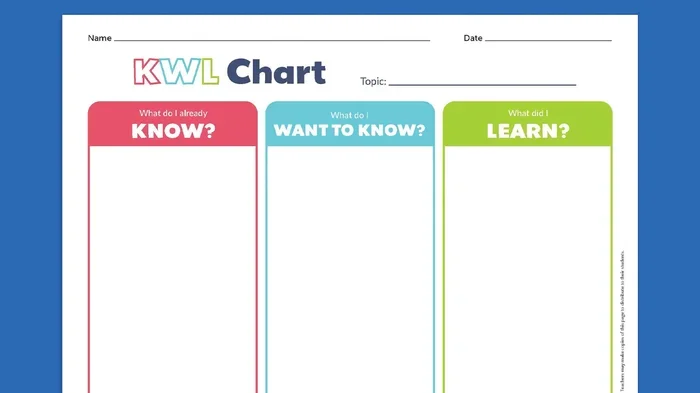
KWL in education is a powerful learning framework that helps students organize what they know, what they want to know, and what they learned. This graphic organizer transforms passive reading into active learning, making it one of the most effective instructional strategies for teachers. Whether you are a seasoned educator or a new instructor, KWL in education gives you a simple tool to boost student engagement and knowledge retention.
Have you ever wondered why some students soak up new information like sponges while others seem to stare blankly at the page? The secret often lies in how they approach learning. KWL in education is a simple yet powerful strategy that changes how students interact with new material. It gives them a clear roadmap for what they already know, what they want to discover, and what they actually learned. This learning framework has been around for decades, but it remains one of the most effective teaching tools in any classroom today.
The beauty of KWL in education is its simplicity. You do not need fancy technology or expensive materials. All you need is a blank sheet of paper or a whiteboard and a willingness to guide your students through a structured thinking process. In this article, we will walk you through everything you need to know about KWL in education, from the basics to advanced tips that will transform your classroom activities.
Key Takeaways
- KWL stands for Know, Want to Know, and Learned: It is a three-column chart that guides students through pre-reading, during-reading, and post-reading reflection.
- KWL improves reading comprehension: By activating prior knowledge, students connect new information to what they already understand.
- It is a versatile teaching tool: KWL in education works across all subjects, grade levels, and learning styles.
- Teachers can use it for formative assessment: The “Learned” column reveals what students have absorbed and what still needs attention.
- KWL supports differentiated instruction: It adapts easily for visual, auditory, and kinesthetic learners.
- It promotes critical thinking: Students learn to ask questions and reflect on their own learning outcomes.
📑 Table of Contents
What Is KWL in Education?
A KWL chart is a graphic organizer that breaks learning into three clear stages. Each column represents a different phase of the learning process. The first column asks students to list what they already know about a topic. The second column invites them to write down what they want to know. The third column captures what they have learned after reading, researching, or discussing.
This instructional strategy was developed by Donna Ogle in 1986 and has since become a staple in educational pedagogy worldwide. Teachers use it to structure reading comprehension lessons, science investigations, social studies discussions, and much more. The chart works because it mirrors how the brain naturally processes new information. It starts with what you know, builds curiosity about what you do not know, and then reflects on what you discovered.
Why Does the KWL Structure Work?
The KWL strategy works because it taps into two powerful learning principles. First, it activates prior knowledge. When students recall what they already know, they create mental hooks for new information. Second, it sparks curiosity. The “Want to Know” column turns passive readers into active inquirers. Together, these two principles create a strong foundation for active learning and deeper understanding.
How the KWL Strategy Works in the Classroom
Using KWL in education is straightforward, but doing it well takes a little practice. Here is how most teachers bring the chart to life in their classroom activities.
Step One: Set the Stage. Introduce the topic to your students. Write the topic at the top of the chart. Give them a few minutes to brainstorm what they already know. Encourage them to think freely. No idea is too simple or too silly at this stage.
Step Two: Generate Questions. Move to the “Want to Know” column. Ask students what they are curious about. What do they hope to learn? What confuses them? This step builds inquiry-based learning skills and encourages students to take ownership of their learning outcomes.
Step Three: Learn and Reflect. After students have read, researched, or discussed the topic, they fill in the “Learned” column. This is where the magic happens. Students see their growth in real time. They can compare what they thought they knew with what they actually discovered.
Using Think-Pair-Share with KWL
One of the best ways to deepen student engagement with a KWL chart is to pair it with the think-pair-share technique. Have students think about their answers individually first. Then let them pair up to share and compare their lists. Finally, invite pairs to share their insights with the whole class. This simple routine ensures every voice gets heard and builds critical thinking skills along the way.
Benefits of Using KWL in Education
KWL in education offers a wide range of benefits for both teachers and students. Let us look at why this learning framework deserves a permanent spot in your teaching toolkit.
- Boosts Reading Comprehension: When students activate their prior knowledge before reading, they understand the text better. The KWL strategy gives them a clear purpose for reading.
- Increases Student Engagement: Students feel more invested when they help shape the learning process. The “Want to Know” column gives them a voice and a reason to pay attention.
- Supports Differentiated Instruction: Every student brings different background knowledge. The KWL chart honors that diversity. Visual learners can draw their ideas. Auditory learners can discuss them. Kinesthetic learners can move sticky notes around.
- Provides Formative Assessment: The “Learned” column gives teachers instant insight into what students have absorbed. It helps you identify gaps and adjust your next lesson accordingly.
- Builds Metacognitive Skills: Students learn to think about their own thinking. They become more aware of how they learn, which is a skill that serves them far beyond the classroom.
- Encourages Collaboration: When students work together on a KWL chart, they learn from each other. They hear different perspectives and build shared understanding.
Quick Tips for Maximizing the Benefits
Here are a few quick tips to get the most out of KWL in education:
- Start each new unit with a blank KWL chart. Make it a routine.
- Give students at least five minutes for each column. Do not rush the process.
- Use color coding. Blue for “Know,” yellow for “Want to Know,” and green for “Learned.”
- Revisit the chart throughout the unit. Update the “Learned” column as new information comes in.
- Display completed charts on the classroom wall. They serve as a visual record of the learning journey.
How to Create a KWL Chart Step by Step
Creating a KWL chart is easy, and you can adapt it to fit any subject or grade level. Here is a step-by-step guide to get you started.
- Draw three columns on the board or hand out a pre-made template. Label them “Know,” “Want to Know,” and “Learned.”
- Write the topic at the top of the chart. Keep it broad enough to allow for exploration but specific enough to guide discussion.
- Model the first column. Think aloud and share a few things you already know about the topic. This shows students what quality responses look like.
- Let students work independently for the first two columns. Walk around the room and offer guidance. Ask probing questions like “Why do you think that?” or “What makes you curious about that?”
- Facilitate a whole-class discussion to share ideas from the first two columns. Write student contributions on the board.
- After the lesson or reading, have students complete the third column. Encourage them to use specific details and examples.
- Review and discuss the completed charts. Celebrate what students learned and address any misconceptions.
Digital KWL Charts for Modern Classrooms
If you teach in a tech-enabled classroom, you can create digital KWL charts using tools like Google Docs, Padlet, or Jamboard. Digital charts allow students to collaborate in real time, even when they are learning from home. They also make it easy to save and revisit charts throughout the year. KWL in education adapts beautifully to both traditional and virtual learning environments.
KWL Chart Examples Across Different Subjects
The KWL strategy is incredibly flexible. You can use it in almost any subject area. Here are some examples to spark your ideas.
Science: The Water Cycle
For a lesson on the water cycle, the “Know” column might include entries like “Water evaporates when it heats up” or “Clouds hold water.” The “Want to Know” column could feature questions like “Why does it rain?” or “How does the sun power the water cycle?” After the lesson, the “Learned” column captures new details such as “Water vapor cools and condenses into tiny droplets” or “The water cycle has no real beginning or end.”
Social Studies: Ancient Egypt
When studying ancient Egypt, students might list pharaohs and pyramids in the “Know” column. Their “Want to Know” entries could include “How were the pyramids built?” and “What did ancient Egyptians eat?” The “Learned” column then captures facts like “The Nile River was essential for farming” or “Hieroglyphics were a form of written communication.”
English Language Arts: Character Analysis
In an ELA class, a KWL chart can help students analyze a character in a novel. The “Know” column might list traits they notice early in the story. The “Want to Know” column could pose questions about the character’s motivations. The “Learned” column captures insights gained by the end of the book.
Teachers who love exploring language in creative ways also enjoy using idioms for education to help students build vocabulary and understand figurative language. Similarly, similes for education and metaphors for education offer wonderful extensions for students who want to go deeper into descriptive language and literary devices.
Common Mistakes and How to Avoid Them
Even the best instructional strategies can fall flat if they are not implemented correctly. Here are the most common mistakes teachers make with KWL in education and how to fix them.
| Mistake | Why It Happens | How to Fix It |
|---|---|---|
| Rushing through the chart | Teachers feel pressure to cover content quickly | Block at least 15 minutes per column. Quality matters more than speed. |
| Ignoring the “Want to Know” column | Students copy questions from the board instead of generating their own | Give students time to brainstorm individually before sharing as a group. |
| Skipping the reflection step | Teachers move on to the next topic before reviewing the “Learned” column | Always dedicate time to discuss what students learned. Use it as a formative check. |
| Using the same template every time | Routine can become stale and students lose interest | Try variations like KWL+ (adding “How I Will Find Out”) or KWHL (adding “How”). |
| Not differentiating for all learners | One-size-fits-all approach leaves some students behind | Offer sentence starters, visual prompts, or oral responses for struggling learners. |
Expert Insight: The Power of Reflection
Many educators agree that the real value of KWL in education lies in the reflection it encourages. When students pause to think about what they know and what they have learned, they develop stronger metacognitive awareness. This skill is at the heart of inquiry-based learning and helps students become self-directed learners. As one veteran teacher puts it, “The KWL chart is not just a worksheet. It is a thinking tool that teaches students how to learn.”
Extending KWL to Other Teaching Methods
KWL in education pairs beautifully with other teaching methods. You can combine it with think-pair-share discussions, active learning stations, or group projects. Some teachers extend the basic KWL model to include a fourth column. For example, the “H” in KWHL stands for “How will I find out?” This addition teaches students to plan their own research and knowledge retention strategies. Others use KWL+, which adds a column for “What I Still Wonder.” This keeps the curiosity alive even after the lesson ends.
Once students become comfortable with the KWL strategy, they start applying it naturally. They ask themselves questions before reading a new article. They reflect on what they learned at the end of a lesson. Over time, this learning framework becomes second nature to them. It supports differentiated instruction because every student can engage at their own level. And it strengthens reading comprehension by giving students a clear purpose for every piece of text they encounter.
The ultimate goal of KWL in education is to create independent, reflective learners. When students can monitor their own understanding, they take ownership of their learning outcomes. They stop being passive recipients of information and become curious, confident explorers of knowledge. That is a skill no textbook can teach, but a well-used KWL chart can absolutely build.
Conclusion
KWL in education is one of the simplest and most effective tools you can add to your teaching practice. It gives students structure, sparks curiosity, and builds critical thinking skills that last a lifetime. Whether you teach elementary school or high school, whether your subject is science, history, or language arts, the KWL chart adapts to your needs. Start small. Try it in one lesson this week. Observe how your students respond. You will likely see more participation, deeper understanding, and stronger student engagement. The best part is that KWL in education costs nothing, takes minimal preparation, and delivers powerful results every single time.
So grab a blank sheet of paper, write three columns, and watch your students transform from passive listeners into active, curious learners. KWL in education is not just a strategy. It is a mindset shift that puts the power of learning back into the hands of your students.
Frequently Asked Questions
What does KWL stand for in education?
KWL stands for Know, Want to Know, and Learned. It is a three-column graphic organizer that helps students structure their thinking before, during, and after a lesson. The first column captures what students already know, the second lists what they want to discover, and the third records what they have learned.
Who created the KWL chart?
Donna Ogle developed the KWL strategy in 1986. She designed it as a reading comprehension tool to help students activate their prior knowledge and set a purpose for reading. Since then, it has expanded into a widely used instructional strategy across all subjects.
Can KWL charts be used for online learning?
Absolutely. KWL in education works just as well in virtual settings as in traditional classrooms. Teachers can use digital tools like Google Docs, Padlet, or Jamboard to create collaborative KWL charts. Students can fill in columns independently or in breakout rooms, making it a flexible option for remote and hybrid learning.
Is KWL suitable for all grade levels?
Yes. KWL in education is highly adaptable. Younger students can draw pictures or use simple sentences in the chart. Older students can write detailed paragraphs and use the chart for complex research projects. The key is to adjust the expectations to match the grade level and learning goals.
How often should I use KWL charts in my classroom?
There is no set rule, but using a KWL chart at the start of each new unit or topic is a great habit. Some teachers use it once a week, while others integrate it into every major lesson. The more consistently you use it, the more naturally students will engage with the process and build their metacognitive skills.
What is the difference between KWL and KWHL charts?
The KWHL chart adds a fourth column that stands for “How will I find out?” This extra step teaches students to plan their research methods and active learning strategies. Both charts serve the same core purpose, but KWHL adds a layer of critical thinking about the learning process itself.
=== CONCLUSION ===
KWL in education is a timeless, research-backed strategy that transforms how students interact with new material. From activating prior knowledge to sparking curiosity and measuring learning outcomes, this simple three-column chart packs a powerful punch. It works for every subject, every grade level, and every type of learner. The best part? It is free, easy to implement, and incredibly effective. Start using KWL in education in your classroom today and watch your students become more engaged, more reflective, and more confident learners.


