
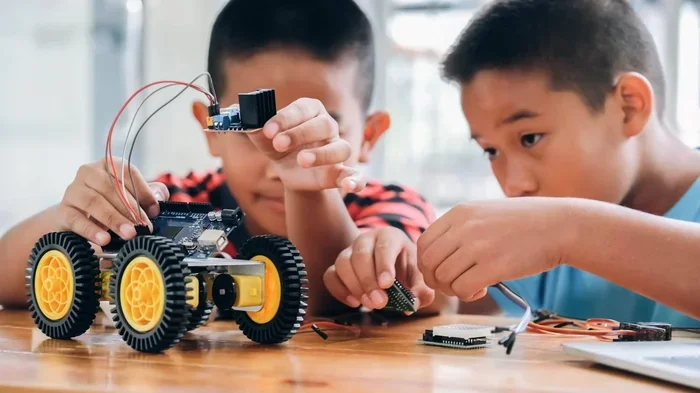
STEM in early childhood education lays the foundation for critical thinking, creativity, and problem-solving skills that children need for life. Introducing science, technology, engineering, and math at a young age helps young learners build curiosity and confidence. This guide covers why early STEM exposure matters, how it supports child development, and practical ways parents and teachers can get started today.
Why is stem in early childhood education such a big deal right now? The answer is simple. Kids are naturally curious. They want to know how things work, why things happen, and what happens next. When we tap into that curiosity with STEM activities, we give children a powerful toolkit for life.
STEM stands for science, technology, engineering, and math. These four fields shape nearly everything in our modern world. From the phones we use to the medicine that keeps us healthy, STEM drives progress. And the earlier we introduce these ideas, the deeper the impact. Research shows that children who engage with early STEM learning develop stronger problem-solving skills, better memory, and a love for exploration that lasts a lifetime.
But here is the thing many parents miss. You do not need fancy equipment or a science lab to teach STEM. A simple question like “Why do leaves change color?” or a block-building session can spark a child’s natural love for learning. The key is to create an environment where kids feel safe to experiment, make mistakes, and try again.
Key Takeaways
- Early STEM builds foundational skills: Young children who engage with STEM concepts develop stronger cognitive and analytical abilities.
- Hands-on learning drives engagement: Kids learn best when they touch, build, and explore real-world problems.
- STEM boosts creativity and curiosity: It encourages children to ask questions and think outside the box.
- Future career readiness starts early: Early exposure to science and math opens doors to high-demand jobs later in life.
- Parents and teachers both play a role: Simple everyday activities can introduce STEM concepts without fancy tools.
- Inclusive STEM education matters: All children benefit from early access to STEM regardless of background.
📑 Table of Contents
- What Does STEM Actually Mean for Young Children?
- Why Early STEM Exposure Matters So Much
- The Role of Play in STEM Learning
- How STEM Supports Social and Emotional Growth
- Practical Tips for Parents and Educators
- Overcoming Common Challenges in Early STEM Education
- The Long-Term Impact of Early STEM Education
What Does STEM Actually Mean for Young Children?
When we talk about STEM in early childhood, we are not talking about algebra worksheets or coding bootcamps. We are talking about age-appropriate activities that spark wonder and exploration. For a four-year-old, STEM might mean mixing colors to see what happens. For a six-year-old, it might mean building a bridge out of sticks and testing how much weight it holds.
Science for Little Explorers
Young children are natural scientists. They observe the world around them constantly. When they drop a ball and watch it bounce, they are learning about gravity. When they mix water and sand, they are learning about textures and states of matter. Science for kids is really about asking questions and finding answers through simple experiments.
Technology in a Child-Friendly Way
Technology does not just mean screens. For young children, technology includes any tool that helps them solve a problem. A pair of scissors, a magnifying glass, or even a wheelbarrow counts. When kids use these tools to build or create, they are learning early technology concepts like cause and effect.
Engineering Through Play
Building towers with blocks, stacking cups, or creating forts from blankets — these are all forms of engineering. Children test structures, learn what works and what does not, and adjust their approach. This kind of hands-on engineering play teaches resilience and creative thinking.
Math in Everyday Moments
Math is everywhere. Counting toys, sorting socks by color, noticing patterns in tiles — these are all early math skills. When we help children see math in daily life, we remove the fear and mystery around the subject. Early math exposure sets the stage for stronger academic performance later on.
Why Early STEM Exposure Matters So Much
The first few years of a child’s life are the most critical for brain development. During this time, the brain forms more than one million new neural connections every second. This is why early childhood STEM education has such a profound impact. The experiences children have during these years shape how they think, learn, and solve problems for the rest of their lives.
Building Strong Cognitive Foundations
STEM activities challenge the brain in unique ways. They require children to observe, compare, predict, and test. These are all high-level thinking skills. When children practice them regularly, they build a strong cognitive foundation that supports learning in every subject, not just math and science.
Developing Problem-Solving Skills
Life is full of problems. Some are big and some are small. But the ability to break a problem into smaller parts and find a solution is invaluable. STEM learning teaches children exactly this skill. When a tower keeps falling, they learn to adjust the base. When a puzzle seems too hard, they try a different piece. These small victories build confidence and persistence.
Encouraging Curiosity and Inquiry
Children are born with a deep sense of wonder. They want to know why the sky is blue and how birds fly. STEM education nurtures this curiosity instead of shutting it down. When adults encourage questions and explore answers together, children learn that learning is a lifelong adventure, not just something that happens in a classroom.
The Role of Play in STEM Learning
Here is a secret that many educators know. The best way young children learn is through play. And play is naturally STEM-rich. When a child plays with blocks, they are learning about balance and geometry. When they play with water at the sink, they are learning about volume and flow.
Learning Through Play vs. Formal Instruction
There is a big difference between forcing a child to sit through a lecture and letting them discover concepts through play. Learning through play is far more effective for young minds. It engages multiple senses, keeps children motivated, and makes connections that last. Studies consistently show that play-based early education leads to better long-term academic outcomes.
Simple STEM Toys and Materials
You do not need expensive gadgets to teach STEM. Some of the best tools are simple and affordable. Here are a few ideas:
- Building blocks — teach engineering and spatial awareness
- Magnifying glasses — spark scientific observation
- Counting beads — build early math skills
- Puzzle sets — develop logical thinking
- Ramps and balls — explore physics concepts like speed and gravity
How STEM Supports Social and Emotional Growth
We often think of STEM as purely academic. But the truth is, it plays a huge role in a child’s social and emotional development too. When children work on STEM projects together, they learn to communicate, share ideas, and collaborate.
Teamwork and Communication
Building a group project, like a cardboard city or a simple machine, requires children to talk to each other. They need to explain their ideas and listen to others. This builds communication skills and teaches children how to work as part of a team.
Resilience and Growth Mindset
Not every experiment works. Not every structure stands tall. And that is exactly the point. STEM education teaches children that failure is not the end — it is a stepping stone. When a child’s creation falls apart, they learn to try again. This growth mindset is one of the most valuable life skills a person can develop.
Confidence Through Achievement
There is nothing quite like the look on a child’s face when something they built actually works. That moment of pride builds self-confidence in a powerful way. It tells children, “I can figure things out. I am capable.” This belief in themselves carries over into every area of their lives.
Practical Tips for Parents and Educators
Want to bring more STEM into a child’s daily routine? It is easier than you think. You do not need a teaching degree or a science background. Here are some practical, everyday ideas that work beautifully.
Ask Open-Ended Questions
Instead of giving answers, ask questions that spark thinking. Try “What do you think will happen if…?” or “How could we make this better?” These types of questions encourage children to think critically and explore possibilities.
Embrace Everyday Science
Cooking is a fantastic STEM activity. Measuring ingredients teaches math. Watching dough rise teaches chemistry. Even a trip to the grocery store can become a lesson in counting and sorting. The key is to narrate what is happening and invite children to notice the world around them.
Create a STEM-Friendly Environment
Set up your home or classroom with materials that invite exploration. Keep a bin of recycled materials for building projects. Have a weather journal by the window. Put out simple tools like rulers, scales, and magnifying glasses. When the environment supports curiosity, children will naturally gravitate toward it.
Connect STEM to Real-World Problems
Children love feeling like they are making a difference. Challenge them to solve real problems in their world. “How can we keep our plants alive during the weekend?” or “Can we build a shelter for the garden bugs?” These kinds of challenges make STEM learning feel meaningful and exciting.
Overcoming Common Challenges in Early STEM Education
Even with the best intentions, bringing STEM into early childhood education can face some hurdles. Let us look at a few common challenges and how to overcome them.
Lack of Time or Resources
Many teachers and parents feel they do not have enough time or money for STEM activities. But the truth is, the most powerful STEM lessons cost almost nothing. A walk in nature, a kitchen experiment, or a building challenge with household items can be just as effective as any fancy kit. The key is consistency, not cost.
Fear of Getting It Wrong
Some adults feel uncomfortable with STEM because they do not consider themselves “science people.” But you do not need to be an expert. When you learn alongside your child, you model something incredibly valuable — the joy of discovery. You can even explore concepts together using resources like similes for education to make abstract ideas more relatable for young learners through creative comparisons.
Making STEM Inclusive for All Children
Every child deserves access to quality STEM education, regardless of their background or abilities. Using diverse examples, culturally relevant materials, and adaptive tools ensures that all children feel welcome and capable in STEM spaces. When we make STEM education inclusive, we open doors for every child to thrive.
Balancing Screen Time with Hands-On Learning
Technology is a part of modern life, and it has a place in education. But for young children, hands-on experiences should always come first. Screens should supplement, not replace, real-world exploration. A tablet app about animals is great — but nothing beats watching a real ant carry food across the sidewalk.
The Long-Term Impact of Early STEM Education
The benefits of early STEM exposure go far beyond kindergarten. Children who develop strong foundational skills in science and math during their early years tend to perform better academically throughout school. They are more likely to pursue STEM careers, which are among the fastest-growing and highest-paying job sectors in the world.
But beyond career prospects, early STEM education shapes how children see the world. It teaches them to be analytical thinkers, creative problem-solvers, and confident learners. These skills are useful in every career and every aspect of life. By investing in STEM in early childhood education, we are investing in a brighter, more innovative future for everyone.
Using creative teaching methods, like incorporating figurative language and metaphors, can also make STEM concepts more memorable for young minds. For instance, comparing a cell to a “tiny factory” or a river to a “nature’s highway” helps children grasp complex ideas more easily. You can explore more about how such techniques work by checking out resources like metaphors for education that offer creative ways to make learning stick.
The bottom line is clear. STEM in early childhood education is not a trend or a buzzword. It is a fundamental approach to raising curious, capable, and resilient children. Every block stacked, every question asked, and every experiment tried is a step toward a stronger, smarter future.
So whether you are a parent reading this at home or a teacher planning your next lesson, know that your efforts matter. You are shaping young minds in ways that will ripple out for decades. Start small, stay consistent, and watch the magic of early STEM learning unfold before your eyes.
And remember, you can always find more creative ways to enhance your teaching. Exploring resources on idioms for education can add a fun and engaging layer to how you explain STEM concepts to children, making abstract ideas feel familiar and easy to understand.
Frequently Asked Questions
What age should children start learning STEM?
Children can start engaging with STEM concepts as early as infancy. Even babies benefit from sensory exploration and simple cause-and-effect activities. By preschool age, children are ready for more structured but play-based STEM experiences. The key is to match activities to the child’s developmental stage and interests.
Do I need special training to teach STEM to young children?
Not at all. Most effective STEM activities for young children are simple and require no specialized knowledge. Parents and teachers just need a willingness to explore alongside the child. Asking questions, providing materials, and encouraging curiosity are skills anyone can develop.
How is STEM different from regular science or math lessons for kids?
Traditional lessons often focus on memorization and worksheets. STEM in early childhood is hands-on, interactive, and integrated. It combines multiple subjects and emphasizes real-world application. Instead of just learning that 2 plus 2 equals 4, children might use that knowledge to figure out how many blocks they need to build a wall.
Can STEM education help children who struggle with traditional learning?
Absolutely. STEM learning often engages children who struggle with conventional academic approaches. Because it is hands-on and experiential, it reaches different types of learners. Children who have trouble sitting still or focusing often thrive when they can build, move, and explore.
What are some easy STEM activities I can do at home today?
Try a baking soda and vinegar volcano, a sink-or-float experiment with household objects, or a building challenge with pillows and chairs. You can also count objects during grocery shopping, sort laundry by color, or plant seeds in a cup and observe growth. These simple activities build early STEM skills without any special preparation.
How does STEM education prepare children for future careers?
The jobs of the future increasingly require STEM skills. From healthcare to engineering to environmental science, STEM literacy opens doors. But more importantly, early STEM education builds transferable skills like critical thinking, creativity, and perseverance that are valuable in any career path a child chooses.
=== CONCLUSION ===
STEM in early childhood education is one of the most impactful investments we can make in our children’s futures. It builds cognitive skills, emotional resilience, and a lifelong love for discovery. The beauty of early STEM is that it does not require perfection or expensive resources. It just requires presence, curiosity, and a willingness to let children explore.
Whether you are a parent, a teacher, or a caregiver, you have the power to spark a child’s journey into the world of science, technology, engineering, and math. Start today. Ask a question. Build something together. And watch a young mind light up with the joy of learning through STEM.


