
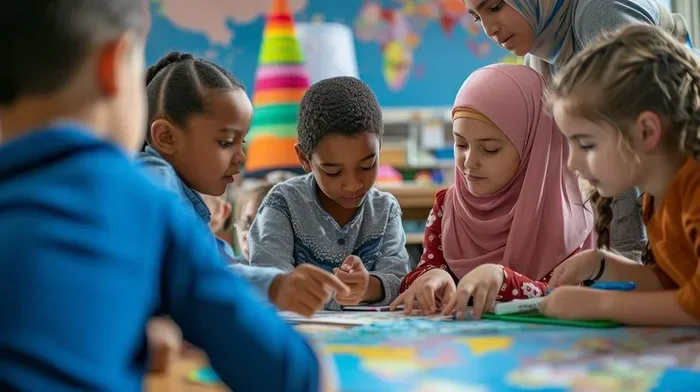
Multicultural education helps every student feel seen, valued, and supported in the classroom. It builds cross-cultural understanding, promotes educational equity, and prepares learners for a diverse world. When teachers embrace diverse perspectives, students thrive academically and socially.
Key Takeaways
- Multicultural education creates fairness: It ensures every student has equal access to learning opportunities regardless of background.
- It boosts academic performance: Students in inclusive classrooms show higher engagement and better outcomes.
- It builds social skills: Learning about different cultures teaches empathy, respect, and collaboration.
- It prepares students for the real world: Today’s global economy demands cross-cultural competence.
- It reduces bias and stereotypes: Exposure to diverse perspectives helps break down harmful assumptions.
- Teachers benefit too: Culturally responsive teaching methods make classrooms more dynamic and effective.
📑 Table of Contents
- Why Is Multicultural Education Important for Everyone
- What Does Multicultural Education Really Mean
- How Multicultural Education Boosts Academic Success
- Building Empathy and Social Skills Through Diversity
- Preparing Students for a Global World
- Reducing Bias and Breaking Down Stereotypes
- Common Mistakes Schools Make with Multicultural Education
- Quick Tips for Bringing Multicultural Education Into Your Classroom
- Final Thoughts
- Conclusion
Why Is Multicultural Education Important for Everyone
Education should work for everyone. Not just some students. Not just those who fit a single mold. Multicultural education makes that promise real. It brings diverse voices, stories, and experiences into the learning space. When classrooms reflect the world we live in, every student wins.
You might wonder why this topic gets so much attention. The answer is simple. Our communities are more diverse than ever before. Students come from different ethnic backgrounds, speak different languages, and carry unique cultural identities. If education ignores that reality, it leaves too many kids behind. Why is multicultural education important for everyone? Because it levels the playing field and opens doors that would otherwise stay closed.
The benefits go way beyond just feeling included. Research shows that students in diverse learning environments develop stronger critical thinking skills. They learn to see problems from multiple angles. They grow up understanding that different does not mean less. That understanding shapes better citizens, better workers, and better neighbors.
Let us dig into the real reasons multicultural education matters. We will look at how it helps students, teachers, and entire school communities. By the end, you will see that this is not just an educational trend. It is a fundamental shift toward a fairer and smarter way of teaching.
What Does Multicultural Education Really Mean
Before we go further, let us clear up what multicultural education actually means. It is not just about celebrating cultural holidays or hanging a world map on the wall. It is a deep, intentional approach to teaching that values every student’s background.
At its core, multicultural education means designing learning experiences that reflect the diverse perspectives of all students. It includes curriculum content that represents different ethnic groups, languages, histories, and viewpoints. It also means creating a classroom culture where every voice matters.
Think of it this way. A culturally responsive teaching approach does not just teach about diversity. It teaches through diversity. Students learn math through real-world examples from different cultures. They explore science by studying contributions from researchers around the globe. History lessons include stories that traditional textbooks often skip.
This approach also addresses educational equity head-on. It asks tough questions about who gets access to advanced classes, who gets disciplined more often, and whose stories get told in the curriculum. Answering these questions honestly is the first step toward real change.
The Five Dimensions of Multicultural Education
Scholars like James Banks have outlined key dimensions that define multicultural education. These include:
- Content Integration: Bringing examples and materials from various cultures into lessons.
- Knowledge Construction: Helping students understand how cultural backgrounds shape what we know.
- Prejudice Reduction: Actively working to break down stereotypes and biases.
- Equity Pedagogy: Adapting teaching styles to meet the needs of diverse learners.
- Empowering School Culture: Building a school environment that values every group.
When schools focus on all five of these areas, they create a truly inclusive classroom. Students do not just tolerate differences. They learn to appreciate and build on them.
How Multicultural Education Boosts Academic Success
One of the most compelling reasons to embrace multicultural education is the impact on student achievement. When students see themselves reflected in their learning materials, something powerful happens. They feel a sense of belonging. And that sense of belonging drives motivation.
Studies have shown that students in inclusive classrooms perform better on standardized tests. They show higher levels of engagement and attendance. Why? Because they feel connected to what they are learning. When a student reads a book by an author who shares their background, or solves a problem using a culturally familiar scenario, the material becomes more real.
Teachers also benefit from diverse teaching methods. Using culturally responsive teaching strategies means you are not relying on a one-size-fits-all approach. Instead, you draw on a rich variety of instructional techniques that reach more students. This is where tools like creative language devices come in handy. For example, using similes for education can help students from different linguistic backgrounds grasp abstract concepts more easily. Similarly, metaphors for education allow teachers to bridge cultural gaps and make complex ideas accessible to all learners.
Real-World Examples of Academic Gains
Let us look at some practical examples:
- A middle school in a diverse district replaced traditional history texts with materials that included multiple cultural viewpoints. Student participation in class discussions rose by 40 percent.
- A high school English teacher added literature from authors of various ethnic backgrounds. Reading scores improved, and students reported feeling more excited about assignments.
- A science program integrated indigenous knowledge systems alongside Western scientific methods. Both engagement and understanding of scientific concepts increased significantly.
These are not isolated cases. They reflect a growing body of evidence that diverse learning environments produce stronger academic results for all students, not just those from underrepresented groups.
Building Empathy and Social Skills Through Diversity
Academics matter. But education is about more than test scores. Multicultural education shapes how students see each other and the world around them. It builds empathy in ways that a textbook alone never can.
When students learn about different cultures, religions, and traditions, they start to understand people who are different from them. They learn that someone else’s experience is valid, even if it looks nothing like their own. This understanding reduces prejudice and bullying in schools.
Think about how kids interact. Children naturally notice differences. Without guidance, they may form stereotypes or exclude peers who seem different. Multicultural education gives them the tools to do the opposite. It teaches them to ask curious questions instead of making judgments. It shows them that respect for differences is a strength, not a weakness.
Inclusive classrooms also help students develop communication skills that will serve them for life. Working with peers from different backgrounds teaches collaboration, negotiation, and perspective-taking. These are skills that employers consistently rank as essential.
How Teachers Can Foster Empathy Daily
Building empathy does not require a special program or expensive materials. Small, consistent actions make a big difference:
- Start each day with a brief sharing circle where students can talk about their cultures or experiences.
- Use literature and media that feature characters from a wide range of backgrounds.
- Encourage students to interview family members about their heritage and share those stories with the class.
- Address biased language or stereotypes immediately and calmly, turning them into learning moments.
Over time, these practices create a classroom culture where every student feels safe to be themselves. That culture of respect extends beyond the classroom walls and into the wider community.
Preparing Students for a Global World
The world our students will enter as adults is more connected than ever before. Jobs, markets, and communities cross borders every day. Global awareness is no longer a nice-to-have skill. It is a necessity.
Multicultural education prepares students for this reality. It teaches them how to work with people from different cultures, understand international perspectives, and navigate complex global challenges. Whether a student becomes a nurse, an engineer, a teacher, or a business owner, they will interact with people from diverse backgrounds.
Students who understand cross-cultural understanding are better equipped to solve problems creatively. They can draw on a wider range of ideas and approaches. They are less likely to get stuck in one way of thinking. In a rapidly changing world, that flexibility is a huge advantage.
Language learning also plays a role here. When students study other languages, they gain insight into how different cultures think and communicate. This ties directly into the broader goals of multicultural education. Understanding language diversity helps students appreciate the richness of human expression.
The Role of Language in Cultural Understanding
Language is more than words. It carries history, values, and ways of seeing the world. When students explore idioms, sayings, and expressions from different cultures, they gain a deeper appreciation for those cultures. For instance, learning about idioms for education across different languages can reveal fascinating cultural insights that textbooks alone cannot provide. These language connections help students see the beauty in diversity and understand that there are many valid ways to express the same idea.
This kind of exploration builds cultural competence naturally. Students do not have to be forced to appreciate differences. When they discover them through language and storytelling, the learning feels genuine and lasting.
Reducing Bias and Breaking Down Stereotypes
Every one of us carries biases. They come from the media we consume, the communities we grow up in, and the stories we hear. Multicultural education addresses these biases directly and constructively.
In a classroom that embraces diverse perspectives, students get to know people as individuals rather than as members of a stereotype. When a student works closely with a classmate from a different cultural background, abstract stereotypes lose their power. Real human connection replaces generalizations.
This is not about making anyone feel guilty for their background. It is about creating awareness. It is about giving students the tools to recognize bias when they see it and to challenge it thoughtfully.
Why This Matters Beyond School
The impact of bias reduction extends far beyond the classroom. Students who learn to recognize and challenge stereotypes become adults who build fairer workplaces, stronger communities, and more just institutions. Social justice starts with education. When we teach young people to value equity and inclusion, we invest in a better future for everyone.
Schools that implement strong multicultural programs often see reductions in disciplinary issues and conflicts between student groups. Students report feeling safer and more supported. The entire school climate improves.
Common Mistakes Schools Make with Multicultural Education
Even with good intentions, schools can stumble when implementing multicultural education. Being aware of these pitfalls helps educators do it right.
Mistake 1: Treating It as a One-Time Event
Multicultural education is not a unit you teach in October and forget about until next year. It should be woven into everyday teaching. It should show up in math problems, science examples, and English assignments all year long.
Mistake 2: Focusing Only on Celebrations
Food, festivals, and flags are a great starting point. But they are not enough. True multicultural education dives deep into history, systemic issues, and the lived experiences of marginalized groups.
Mistake 3: Ignoring Teacher Bias
Teachers are human too. We all carry biases that we may not even be aware of. Schools need to invest in ongoing training that helps educators examine their own assumptions and grow.
Mistake 4: Tokenism
Including one book by an author of color and calling it done is not enough. Representation matters, and it needs to be meaningful. Students need to see diverse voices throughout the curriculum, not just in isolated moments.
Avoiding these mistakes takes effort and commitment. But the payoff is enormous. When done well, multicultural education transforms schools into places where every student can flourish.
Quick Tips for Bringing Multicultural Education Into Your Classroom
Ready to get started? Here are some practical steps you can take today:
- Audit your materials. Look at your textbooks, novels, and teaching resources. Do they represent a wide range of cultures and voices?
- Invite guest speakers. Bring in community members from different backgrounds to share their experiences and expertise.
- Create a classroom library with books from diverse authors and about diverse characters.
- Use cooperative learning structures that mix students from different backgrounds and encourage shared leadership.
- Celebrate multilingualism. Encourage students to share words and phrases from their home languages.
- Start a cultural exchange project where students research and present on their own heritage.
You do not need to overhaul your entire curriculum overnight. Start small. Pick one area to improve this semester. Build from there. Each step forward makes your classroom more welcoming and effective.
Final Thoughts
The question of why is multicultural education important has a clear answer. It matters because every student deserves to see themselves reflected in their education. It matters because our world needs people who can work across differences with empathy and respect. And it matters because diverse classrooms produce better outcomes for everyone.
Multicultural education is not about lowering standards or changing what we teach. It is about expanding who gets to see themselves in the curriculum. It is about making sure that every child walks into school feeling valued and walks out feeling prepared for a diverse world.
When we commit to this approach, we do more than teach content. We shape the next generation of leaders, thinkers, and citizens. We build schools that truly serve everyone. And that is something worth fighting for.
Conclusion
Multicultural education is not optional. It is essential. It makes classrooms fairer, smarter, and more connected. It gives students the academic skills and social awareness they need to thrive in a diverse world. Teachers who embrace culturally responsive teaching see their students grow in confidence, curiosity, and compassion.
The evidence is clear. Inclusive classrooms boost achievement. Diverse curricula reduce bias. Global awareness prepares students for real-world success. Every one of these benefits starts with a simple commitment: to make education work for every single student.
So whether you are a teacher, a parent, or a school leader, you have a role to play. Start where you are. Use what you have. And keep pushing toward a classroom where educational equity is not a goal but a daily reality.
Frequently Asked Questions
What is multicultural education and why does it matter?
Multicultural education is an approach that integrates diverse cultural perspectives into teaching and learning. It matters because it ensures every student feels represented, respected, and supported. This approach boosts academic outcomes and prepares students for life in a diverse society.
How does multicultural education benefit students from majority groups?
Students from majority groups also gain a lot. They develop empathy, learn to work across differences, and build critical thinking skills. Exposure to diverse perspectives helps them understand the world more fully and succeed in global workplaces.
Can multicultural education improve test scores?
Yes, research supports this. When students see themselves in the curriculum, they become more engaged. That engagement leads to better attendance, higher motivation, and improved performance on assessments. Inclusive classrooms create conditions where all students can do their best work.
What is culturally responsive teaching?
Culturally responsive teaching is a method where educators connect learning materials to students’ cultural backgrounds and experiences. It adapts instructional strategies to meet the needs of diverse learners. This approach makes lessons more relevant and accessible to every student in the room.
How can schools start implementing multicultural education?
Schools can start by auditing their curriculum and materials for representation. They can provide teacher training on cultural competence and inclusive practices. Small steps like diversifying classroom libraries and inviting guest speakers from different communities can make a meaningful difference over time.
Is multicultural education the same as teaching about holidays from different cultures?
No, it is much more than that. While learning about cultural celebrations is a part of it, true multicultural education goes deeper. It includes examining history, addressing systemic inequities, integrating diverse perspectives into daily lessons, and building a classroom culture of genuine respect and belonging.


