
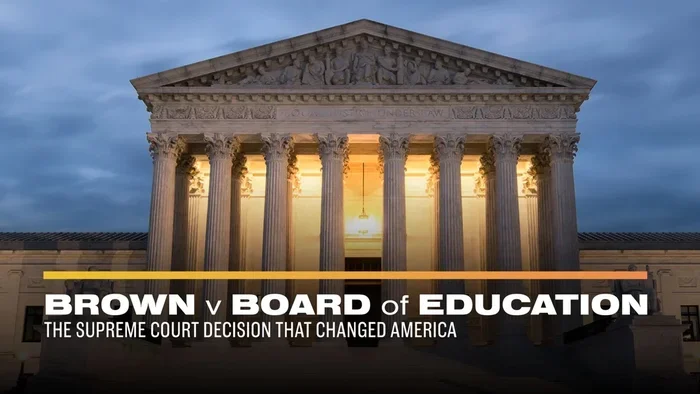
The brown vs board of education case took place in Topeka, Kansas, where Oliver Brown challenged segregated schools. This landmark Supreme Court decision overturned “separate but equal” and reshaped civil rights in America. The case centered on Linda Brown and the fight for equal education for Black children.
Key Takeaways
- Location: The case originated in Topeka, Kansas, and was decided by the U.S. Supreme Court in Washington, D.C.
- Key Figure: Oliver Brown, a parent from Topeka, became the lead plaintiff in the case.
- Historic Ruling: The Supreme Court unanimously ruled that racial segregation in public schools was unconstitutional.
- Impact: The decision paved the way for the broader civil rights movement and school integration efforts across the nation.
- Legacy: Monroe Elementary School in Topeka is now a National Historic Site commemorating the case.
- Legal Foundation: The ruling overturned the “separate but equal” doctrine established by Plessy v Ferguson.
📑 Table of Contents
- Where Did the Brown vs Board of Education Take Place?
- The Origins of the Case in Topeka, Kansas
- The Legal Journey: From Kansas to the Supreme Court
- The Impact of the Brown vs Board of Education Decision
- Visiting the Brown vs Board of Education National Historic Site
- Common Misconceptions About the Case
- Why the Brown vs Board of Education Case Still Matters Today
Where Did the Brown vs Board of Education Take Place?
The brown vs board of education case is one of the most important moments in American history. But do you know exactly where it all began? The story starts in a quiet city in Kansas. From there, it traveled all the way to the highest court in the land. Let us walk through the full story together.
If you have ever wondered about the location of the brown vs board of education case, the answer is simple. The case started in Topeka, Kansas. It was filed in the U.S. District Court for the District of Kansas. Later, it moved to the Supreme Court in Washington, D.C. The ruling that changed everything came from nine justices sitting in Washington.
The case was not just about one school or one family. It was about millions of children. It was about fairness. It was about what the word “equal” really means in education. And it all started in a place many people have never heard of: Topeka.
The Origins of the Case in Topeka, Kansas
Why Topeka?
You might ask yourself, why Topeka? The answer lies in the laws of Kansas at the time. In the early 1950s, Kansas allowed de jure segregation in public schools. This means segregation was written into state law. Many states across the South had similar rules. But Kansas was different in one important way. The law allowed local school districts to decide whether to segregate. This created a patchwork of segregated and integrated schools across the state.
Topeka was a mid-sized city with a population of about 120,000 people. It was not a Deep South city. It was not a Northern city either. It was right in the middle. And that middle-ground position made it a powerful place to challenge racial segregation in schools.
The NAACP (National Association for the Advancement of Colored People) had been looking for the right case to challenge school segregation. They wanted a case that would show how unfair segregated schools really were. Topeka offered the perfect opportunity. The local NAACP chapter recruited parents who were willing to step forward.
Oliver Brown and the Topeka Schools
The lead plaintiff in the case was Oliver Brown. He was a welder and a church minister in Topeka. His daughter, Linda Brown, had to walk several blocks to a segregated school for Black children. There was a white school much closer to their home. But Linda was not allowed to attend it because of the color of her skin.
This situation was painfully common across the country. Black children were often bused to schools far from their neighborhoods. White children attended well-funded schools nearby. The inequality was obvious. And Oliver Brown decided enough was enough.
Oliver Brown joined a group of 13 other parents. Together, they filed a lawsuit in 1951. They argued that segregated schools violated the Fourteenth Amendment to the U.S. Constitution. The Fourteenth Amendment guarantees equal protection under the law. The parents believed that separate schools could never truly be equal.
Monroe Elementary School
Linda Brown attended Monroe Elementary School. It was a segregated school for Black children in Topeka. The building was old and lacked resources. It was not far from the Brown family home, but Linda could not attend the Sumner Elementary, a white school just a few blocks away.
Today, Monroe Elementary School is a National Historic Site. Visitors from all over the world come to walk its halls. The site tells the story of the brown vs board of education case. It reminds us how far we have come and how much work remains. If you ever visit Topeka, it is worth a stop.
You can explore more about the language of education and how we talk about learning in our Idioms For Education guide, which shows how education shapes our everyday expressions.
The Legal Journey: From Kansas to the Supreme Court
The District Court Ruling
The case first went to the U.S. District Court in Kansas. The parents’ lawyers argued that segregated schools were inherently unequal. But the court ruled against them. It cited the “separate but equal” doctrine. This doctrine had been established decades earlier by another Supreme Court case called Plessy v Ferguson.
The Plessy v Ferguson decision came from Louisiana in 1896. It allowed racial segregation as long as the facilities were “separate but equal.” In reality, facilities for Black Americans were almost never equal. The doctrine gave legal cover to decades of discrimination. The Topeka parents knew they needed to challenge this.
The district court ruling was disappointing. But the legal team did not give up. They appealed the case to the U.S. Supreme Court. This is where the story really takes flight.
The Supreme Court Consolidates the Cases
Here is something many people do not know. The brown vs board of education case was not just one case. The Supreme Court combined it with cases from other states. These included cases from South Carolina, Virginia, Delaware, and Washington, D.C. All of these cases dealt with school segregation.
By combining the cases, the Court could make one sweeping decision. The lead attorney for the plaintiffs was Thurgood Marshall. He later became the first Black Supreme Court Justice. Marshall made a powerful argument. He said that segregated schools harmed Black children. He showed through psychological studies that segregation created feelings of inferiority.
The Supreme Court heard the arguments in December 1952. They revisited the case in December 1953. Chief Justice Earl Warren led the Court. He pushed the justices to reach a unanimous decision.
The Historic Ruling
On May 17, 1954, the Supreme Court issued its ruling. It was unanimous. All nine justices agreed. Chief Justice Warren wrote the opinion. The Court declared that “separate educational facilities are inherently unequal.”
This ruling overturned Plessy v Ferguson. It said that segregation in public schools violated the Fourteenth Amendment. The brown vs board of education decision was a victory for civil rights and education equality. It changed the legal landscape of America overnight.
You can also explore how education language shapes our thinking in our Similes For Education collection and our Metaphors For Education guide to see how figurative language reflects the world of learning.
The Impact of the Brown vs Board of Education Decision
Immediate Effects
The ruling did not end segregation overnight. In fact, many states resisted the decision for years. Some Southern states passed laws to avoid integration. This period of resistance is often called “massive resistance.” But the brown vs board of education case planted a seed that could not be ignored.
The decision gave fuel to the broader civil rights movement. Leaders like Martin Luther King Jr. drew inspiration from the ruling. The case showed that the legal system could be used to fight injustice. It gave hope to millions of Americans.
School integration happened slowly. Some districts complied right away. Others fought the ruling in court for years. The process of school desegregation took decades. But the direction was clear. The law now stood on the side of equality.
Long-Term Legacy
Today, the brown vs board of education case is studied in every American history class. It is a cornerstone of the civil rights movement. The decision helped set the stage for the Civil Rights Act of 1964 and the Voting Rights Act of 1965.
The case also changed how Americans think about education equality. It established the idea that every child deserves access to quality education. Regardless of race. Regardless of zip code. Regardless of background.
The legacy of the case lives on in courtrooms and classrooms. When people fight for equal access to education today, they stand on the shoulders of Oliver Brown and the other Topeka parents. Their courage changed the course of history.
Visiting the Brown vs Board of Education National Historic Site
What You Will Find in Topeka
If you want to see where the brown vs board of education story began, visit Topeka. The Brown v. Board of Education National Historic Site is located at Monroe Elementary School. The site is managed by the National Park Service.
Visitors can tour the restored school building. They can see exhibits about the case and the history of racial segregation in America. The site also features a visitor center with films and educational materials.
The historic site is located at 1515 SE Monroe Street in Topeka. Admission is free. It is open year-round, with hours that vary by season. Plan to spend at least an hour exploring the exhibits.
Why the Site Matters
The site is more than a museum. It is a place of remembrance. It honors the families who risked everything to fight for their children’s future. It reminds us that progress often starts with ordinary people doing extraordinary things.
When you stand in the halls of Monroe Elementary, you feel the weight of history. You understand why the brown vs board of education case matters. It is not just a legal decision. It is a human story. It is about dignity. It is about justice. It is about the promise of equal opportunity for all.
Common Misconceptions About the Case
Myth: The Case Was Only About Topeka
While the case started in Topeka, it was really a national case. The Supreme Court combined it with similar cases from across the country. The ruling applied to all public schools in America. It was not limited to Kansas or even the South.
Myth: Segregation Ended Immediately After the Ruling
The ruling was a legal victory, but change did not happen overnight. Many schools remained segregated for years after 1954. Full integration took decades of effort, protest, and sometimes violence. The case was a starting point, not a finish line.
Myth: Oliver Brown Was a Lawyer or Activist
Oliver Brown was not a lawyer. He was a welder and a minister. He was an ordinary parent who wanted a better education for his daughter. His story shows that you do not need to be an expert to fight for what is right. Sometimes, all it takes is a parent who loves their child enough to stand up.
Why the Brown vs Board of Education Case Still Matters Today
The brown vs board of education case is not just history. Its lessons are still relevant today. Schools across America still face issues of inequality. Funding gaps between districts often fall along racial lines. Access to quality education is still not the same for every child.
The principles established in the ruling remind us that education equality is a fundamental right. The Fourteenth Amendment continues to be cited in court cases about school funding and access. The brown vs board of education decision remains a touchstone for anyone who believes in fairness in education.
When we talk about civil rights today, we owe a debt to the families in Topeka. Their courage in the early 1950s opened doors for generations of Americans. The brown vs board of education case shows us that the law can be a powerful tool for change. But it also shows us that legal victories require ongoing effort to make them real.
The story of the brown vs board of education case is a story of hope. It is a story about parents who refused to accept inequality. It is about a community that came together to fight for justice. And it is about a nation that, slowly and imperfectly, moved closer to the promise of equality for all.
Understanding where the brown vs board of education case took place helps us understand its full significance. From the streets of Topeka to the halls of the Supreme Court, the journey of this case shaped the America we live in today. It reminds us that change is possible. It starts with a single step. And sometimes, that step begins in a quiet city called Topeka.
Frequently Asked Questions
What city did the Brown vs Board of Education case take place in?
The case took place in Topeka, Kansas. Oliver Brown and other parents filed the lawsuit in the U.S. District Court for the District of Kansas. The case was later heard by the U.S. Supreme Court in Washington, D.C.
Why was the Brown vs Board of Education case filed in Kansas?
Kansas was chosen because its laws allowed local school districts to decide on segregation. This created a mix of segregated and integrated schools, making it an ideal place to challenge the “separate but equal” doctrine. The NAACP wanted a case that would expose the inequality of segregation clearly.
Where is the Brown vs Board of Education National Historic Site located?
The historic site is located at Monroe Elementary School in Topeka, Kansas, at 1515 SE Monroe Street. It is a free attraction managed by the National Park Service and features exhibits about the case and the history of school segregation in America.
Who was Oliver Brown in the Brown vs Board of Education case?
Oliver Brown was a welder and church minister from Topeka, Kansas. He became the lead plaintiff because his name came first alphabetically among the parents who filed the lawsuit. His daughter Linda had to attend a segregated school far from their home while a white school was nearby.
How did the Brown vs Board of Education ruling affect schools across America?
The ruling declared that segregated schools were unconstitutional and violated the Fourteenth Amendment. It overturned the “separate but equal” doctrine from Plessy v Ferguson. The decision set the legal foundation for school integration and the broader civil rights movement, though full desegregation took many more years.
Is the Brown vs Board of Education case still relevant today?
Yes, the case remains highly relevant. Issues of education inequality and school funding gaps still exist in many communities. The principles established in the ruling continue to be cited in legal battles over educational access and equality across the United States.
=== CONCLUSION ===
The brown vs board of education case is one of the most important legal decisions in American history. It all started in Topeka, Kansas, where brave parents stood up for their children’s right to a fair education. From the halls of Monroe Elementary to the chambers of the Supreme Court, the journey of this case changed the nation.
The ruling in brown vs board of education proved that separate schools could never be truly equal. It gave the civil rights movement a powerful legal foundation. And it reminded every American that equality under the law is not just an idea. It is a promise.
Today, when we visit Topeka or study the case in school, we honor the courage of the Brown family and the many others who fought for justice. The brown vs board of education case teaches us that ordinary people can create extraordinary change. And that lesson is one we need now more than ever.


