
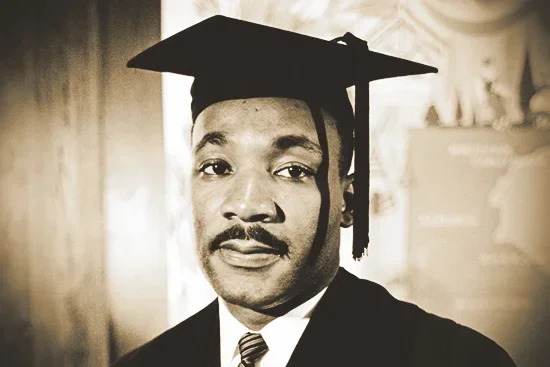
Martin Luther King Jr. earned a Ph.D. in systematic theology from Boston University after attending Morehouse College and Crozer Theological Seminary. His education played a powerful role in shaping his civil rights leadership and his vision for equality. Understanding his academic background reveals how learning fueled his fight for justice.
Key Takeaways
- Early Academic Excellence: MLK skipped grades and entered college at just 15 years old.
- Morehouse College: He earned his BA in sociology from this historically Black institution in Atlanta.
- Crozer Theological Seminary: MLK graduated as valedictorian and studied theology and nonviolent philosophy.
- Boston University PhD: He earned a doctorate in systematic theology, deepening his intellectual foundation.
- Education as a Tool for Justice: MLK believed learning was essential for fighting inequality and building a better society.
- Global Recognition: His education helped him articulate ideas that earned him the Nobel Peace Prize.
📑 Table of Contents
- What Education Did Martin Luther King Receive and Why It Matters
- Early Schooling: A Bright Young Mind
- Morehouse College: The First Major Milestone
- Crozer Theological Seminary: Deepening His Faith
- Boston University: Earning a Doctorate
- Why Education Was Central to Martin Luther King’s Mission
- King’s Educational Legacy Today
- Common Mistakes People Make When Learning About King’s Education
- Expert Insights on King’s Academic Influence
- Quick Tips for Understanding King’s Education Journey
- Conclusion: The Power of Education in Martin Luther King’s Life
What Education Did Martin Luther King Receive and Why It Matters
Martin Luther King Jr. is known worldwide as a civil rights leader. But many people don’t know much about Martin Luther King education and how it shaped his path. His journey through school was nothing short of remarkable. He skipped two grades as a child and entered college at just 15 years old.
His academic journey took him from Atlanta to Pennsylvania and then to Boston. Each stop built his knowledge and sharpened his voice. Understanding his education helps us see how learning fueled his fight for justice. King proved that education is one of the most powerful tools for change. Let’s walk through every step of his academic story.
King once said that the function of education is to teach one to think intensively and to think critically. That belief stayed with him his entire life. His educational background gave him the words and ideas that moved millions. In this article, we will explore every degree, every school, and every milestone that made him who he was.
Early Schooling: A Bright Young Mind
Martin Luther King Jr. was born in Atlanta, Georgia, in 1929. He grew up in a time when segregated education was the law of the land. Black children and white children attended separate schools, and resources were often unequal. Despite this, young Martin showed incredible intelligence from a very early age.
He started elementary school at the age of six. By the time he was twelve, he had already studied subjects well beyond his grade level. He skipped the ninth and twelfth grades entirely. This meant he entered Morehouse College in 1944 when he was only fifteen years old. Imagine walking onto a college campus as a teenager! It takes real dedication and bright curiosity.
King’s parents nurtured his love of learning. His father was a pastor, and his mother was a schoolteacher. They encouraged him to read widely and think deeply. Books about history, philosophy, and religion filled his home. This early exposure to ideas gave him a strong foundation. It also planted the seed for his future intellectual development.
How Segregated Schools Shaped His Thinking
Growing up in segregated schools taught King about inequality firsthand. He saw how separate could never truly mean equal. These early experiences fueled his desire to fight for fairness. They also made him value education even more. He knew that knowledge could be a way to break down barriers.
King attended David T. Howard Elementary School and then Booker T. Washington High School. At Washington High, he excelled in English, history, and public speaking. His teachers noticed his talent early on. They encouraged him to aim high. That support mattered. It shows how important good teachers are in shaping young minds.
Morehouse College: The First Major Milestone
In 1944, Martin Luther King Jr. enrolled at Morehouse College in Atlanta. Morehouse is one of the most famous historically Black colleges in the United States. It was a place where Black students could thrive academically without the limits of segregation. King thrived there.
He studied sociology and graduated with a Bachelor of Arts degree in 1948. During his time at Morehouse, King discovered the power of nonviolent resistance. He read the works of Mahatma Gandhi and was deeply inspired. He also studied under President Benjamin Mays, who became a major academic influence on him.
Mays taught King to think about religion and social justice together. He encouraged King to use his education to serve others. This idea stayed with King for the rest of his life. After Morehouse, King knew he wanted to do more. He wanted to understand the deeper philosophical and theological roots of justice and equality.
Why Morehouse Was Important
Morehouse gave King something he could not get elsewhere at the time. It gave him a community of Black scholars and leaders. It gave him access to ideas that challenged segregation and injustice. It also gave him the confidence to speak up. King’s time at Morehouse was a turning point. It transformed him from a bright student into a future leader.
Many people wonder what education did Martin Luther King receive beyond Morehouse. The answer takes us to two more important institutions. Let’s explore those next.
Crozer Theological Seminary: Deepening His Faith
After graduating from Morehouse, King enrolled at Crozer Theological Seminary in Chester, Pennsylvania. This was a big step. He left his home state of Georgia to study theology in a predominantly white institution. It was a bold move for a young Black man in the 1940s.
At Crozer, King studied theological studies and explored many different religious traditions. He read widely in philosophy and ethics. He also took classes in oratory and public speaking. These skills would later help him deliver his famous speeches.
King graduated from Crozer in 1951. He earned the Bachelor of Divinity degree. But here is something truly impressive: he graduated as valedictorian. That means he was the top student in his class. He also won the J. Lewis Crozer Fellowship. This award gave him money to continue his studies. It was a sign that his professors saw great promise in him.
Building a Foundation in Nonviolence
During his time at Crozer, King began to form his ideas about nonviolent protest. He studied the teachings of Jesus and compared them to Gandhi’s methods. He saw a strong connection between faith and justice. This connection became the heart of his civil rights movement education.
King also faced challenges at Crozer. He was one of very few Black students on campus. He dealt with prejudice and isolation. But he used those experiences to grow stronger. He learned how to stand firm in his beliefs. These lessons would serve him well in the years ahead.
Boston University: Earning a Doctorate
In 1951, King began studying at Boston University. He enrolled in the School of Theology. He wanted to earn his Ph.D. and deepen his understanding of religion and society. This was the final and most advanced stop on his educational journey.
King completed his coursework and passed his exams. He wrote a doctoral dissertation on the ideas of Paul Tillich and Henry Nelson Wieman. His work explored how different thinkers understood God. In 1955, Boston University awarded him a PhD in systematic theology. He was just 25 years old.
Earning a doctorate is a huge accomplishment. It requires years of hard work, research, and writing. For King, it was more than an academic achievement. It gave him the intellectual tools to lead a movement. His educational milestones at Boston University helped him craft powerful arguments for equality.
How Boston University Shaped His Leadership
At Boston University, King met Coretta Scott, who was studying music at the New England Conservatory of Music. They married in 1953. Boston also exposed King to diverse ideas and people from around the world. He attended lectures, joined discussion groups, and continued reading deeply.
His time in Boston helped him develop a global perspective. He saw that the fight for civil rights was part of a larger struggle for human dignity. This broader view strengthened his leadership. It also helped him connect with people from many different backgrounds.
King’s academic achievements at Boston University gave him credibility. When he spoke, people listened. His education gave him the language and logic to make his case. It also gave him the patience to work through complex problems. These qualities made him an effective and respected leader.
Why Education Was Central to Martin Luther King’s Mission
King believed deeply in the power of learning and leadership. He saw education as more than just getting good grades. He saw it as a path to freedom and equality. In one of his speeches, he explained that education must train people to think critically and independently.
For King, education was not just personal. It was a tool for social change. He wanted every child, regardless of race, to have access to quality schooling. He believed that ignorance was one of the biggest enemies of justice. And he knew that knowledge could build bridges between communities.
His own MLK academic journey shows us how education can transform a life. From a young boy in Atlanta to a Nobel Peace Prize winner, King used every lesson he learned. He turned his studies into action. He turned his knowledge into a movement that changed the world.
Lessons We Can Learn from King’s Education
There is so much we can learn from King’s dedication to learning. Here are a few important lessons:
- Never stop learning: King kept studying throughout his life. He read books, attended lectures, and sought new ideas.
- Use education to serve others: King always connected his learning to helping people. He never treated education as just a personal achievement.
- Embrace challenges: King faced prejudice and hardship at every school he attended. He used those challenges to grow stronger.
- Think critically: King valued education that taught people to question, analyze, and form their own opinions.
- Connect ideas across fields: King drew from theology, philosophy, history, and social science. He saw how all these fields were connected.
King’s belief in education also connects to broader ideas about similes for education, metaphors for education, and idioms for education. He often used powerful language to describe the value of learning. He compared education to a light that guides people through darkness. He spoke of knowledge as a key that opens doors. These education figures of speech capture his deep respect for learning.
King’s Educational Legacy Today
Martin Luther King Jr.’s legacy lives on in many ways. His name is attached to schools, scholarships, and educational programs across the country. The Martin Luther King Jr. Center for Nonviolent Social Change continues to promote his vision of justice and equality through education.
Today, many young people study King’s life and work in school. They learn about his academic achievements alongside his civil rights victories. This helps them understand that education and activism go hand in hand. King showed the world that a strong education can be a force for tremendous good.
His story also reminds us of the importance of access to education. King fought so that all people, regardless of skin color, could have the same opportunities to learn. His dream was not just about ending segregation. It was about building a society where every person could reach their full potential through education and opportunity.
We honor King’s memory best by continuing to value learning. By supporting schools in underserved communities. By mentoring young people. By believing that education can change the world. King’s journey from a precocious child in Atlanta to a world-changing leader proves that point every day.
Common Mistakes People Make When Learning About King’s Education
There are a few common myths and misunderstandings about King’s academic life. Let’s clear them up.
- Myth 1: People think King only studied religion. In reality, he studied sociology, philosophy, theology, and ethics. His education was broad and interdisciplinary.
- Myth 2: Some believe King’s education was not taken seriously. In fact, he earned top honors at every institution he attended. His academic record was outstanding.
- Myth 3: Others assume King’s education was only about personal success. His learning was always directed toward serving others and advancing justice.
Understanding the full picture of King’s education helps us appreciate his depth as a thinker and leader. He was not just a great speaker. He was also a rigorous scholar who spent years studying and preparing for his role in the civil rights movement education effort.
Expert Insights on King’s Academic Influence
Historians and educators often point to King’s education as a key factor in his success. Dr. Clayborne Carson, a historian at Stanford University, has written extensively about King’s intellectual development. He notes that King’s ability to draw from many different fields made his arguments powerful and persuasive.
Professor Drew Hansen, author of “The Dream: Martin Luther King Jr. and the Story Behind ‘I Have a Dream,'” explains that King’s theological training gave him a unique moral voice. His education helped him frame the civil rights struggle in terms that resonated with people of all faiths and backgrounds.
These expert perspectives remind us that King’s education was not just a personal achievement. It was a public good. His learning enriched the entire movement and continues to inspire students and leaders today.
Quick Tips for Understanding King’s Education Journey
- Start with Morehouse College to understand King’s undergraduate foundation.
- Read about Crozer Theological Seminary to learn how King developed his nonviolent philosophy.
- Explore Boston University to see how King earned his doctorate and connected with global ideas.
- Look at King’s speeches and writings to see how his education shaped his words.
- Compare King’s educational path with other civil rights leaders to see the role of learning in social movements.
Conclusion: The Power of Education in Martin Luther King’s Life
Martin Luther King Jr.’s education was extraordinary. He earned a BA from Morehouse College, a Bachelor of Divinity from Crozer Theological Seminary, and a PhD in systematic theology from Boston University. Each step built his knowledge and prepared him for leadership. His Martin Luther King education was not just about degrees. It was about developing the mind, the spirit, and the courage to fight for justice.
King proved that education is one of the most powerful forces for good in the world. His academic journey gave him the tools to inspire millions. It gave him the wisdom to lead a movement that changed America. And it gave him the vision to dream of a more equal and just society.
As we reflect on King’s life, let us remember the central role that education played in his story. Let us honor his legacy by valuing learning, seeking knowledge, and using education to make the world a better place for everyone. King’s life reminds us that when we invest in education, we invest in the future.
His journey from a young boy in Atlanta to a world-renowned leader shows us what is possible when knowledge meets purpose. Martin Luther King’s education was the foundation of everything he achieved. And it continues to inspire new generations to learn, to lead, and to dream big.
Frequently Asked Questions
What degrees did Martin Luther King Jr. earn?
King earned a Bachelor of Arts in sociology from Morehouse College, a Bachelor of Divinity from Crozer Theological Seminary, and a PhD in systematic theology from Boston University. Each degree built his knowledge and prepared him for his role as a civil rights leader.
How old was Martin Luther King when he started college?
King was just fifteen years old when he entered Morehouse College in 1944. He had skipped two grades during his early schooling, which allowed him to start college at a very young age. His intelligence and dedication made this possible.
Why is Martin Luther King’s education important to his legacy?
King’s education gave him the intellectual tools to lead the civil rights movement. His studies in theology, philosophy, and sociology helped him craft powerful arguments for equality. Education was central to his mission and his ability to inspire millions.
Did Martin Luther King face challenges in his education?
Yes, King faced segregation and prejudice throughout his educational journey. At Crozer, he was one of very few Black students and dealt with isolation. Despite these challenges, he excelled academically and graduated as valedictorian.
What role did Boston University play in King’s education?
Boston University was where King earned his PhD. It gave him a global perspective and exposed him to diverse ideas. His time there also helped him develop the intellectual depth that made his speeches and writings so influential.
How can we honor Martin Luther King’s educational legacy today?
We can honor King’s legacy by supporting education for all, mentoring young people, and believing in the power of learning to create change. King showed us that education is one of the strongest tools for building a just and equal society.
=== INTERNAL LINKS ===
King’s use of powerful language to describe learning connects to broader ideas about similes for education, metaphors for education, and idioms for education that capture the deep meaning of academic growth.


