
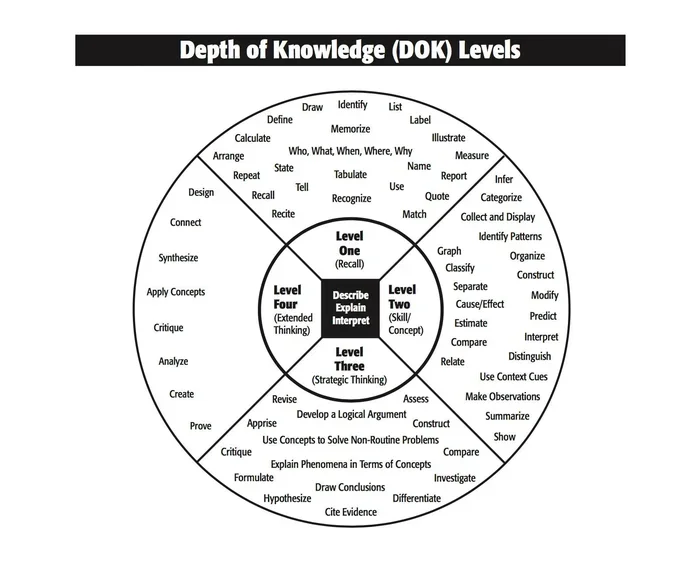
DOK stands for Depth of Knowledge, a framework created by Norman Webb that classifies tasks by their cognitive demand. It helps teachers design lessons that push students beyond memorization into critical thinking and complex reasoning. Understanding the four DOK levels transforms how you plan instruction, create assessments, and measure real learning outcomes.
Have you ever heard teachers talk about DOK in a meeting and wondered what it really means? You are not alone. DOK is one of those education terms that sounds simple but carries a lot of weight. It shapes how teachers plan lessons, design tests, and challenge students to think harder. In this article, we will break down what DOK stands for in education, explore each level in detail, and show you practical ways to use it in your classroom or studies.
Whether you are a teacher looking to raise the rigor in your lessons or a student wanting to understand why some assignments feel harder than others, this guide has you covered. We will walk through everything step by step. No jargon overload. No fluff. Just clear, actionable insights that you can use right away. Let us dive in.
Key Takeaways
- DOK stands for Depth of Knowledge: A four-level framework that measures the cognitive complexity of learning tasks and assessments.
- Level 1 is recall, Level 4 is extended thinking: Each level builds on the previous one to create a progression of intellectual challenge.
- DOK improves lesson planning: Teachers who use DOK design activities that develop deeper understanding rather than surface-level memorization.
- Assessment quality depends on DOK alignment: Matching test questions to the right DOK level gives a true picture of student learning.
- DOK is not Bloom’s Taxonomy: They are related but different frameworks, and knowing the distinction helps you apply both effectively.
- Students benefit from all four levels: A balanced mix of DOK levels in your classroom boosts engagement, retention, and real-world problem-solving skills.
📑 Table of Contents
What Does DOK Stand for in Education?
DOK stands for Depth of Knowledge. It is a framework developed by Norman Webb in 1997. The purpose is simple but powerful: classify educational tasks based on how much thinking they require. Not all assignments are created equal. Some ask students to simply recall a fact. Others push them to analyze, evaluate, and create.
The Depth of Knowledge framework gives educators a common language to talk about cognitive demand. When a teacher says a question is “DOK Level 3,” everyone knows it requires complex reasoning. This shared understanding helps teams align their learning objectives and build a more coherent curriculum. It also makes it easier to design assessments that truly measure what students know and can do.
Think of DOK as a ladder. Each rung represents a deeper level of thinking. Students start at the bottom with basic recall and work their way up to extended, sophisticated analysis. The goal is not to stay at the bottom. It is to help learners climb higher over time. This progression mirrors how we naturally grow in our understanding of any subject.
You may also encounter related concepts like similes for education or metaphors for education that teachers use to explain complex ideas in relatable ways. These language tools complement the DOK framework by making abstract thinking more concrete for students. Similarly, educators often draw on idioms for education to build classroom culture and communicate expectations clearly.
The Four DOK Levels Explained
The heart of the Depth of Knowledge framework lies in its four levels. Each level describes a different kind of thinking. Let us unpack them one by one.
DOK Level 1: Recall and Reproduction
Level 1 is all about remembering. Students retrieve facts, define terms, or perform basic procedures. These tasks do not require deep understanding. They test whether a learner can recall information from memory.
Examples of DOK Level 1 tasks include:
- Reciting the capital of a state
- Solving a simple arithmetic problem like 2 + 3
- Defining a vocabulary word from a list
- Identifying a character in a story
These tasks have an important place in learning. They build the foundation of knowledge that students need before tackling harder problems. Without a solid base of recall, higher-level thinking becomes very difficult. However, if an entire lesson stays at Level 1, students miss out on opportunities to grow.
DOK Level 2: Skills and Concepts
Level 2 requires more than just remembering. Students must make decisions about how to approach a task. They might compare, classify, or explain ideas in their own words. The thinking is a step beyond recall but does not yet involve abstract reasoning.
Examples of DOK Level 2 tasks include:
- Explaining why a character made a certain choice in a story
- Comparing two different ecosystems and listing their differences
- Using a formula to solve a multi-step math problem
- Summarizing the main idea of a paragraph
At this level, students start to connect ideas. They see relationships between pieces of information. This is where critical thinking begins to take shape. Teachers who include more Level 2 tasks in their lessons help students move from passive learning to active engagement.
DOK Level 3: Strategic Thinking
Level 3 is where things get interesting. Students must reason, plan, and use evidence to support their answers. There is often more than one correct approach, and students need to justify their thinking. This level demands higher-order thinking and intellectual flexibility.
Examples of DOK Level 3 tasks include:
- Writing an essay that argues for or against a historical decision
- Designing an experiment to test a scientific hypothesis
- Analyzing the cause-and-effect relationship in a social studies topic
- Evaluating the strengths and weaknesses of an argument
DOK Level 3 tasks push students to think like experts in a field. They must go beyond surface understanding and dig into the “why” and “how.” This is the level where real knowledge retention happens because students are actively processing and organizing information rather than just absorbing it.
DOK Level 4: Extended Thinking
Level 4 represents the highest cognitive demand. Students tackle complex, multi-step projects that require sustained effort over time. They synthesize information from multiple sources, draw original conclusions, and communicate their findings in meaningful ways.
Examples of DOK Level 4 tasks include:
- Conducting a long-term research project with original data collection
- Creating a comprehensive multimedia presentation that solves a real-world problem
- Developing a proposal to address a community issue using evidence from multiple texts
- Writing a thesis-level paper that contributes new insights to a subject
DOK Level 4 tasks mirror real-world challenges. They require persistence, creativity, and the ability to manage complex workflows. While not every lesson needs to reach Level 4, regularly exposing students to extended thinking tasks prepares them for academic rigor beyond the classroom.
Why DOK Matters in the Classroom
You might wonder why the Depth of Knowledge framework deserves so much attention. The answer comes down to one word: balance. When teachers understand DOK levels, they can design instruction that hits the right cognitive targets. This leads to better student engagement and more meaningful learning outcomes.
Here are the key reasons DOK matters:
- It clarifies learning goals: Teachers can articulate exactly what kind of thinking a task requires.
- It improves assessment design: Tests that align with DOK levels give a more accurate picture of student ability.
- It supports differentiated instruction: Teachers can assign tasks at different DOK levels to meet diverse learner needs.
- It prepares students for the real world: Most real-life problems require Level 3 or Level 4 thinking.
- It raises the bar for everyone: A DOK-aware classroom naturally pushes all students toward deeper understanding.
Without a framework like DOK, it is easy to default to low-level tasks. Worksheets that only ask students to fill in blanks feel simple to create but do little to build genuine understanding. The Depth of Knowledge framework reminds us that true learning happens when students are challenged to think deeply.
How to Apply DOK in Lesson Planning
Using DOK in your daily instruction does not require a complete overhaul of your teaching style. Small, intentional shifts can make a big difference. Here is a practical guide to get started.
Start With Your Learning Objectives
Before planning any activity, ask yourself what kind of thinking you want students to demonstrate. Do you want them to recall a fact, or do you want them to analyze a concept? Write your objectives with DOK levels in mind. This simple step ensures that your lessons are intentionally designed for cognitive growth.
Use a DOK Questioning Toolkit
Build a set of questions for each DOK level. Keep them handy during lessons and discussions. For example:
- DOK 1: “What is the definition of ___?”
- DOK 2: “How is ___ similar to ___?”
- DOK 3: “Why do you think ___ happened? What evidence supports your view?”
- DOK 4: “What would happen if we applied ___ to solve this larger problem?”
Balance Your Instruction Across Levels
A common mistake is focusing too heavily on one DOK level. Most lessons should include a mix. Start with a Level 1 warm-up to activate prior knowledge. Move to Level 2 instruction to build understanding. Then challenge students with Level 3 or Level 4 tasks that push them to apply what they have learned.
Revise Your Assessments
Look at your existing tests and quizzes. What DOK levels do they target? If most questions are Level 1, consider adding a few Level 2 or Level 3 items. This small change can dramatically improve the diagnostic value of your assessments.
Quick Tips for DOK Implementation
- Post DOK level labels on classroom activities so students understand the cognitive demand
- Use sentence starters that prompt higher-level thinking (“In my opinion…” or “The evidence suggests…”)
- Collaborate with colleagues to audit your curriculum for DOK balance
- Give students regular feedback on the level of thinking they are demonstrating
- Celebrate growth when students move from one DOK level to the next
DOK vs Bloom’s Taxonomy: What Is the Difference?
Many educators confuse DOK with Bloom’s Taxonomy. While both frameworks address cognitive complexity, they approach it differently. Bloom’s Taxonomy organizes thinking skills into six categories: Remember, Understand, Apply, Analyze, Evaluate, and Create. DOK organizes tasks into four levels based on the depth and complexity of the thinking required.
The key distinction is this: Bloom’s focuses on the type of thinking skill being used, while DOK focuses on the depth of processing required by the task. A task might require the same Bloom’s level but sit at different DOK levels depending on context. Understanding both frameworks gives you a more complete picture of instructional rigor.
Teachers who master both frameworks can design instruction that is both skill-focused and depth-focused. This dual awareness leads to richer classroom experiences and more robust learning outcomes for every student.
Common Mistakes Teachers Make With DOK
Even well-intentioned educators can stumble when implementing the Depth of Knowledge framework. Here are the most common pitfalls and how to avoid them.
- Mistake 1: Confusing difficulty with cognitive demand. A hard math problem is not necessarily DOK Level 3. If it only requires applying a memorized formula, it is Level 1 or Level 2. True DOK Level 3 tasks require reasoning and justification.
- Mistake 2: Skipping Level 1 entirely. Recall is not a waste of time. It is the foundation. Students need solid retrieval practice before they can think strategically.
- Mistake 3: Overloading with Level 4 tasks. Extended thinking projects are valuable but should not dominate every lesson. Balance is key.
- Mistake 4: Ignoring student readiness. Pushing all students to the same DOK level regardless of their current ability can lead to frustration. Use scaffolding to help learners progress through the levels at their own pace.
Conclusion
What does DOK stand for in education? Depth of Knowledge. And it is one of the most practical frameworks any teacher or learner can use. By understanding the four levels of cognitive demand, you can design lessons that genuinely challenge students, create assessments that accurately measure understanding, and foster a classroom culture where deep thinking is the norm rather than the exception.
The Depth of Knowledge framework is not about making everything harder. It is about making every lesson more intentional. When you know what kind of thinking a task requires, you can match it to the right moment in your lesson, the right student, and the right learning goal. That is the real power of DOK.
Start small. Pick one lesson this week and audit its DOK levels. Ask yourself whether you are challenging your students enough or whether the work stays too shallow. Small shifts lead to big results. The journey to deeper learning begins with a single question: What does DOK stand for in education? Now you know the answer, and you have the tools to put it into practice.
Frequently Asked Questions
What does DOK stand for in education?
DOK stands for Depth of Knowledge. It is a framework created by Norman Webb that classifies educational tasks into four levels based on the cognitive demand they place on students, from basic recall to extended, complex thinking.
Why is DOK important for teachers?
DOK helps teachers design lessons and assessments that target the right level of thinking. It ensures that instruction goes beyond memorization and pushes students to develop critical thinking, reasoning, and problem-solving skills that prepare them for real-world challenges.
How is DOK different from Bloom’s Taxonomy?
Bloom’s Taxonomy focuses on the type of thinking skill being used, while DOK focuses on the depth of processing required by a task. They are complementary frameworks, and using both together gives educators a more complete picture of cognitive demand in the classroom.
What is a DOK Level 3 example?
A DOK Level 3 task requires strategic thinking. Examples include writing an argumentative essay that uses evidence, designing an experiment to test a hypothesis, or analyzing the cause-and-effect relationships in a historical event. These tasks demand reasoning and justification.
Can DOK be used in online learning environments?
Yes, absolutely. The DOK framework works in any instructional setting. Online teachers can design discussion prompts, assignments, and assessments at different DOK levels to ensure that digital learning experiences promote deep thinking and not just surface-level engagement.
How quickly can I start using DOK in my classroom?
You can start today. Begin by labeling your existing activities with DOK levels, then gradually adjust your lesson plans to include a better balance across all four levels. Even small changes in how you frame questions and design tasks can significantly impact the depth of student thinking.


