
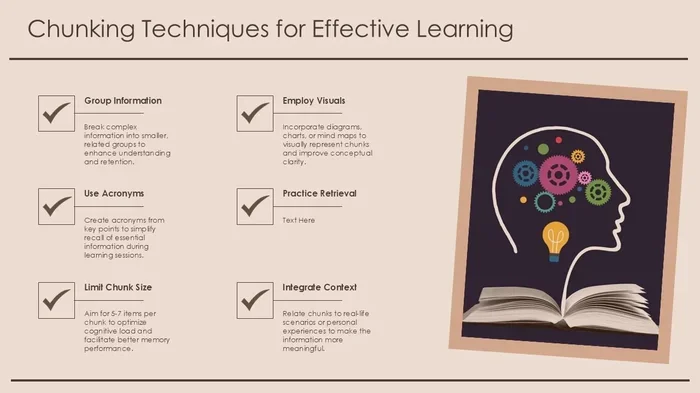
Chunking in education is a learning strategy that breaks big, overwhelming topics into smaller, manageable pieces. It helps students retain information better, reduce stress, and study more effectively. This guide covers the science behind chunking, real classroom examples, and actionable tips you can use right away.
Have you ever stared at a huge textbook chapter and thought, “Where do I even start?” You are not alone. chunking in education is a simple but powerful learning strategy that solves this exact problem. It takes big, intimidating blocks of information and breaks them into smaller, bite-sized pieces your brain can actually handle.
What does chunking mean in education? In plain terms, it is the practice of dividing lessons, concepts, or study material into small groups or “chunks.” Each chunk is easy to digest, remember, and review. Teachers use it to plan lessons, and students use it to study smarter, not harder. This article will walk you through everything you need to know about chunking in education, from the science behind it to practical tips you can start using today.
Key Takeaways
- Chunking simplifies complex material: Breaking lessons into small parts makes learning feel less overwhelming.
- It boosts memory retention: Your brain processes and stores smaller pieces of information more easily.
- Teachers and students both benefit: Chunking improves lesson planning and study habits.
- It reduces cognitive load: You can focus better when you are not trying to absorb too much at once.
- Chunking works with other strategies: Pair it with active learning and spaced repetition for the best results.
- Anyone can start using it today: No special tools or training are needed to begin chunking your study material.
📑 Table of Contents
- What Is Chunking in Education?
- Why Chunking Works: The Science Behind It
- How Teachers Use Chunking in the Classroom
- Chunking Strategies for Students
- Chunking vs. Traditional Study Methods
- Common Mistakes to Avoid with Chunking
- Expert Insights on Chunking in Education
- How to Get Started with Chunking Today
What Is Chunking in Education?
Chunking in education refers to a teaching and learning method where information is grouped into smaller, meaningful units. Instead of trying to memorize a long list of facts all at once, you break them into clusters. Each cluster feels manageable, and your brain can process it more efficiently.
The Basic Idea Behind Chunking
Think of it like eating a big pizza. You would not shove the entire pizza into your mouth at once. You slice it into pieces and enjoy one slice at a time. chunking in education works the same way. You slice your learning material into small portions and tackle them one at a time. This approach is backed by years of research in educational psychology and cognitive load theory.
The concept was popularized by psychologist George Miller in the 1950s. He found that the human short-term memory can hold about seven items at a time, plus or minus two. Chunking helps you work within that limit by grouping related items together. So instead of remembering seven separate facts, you remember one chunk that contains several facts.
Why Is It Called “Chunking”?
The word “chunk” simply means a small group or lump of something. In education, a chunk is a small bundle of related information. For example, a list of ten vocabulary words might be split into two chunks of five words each. Each chunk shares a theme or connection, which makes it easier to recall later.
Many teachers also use idioms for education to help students remember chunks of material. Phrases like “the ball is in your court” or “piece of cake” create vivid mental images that stick. These memory aids work hand in hand with the chunking method to reinforce learning.
Why Chunking Works: The Science Behind It
Understanding why chunking in education works can motivate you to use it more often. The science is clear and fascinating.
How Your Brain Processes Information
Your brain has a limited amount of space in its short-term memory. When you try to learn too much at once, that space gets overloaded. Information gets lost, confused, or never makes it to long-term memory. Chunking prevents this overload by limiting how much you try to absorb at one time.
When you group related pieces of information together, your brain treats the entire group as a single unit. This frees up mental space for other tasks. For example, instead of memorizing the numbers 4, 7, 2, 9, 1, 5, 8 separately, you might group them as 472 and 9158. Now you only need to remember two chunks instead of seven individual digits.
The Role of Cognitive Load
Cognitive load refers to the total amount of mental effort being used in your working memory. High cognitive load leads to confusion and frustration. Low cognitive load allows for deeper understanding and better knowledge retention.
Chunking directly reduces cognitive load. By presenting information in small doses, you give your brain room to process, connect, and store each piece. This is why bite-sized learning has become so popular in modern classrooms and online courses.
Memory Retention and Recall
One of the biggest benefits of chunking in education is improved memory retention. When information is organized into logical groups, your brain builds stronger neural pathways. These pathways make it easier to recall the material later, whether during a test or in real-life situations.
Studies show that students who use chunking techniques score higher on exams and retain information longer than those who try to cram everything at once. Effective studying is not about hours spent; it is about how you organize your learning.
How Teachers Use Chunking in the Classroom
Chunking in education is not just a study trick for students. Teachers rely on it every day to deliver lessons that actually stick. Here is how it works in practice.
Breaking Down Lessons into Sections
Good teachers know that a 45-minute lecture is too long if it is one continuous block of information. Instead, they divide the lesson into three or four smaller sections. Each section covers one main idea. Between sections, they pause for questions, activities, or quick reviews.
This approach keeps students engaged and prevents mental fatigue. It also gives teachers natural break points to check for understanding. If students seem confused during one chunk, the teacher can re-explain before moving on.
Using Visual Aids and Graphic Organizers
Many teachers use charts, diagrams, and graphic organizers to visually chunk information. For instance, a timeline might be broken into eras, or a complex topic might be shown as a mind map with branches. These tools help students see how smaller pieces fit into the bigger picture.
Some educators also draw on metaphors for education to make chunking more vivid. Saying “this chapter is a puzzle, and each section is a piece” helps students visualize the learning process. These creative comparisons make abstract ideas feel concrete and memorable.
Assigning Work in Stages
Another common strategy is assigning homework or projects in stages rather than all at once. A research paper might be chunked into choosing a topic, gathering sources, outlining, drafting, and revising. Each stage is a manageable task that builds on the last.
This method teaches students how to plan and manage their time. It also reduces the last-minute panic that comes from facing a huge assignment with no clear starting point.
Chunking Strategies for Students
You do not need to be a teacher to use chunking in education. Students at every level can apply these strategies to improve their learning. Here are some of the most effective methods.
The Pomodoro Technique
The Pomodoro Technique is a popular study technique that uses time-based chunking. You study for 25 minutes, then take a 5-minute break. After four rounds, you take a longer 15-to-30-minute break. Each 25-minute session is a learning chunk.
This method works because it creates a sense of urgency and focus. You know the clock is ticking, so you stay on task. The breaks give your brain time to rest and process what you just learned. Many students find that their academic performance improves simply by using this technique consistently.
Grouping Related Vocabulary Words
If you are learning new words, do not try to memorize them one by one in a long list. Instead, group them by theme, meaning, or word family. For example, words related to weather (rain, storm, cloudy, humid) form a natural chunk that is easier to remember than a random list.
You can also use similes for education to create associations between chunks. Saying “memorizing vocabulary is like building blocks, one on top of the other” gives you a mental image that supports the grouping strategy.
Breaking Math Problems into Steps
Math can feel overwhelming when you look at a full problem. But when you break it into steps, each part becomes a small chunk you can solve one at a time. Write out each step clearly before moving to the next. This prevents careless errors and builds confidence.
The same approach works for science formulas, history timelines, and even reading comprehension passages. Identify the main idea first, then chunk the supporting details into groups.
Using Flashcards for Small Chunks
Flashcards are a natural fit for chunking. Each card holds one small piece of information. You can group related cards together and review them as a set. This is a form of active learning because you are actively retrieving information rather than passively reading it.
Apps like Anki and Quizlet make it easy to create digital flashcard sets. You can organize them by subject, chapter, or difficulty level. Reviewing a few cards each day keeps your information processing steady and manageable.
Chunking vs. Traditional Study Methods
How does chunking in education compare to traditional ways of studying? Let us look at the key differences.
| Aspect | Traditional Study | Chunking Approach |
|---|---|---|
| Information Size | Large blocks all at once | Small, manageable pieces |
| Cognitive Load | High, often overwhelming | Low and controlled |
| Memory Retention | Short-term, fades quickly | Long-term, stronger recall |
| Student Engagement | Often passive and boring | Active and interactive |
| Stress Level | High, leads to cramming | Low, promotes steady progress |
| Flexibility | Rigid, one-size-fits-all | Adaptable to each learner |
The table shows that chunking has clear advantages. Traditional methods often rely on repetition and memorization without understanding. Chunking encourages deeper processing and meaningful connections between ideas.
For a deeper look at how language shapes our understanding of learning, you might enjoy exploring similes for change in life. These comparisons highlight how breaking big changes into smaller steps mirrors the chunking approach perfectly.
Common Mistakes to Avoid with Chunking
Even a great strategy can fail if you use it incorrectly. Here are some common mistakes students make when trying to apply chunking in education.
Making Chunks Too Small
If your chunks are too tiny, you lose the big picture. Each chunk should contain enough information to form a meaningful connection. A chunk of one single word or one number usually does not work well. Aim for groups that feel challenging but not impossible.
Skipping the Review Step
Breaking material into chunks is only half the battle. You must also review each chunk regularly. Without review, even well-organized chunks fade from memory over time. Consider pairing chunking with spaced repetition, which means reviewing material at increasing intervals.
Not Customizing to Your Learning Style
Every student learns differently. Visual learners might benefit from color-coded chunks and diagrams. Auditory learners might prefer reading chunks aloud or recording themselves. Kinesthetic learners might want to physically sort cards or move sticky notes into groups. Find what works for you and stick with it.
Trying to Chunk Everything
Chunking is a tool, not a rule for every situation. Some material, like creative writing or open-ended discussions, does not need strict chunking. Use chunking where it makes sense, especially for dense or complex subjects like math, science, and history.
Quick Tips for Effective Chunking
- Start with the big picture, then break it down.
- Use headings and subheadings to identify natural chunks.
- Take short breaks between each chunk to let your brain rest.
- Teach what you learned to a friend or family member.
- Use colors or symbols to mark different chunks in your notes.
- Set a timer so you do not spend too long on one chunk.
- Review your chunks at the end of each study session.
Expert Insights on Chunking in Education
Learning experts and educators agree that chunking in education is one of the most effective strategies for student success. Dr. John Sweller, a leading researcher in cognitive load theory, emphasizes that reducing mental overload is key to effective learning. He notes that well-designed chunks allow students to focus on understanding rather than simply memorizing.
Teachers who use chunking report higher levels of student engagement and better test scores. The method works across all age groups, from elementary school to college. Whether you are learning a new language, studying for a certification exam, or mastering a difficult subject in school, chunking can make the process smoother and more enjoyable.
One of the greatest strengths of chunking is its simplicity. You do not need expensive apps, special courses, or advanced training. You just need the willingness to break your material into smaller pieces and approach them one at a time. That alone can transform the way you learn.
How to Get Started with Chunking Today
Ready to try chunking in education for yourself? Here is a simple step-by-step guide to get started.
- Choose your subject: Pick the topic or material you want to study.
- Identify the main ideas: Read through the material and highlight the key concepts.
- Group related ideas: Cluster the main ideas into logical groups of three to five items each.
- Study one chunk at a time: Focus fully on one group before moving to the next.
- Review after each chunk: Close your notes and try to recall what you just learned.
- Take a short break: Rest your brain for five to ten minutes before the next chunk.
- Revisit all chunks: At the end of your session, quickly review all the chunks you studied.
Within just a few days of consistent practice, you will notice improvements in your comprehension and focus and attention. The material will feel less intimidating, and you will remember more of what you study.
Chunking in education is not just another study trend. It is a proven, science-backed method that works. By breaking your learning material into small, meaningful pieces, you give your brain the best chance to absorb, understand, and retain information. Whether you are a teacher planning lessons or a student preparing for exams, chunking can change the way you approach learning.
Start small. Pick one subject, break it into chunks, and notice the difference. Once you see the results, you will wonder how you ever studied without it. Effective studying should feel manageable, not overwhelming. Chunking makes that possible.
Remember, every expert was once a beginner. The only thing standing between you and better learning strategies is the decision to try. Give chunking a chance, and watch your student success grow.
Frequently Asked Questions
What does chunking mean in simple terms?
Chunking in education means breaking large pieces of information into smaller, manageable groups. Instead of learning everything at once, you study a few related items together. This makes it easier for your brain to process, remember, and recall the material later.
Why is chunking important for students?
Chunking reduces mental overload and helps students retain information longer. When you study in small pieces, your brain has time to process each chunk before moving on. This leads to better memory retention, higher test scores, and less study stress.
Can chunking be used for any subject?
Yes! Chunking in education works for almost any subject. It is especially helpful for dense topics like math, science, history, and language learning. You can chunk vocabulary words, math formulas, historical events, or scientific processes. The key is to group related pieces of information together in logical clusters.
How is chunking different from normal studying?
Traditional studying often involves reading large amounts of material in one sitting. Chunking changes this by dividing the material into smaller sections and focusing on one section at a time. It also encourages active review and breaks between chunks, which improves knowledge retention and comprehension compared to passive reading.
What age group benefits most from chunking?
Chunking benefits learners of all ages, from young children to adult learners. In elementary school, teachers use chunking to introduce new concepts gradually. In college, students use it to tackle complex textbooks. The strategy adapts to any learning level and is especially valuable for those who struggle with focus or information processing.
How long should each study chunk be?
There is no fixed rule, but most experts recommend studying one chunk for 15 to 30 minutes before taking a short break. The Pomodoro Technique, which uses 25-minute focused sessions, is a popular framework. The goal is to keep each chunk short enough to maintain focus but long enough to cover a meaningful amount of material.
=== CONCLUSION ===
Chunking in education is a simple, effective, and research-backed strategy that transforms how students learn. By breaking big topics into small, meaningful pieces, you reduce stress, boost memory, and study more efficiently. Whether you are a teacher designing lessons or a student hitting the books, chunking offers real, measurable benefits.
Start today. Take your next study session and try dividing the material into clear chunks. You will be surprised at how much more you can absorb and how much easier learning feels. Effective studying is within your reach, and chunking is the key that unlocks it.


