
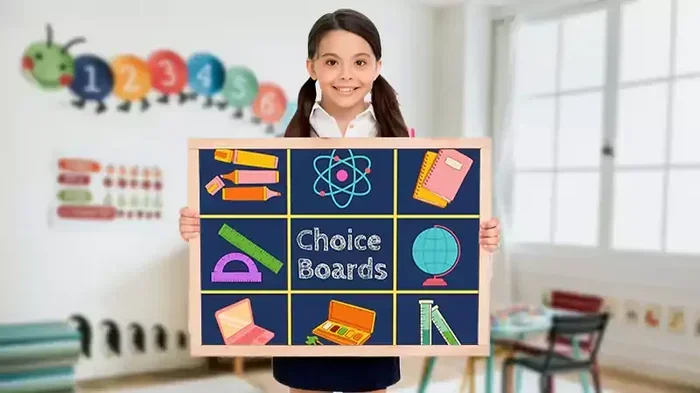
Choice boards in education are flexible learning grids that let students pick how they explore a topic. They empower learners by offering multiple paths to the same goal. Teachers use them to support different learning styles and increase student engagement. This guide covers everything from basics to practical tips you can use today.
Key Takeaways
- What they are: Choice boards are structured activity grids that give students options in how they learn and show understanding.
- Why they matter: They boost motivation, respect individual learning preferences, and support differentiated instruction.
- How to build one: Start with a simple 3×3 grid, mix activity types, and align tasks to learning goals.
- Best practices: Include a mix of difficulty levels, offer student voice, and revisit the board regularly.
- Who benefits: Students of all ages and grade levels gain from choice boards, from elementary to high school.
- Common pitfalls: Avoid overwhelming students with too many options or misaligned activities.
📑 Table of Contents
What Are Choice Boards in Education?
Imagine walking into a classroom where every student is deeply engaged. Some are drawing mind maps. Others are writing short essays. A few are recording videos or building models. And every single one is working on the same core lesson. That is the magic of choice boards in education.
A choice board is a structured grid of activities. It gives students the freedom to choose how they learn a concept or demonstrate their understanding. Think of it like a learning menu. Each cell on the grid offers a different path to the same learning goal. Teachers design these boards around a specific topic or skill.
Choice boards are not just a fun classroom trick. They are backed by solid teaching principles. They tap into differentiated instruction, which means tailoring learning to meet each student where they are. They also honor student choice, which research shows increases motivation and ownership of learning.
If you have heard terms like learning menus, activity grids, or learning playlists, those are close cousins of choice boards. They all share the same core idea. Give students options. Let them learn in ways that fit them best. The result is deeper engagement and better outcomes.
Why Choice Boards Work
The science behind choice boards is straightforward. When students have a say in their learning, they feel more in control. That sense of control fuels intrinsic motivation. Instead of doing tasks because they have to, students do them because they want to.
Choice boards also respect learning preferences. Some students love writing. Others prefer speaking or creating visuals. Some work best alone. Others thrive in pairs or small groups. A well-designed board offers something for every type of learner. It turns a one-size-fits-all lesson into a flexible, student-centered learning experience.
Another reason choice boards work is they reduce student anxiety. When students feel stuck or overwhelmed, they shut down. Choice boards give them a safe starting point. They can pick an activity that matches their comfort level and grow from there. This builds confidence over time.
How Choice Boards Support Differentiated Instruction
Differentiated instruction is a teaching approach that adjusts content, process, and product to meet diverse learner needs. Choice boards are one of the most practical tools for differentiation. They let teachers offer the same core content while giving students different ways to interact with it.
Here is how choice boards support differentiation in real classrooms:
- Content: Some board activities might involve reading a text, while others use videos or hands-on experiments.
- Process: Students might analyze a topic through writing, drawing, discussing, or building.
- Product: The board can include options for essays, presentations, posters, digital slides, or even skits.
When you use choice boards in education, you are not lowering the bar. You are widening the door. Every student works toward the same learning target. They just get there in their own way. This approach is especially powerful for mixed-ability classrooms where students are at different levels.
For example, a choice board for a science lesson on ecosystems might include these options:
- Write a short report about a specific ecosystem.
- Create a diorama showing the food web.
- Record a podcast episode explaining the food chain.
- Design an infographic with key facts and visuals.
- Act out a skit showing how energy flows through an ecosystem.
Each activity hits the same learning goal. But each one appeals to a different set of skills and interests. That is the beauty of personalized learning through choice boards.
Key Benefits of Using Choice Boards
Choice boards in education offer a wide range of benefits for both teachers and students. Let us look at the biggest advantages.
Boosts Student Engagement
When students get to choose, they care more. Engagement goes up because the work feels relevant and personal. Instead of a passive worksheet, students are actively making decisions. That shift from passive to active learning is huge. It transforms the classroom dynamic.
Builds Independent Learning Skills
Choice boards teach students how to manage their own learning. They must read the options, make a decision, and follow through. Over time, this builds self-regulation and executive functioning skills. These are life skills that go far beyond one lesson.
Encourages Creativity
When students have options, they think outside the box. A student who struggles with writing might shine when creating a visual project. Choice boards unlock strengths that traditional assignments often miss. They celebrate different kinds of intelligence.
Saves Teacher Planning Time
Once you build a choice board, you can reuse it across multiple topics and units. You can also share boards with colleagues. The initial effort pays off over time. Many teachers find that designing a quality choice board actually streamlines their planning process.
Supports Formative Assessment
As students work through their chosen activities, teachers can check for understanding in real time. Choice boards give you a window into how each student thinks. You can spot misconceptions early and adjust your instruction. This makes formative assessment feel natural, not forced.
How to Create Effective Choice Boards
Building a choice board does not have to be complicated. Start simple and grow from there. Here is a step-by-step guide to get you started.
Step 1: Define Your Learning Goal
Before you design anything, be clear on what you want students to learn. Write down the specific learning objective. Every activity on the board should connect to that goal. If an activity does not serve the objective, remove it.
Step 2: Choose Your Grid Format
The most common format is a 3×3 grid with nine activities. But you can also try 2×2 grids for younger students or 4×4 grids for advanced learners. The key is to offer enough variety without overwhelming students. Keep the number of options manageable.
Step 3: Mix Activity Types
A strong board includes a range of activity types. Aim for a balance across these categories:
- Writing tasks: essays, journal entries, short answers
- Creative tasks: drawings, posters, songs, videos
- Speaking tasks: presentations, interviews, podcasts
- Hands-on tasks: models, experiments, building projects
- Thinking tasks: concept maps, Venn diagrams, reflections
This variety ensures that every student finds at least one option that fits their strengths. It also keeps the board fresh and interesting.
Step 4: Include a Challenge Option
Consider adding a “bonus” or challenge activity for students who want to go deeper. This could be a research extension or a cross-curricular connection. Challenge options push advanced learners without pressuring others.
Step 5: Share Clear Expectations
Every activity on the board needs a clear description. Students should know exactly what to do and how it will be assessed. Use simple language and, if possible, provide examples. When expectations are crystal clear, students stay on track and feel confident.
Step 6: Allow Student Voice and Choice
Let students choose how many activities to complete and which ones. Some teachers require a “tic-tac-toe” line (three in a row). Others let students pick any three or four activities. The more choice you can offer, the more ownership students feel.
One great way to add even more student voice is to let them suggest activities for future boards. This turns the choice board into a collaborative tool. Students feel valued and invested in the process.
Choice Board Examples Across Grade Levels
Choice boards in education work for all ages. The design changes, but the core idea stays the same. Here are quick examples for different grade levels.
| Grade Level | Topic Example | Sample Activities |
|---|---|---|
| Elementary (K-2) | Animal Habitats | Draw a habitat, sing a song about animals, build a model with blocks |
| Upper Elementary (3-5) | Math Fractions | Solve fraction problems, create a fraction poster, teach a partner |
| Middle School (6-8) | History: Ancient Egypt | Write a diary entry, design a pyramid model, make a digital slideshow |
| High School (9-12) | English: Literary Analysis | Write an essay, record a book review podcast, create a visual essay |
As you can see, the activities scale up in complexity as students grow older. Younger students need more visual and hands-on options. Older students benefit from tasks that involve critical thinking and higher-order skills. You can use Bloom’s taxonomy as a guide when designing activities for different levels.
Common Mistakes to Avoid
Even well-designed choice boards can fall flat if you avoid these common pitfalls.
Too Many Options
More is not always better. If a board has 16 or 20 activities, students may feel paralyzed. They might spend more time choosing than doing. Stick to 9 or fewer options for best results. Keep the choices focused and meaningful.
Activities Not Aligned to Learning Goals
Every activity must connect to the learning objective. A fun task that does not serve the goal is just busy work. Before adding an activity to the board, ask yourself: “Does this help students reach the learning target?” If the answer is no, cut it.
Ignoring Student Readiness
Not all students are ready for the same level of challenge. A choice board should offer activities at different difficulty levels. This is where scaffolding comes in. Some tasks should be more accessible, while others push students to think harder.
Forgetting to Model the Activities
Students need to see what a finished product looks like. If you ask them to create a podcast but have never modeled one, they will struggle. Take time to walk through examples. This sets them up for success.
Overlooking Assessment
You need a clear way to assess each activity on the board. Use a simple rubric that works across all options. This keeps grading fair and consistent. It also helps students understand what quality looks like for each task type.
Expert Insights on Choice Boards
Many experienced educators swear by choice boards as a go-to teaching strategy. Here are some insights from the field.
Start small. You do not need a perfect board on day one. Try a simple 3×3 grid with one topic. See how your students respond. Then refine and expand from there. Choice boards in education are a journey, not a destination.
Use them regularly. The more you use choice boards, the more natural they become. Try incorporating them once a week or once a unit. Over time, students will look forward to the options and take more ownership of their learning.
Connect choice boards to other teaching tools. For example, you can pair a choice board with graphic organizers to help students plan their work. You can also use them alongside formative assessment strategies to check understanding as students work. The more tools you combine, the stronger your instruction becomes.
Keep the language simple and inviting. Use clear headings, friendly wording, and visual cues. A board that looks approachable will draw students in. A cluttered, confusing board will push them away. Think about how you would want to see the board as a student yourself.
One powerful idea is to let students create their own choice boards. This is a fantastic summative assessment activity. Students design a board for a topic they have mastered, then let classmates choose from their options. It reinforces their understanding and builds creativity at the same time.
Final Thoughts
Choice boards in education are more than just a teaching tool. They are a mindset. They say to every student: “Your voice matters. Your way of learning matters. We will find a path that works for you.” That message can change a classroom.
When you give students choices, you give them agency. You turn passive learners into active participants. You honor their individuality while still covering essential content. The result is a classroom that feels alive with purpose and engagement.
If you are new to choice boards, start this week. Pick a topic you are teaching soon. Build a simple 3×3 grid with three activity types. Try it out and see the difference. You will be amazed at how much students grow when they feel ownership of their learning. Choice boards in education are a small shift with a big impact.
And remember, you can always refine your boards over time. Add new activities. Remove ones that do not work. Let your students shape the process. The best choice boards evolve with the learners they serve.
For more ways to enrich your teaching with language and expression, check out resources on idioms for education, similes for education, and metaphors for education to bring creative language into your classroom.
Frequently Asked Questions
What is a choice board in education?
A choice board is a grid of learning activities that gives students options for how they learn or show what they know. Each cell offers a different task, but all tasks connect to the same learning goal. Teachers use choice boards to support differentiated instruction and boost student engagement.
How do choice boards support different learning styles?
Choice boards include a mix of activity types, such as writing, drawing, speaking, and hands-on tasks. This variety lets students pick activities that match their strengths. It honors learning preferences and makes learning more accessible for everyone.
Can choice boards be used for online learning?
Absolutely. Choice boards work great in virtual and hybrid classrooms. Teachers can create digital boards using tools like Google Slides or Padlet. Students can complete activities independently and submit their work online. Choice boards in education are flexible by design.
How many activities should be on a choice board?
Most teachers use a 3×3 grid with nine activities. This is enough to offer variety without overwhelming students. For younger learners, a 2×2 grid with four options works well. The key is quality over quantity.
Do choice boards take a lot of time to create?
Not as much as you might think. A basic board can be put together in under an hour. Once you have a template, you can reuse and adapt it for new topics. Over time, building boards becomes faster and more natural.
Are choice boards suitable for all grade levels?
Yes. Choice boards work for elementary, middle school, and high school students. The activities change to match the age and skill level, but the core idea stays the same. Giving students choice benefits learners at every stage.
=== CONCLUSION ===
Choice boards in education are a simple yet powerful way to put students at the center of their learning. They support differentiated instruction, build independent learning skills, and create a classroom where every voice is valued. Whether you are a new teacher or a seasoned educator, choice boards can transform how your students experience learning. Start small, stay flexible, and watch your students thrive.


