
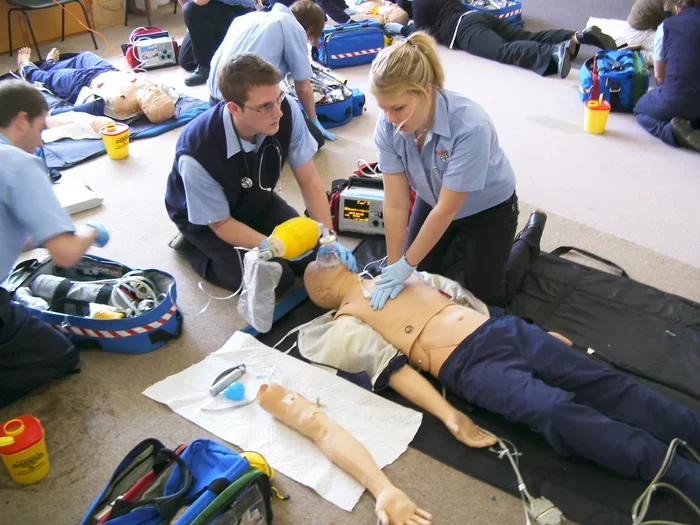
Becoming an EMT requires completing a state-approved training program, passing the NREMT exam, and earning your certification. The education pathway includes classroom learning, hands-on clinical rotations, and ongoing continuing education to keep your skills sharp. This guide walks you through every step of the EMT education journey.
Key Takeaways
- EMT education starts with a high school diploma or GED: You need a solid foundation before entering a training program.
- EMT training programs range from 120 to 150+ hours: These cover classroom instruction and hands-on clinical experience.
- You must pass the NREMT exam: This national test validates your knowledge and skills as an emergency medical technician.
- State certification is mandatory: Each state has its own requirements beyond the national exam.
- Continuing education keeps you current: EMTs must complete ongoing training to maintain their certification.
- Career advancement is possible: You can move from EMT-Basic to EMT-Intermediate or Paramedic with additional education.
📑 Table of Contents
- What Education Is Required to Be an EMT Professional
- Understanding the EMT Role and Why Education Matters
- Basic Education Prerequisites for EMT Training
- EMT Training Programs: What to Expect
- The NREMT Exam: Your Gateway to Certification
- State Certification and Licensure
- Continuing Education and Career Advancement
- Common Mistakes to Avoid During EMT Education
- Expert Tips for Succeeding in EMT Education
- Final Thoughts on EMT Education
What Education Is Required to Be an EMT Professional
Emergency medical technicians save lives every single day. They are often the first healthcare professionals on the scene of a car accident, a heart attack, or a natural disaster. But before anyone can strap on those boots and jump into an ambulance, they need the right education. If you have ever wondered what education is required to be an EMT, you are in the right place.
The path to becoming an EMT professional is not as long as medical school. It is shorter, more focused, and deeply practical. You will learn how to assess patients, perform CPR, control bleeding, and handle emergency situations with confidence. This article breaks down every step of the EMT education requirements in a way that is easy to follow and full of useful details.
Think of it this way. Learning to be an EMT is like building a house. You need a strong foundation first. That foundation is your basic education and prerequisite courses. Then you add the walls, which are your training programs and clinical hours. Finally, you put on the roof, which is your certification and ongoing education. Let us walk through each layer together.
Understanding the EMT Role and Why Education Matters
An emergency medical technician provides immediate care to sick or injured people. They work on ambulances, in hospitals, and at accident scenes. The job demands quick thinking, physical stamina, and a calm demeanor under pressure.
Why does education matter so much in this field? Because the decisions you make in the first few minutes of an emergency can mean the difference between life and death. Proper EMT training programs teach you the knowledge and skills you need to act fast and act correctly. Without education, you simply cannot provide the level of care that patients deserve.
Education also opens doors. Many employers prefer or require certified EMTs. And if you want to grow your career later, having a solid educational background makes the jump to paramedic training much easier.
The Core Responsibilities of an EMT
EMTs handle a wide range of duties. Here are some of the most common tasks you will perform after completing your education:
- Assessing a patient’s condition on arrival
- Performing cardiopulmonary resuscitation (CPR)
- Controlling severe bleeding and treating wounds
- Administering oxygen and basic medications
- Transporting patients to hospitals safely
- Communicating with doctors and hospital staff
- Documenting patient care and incident details
Each of these responsibilities requires training. You cannot learn them on the job alone. That is why structured healthcare education is so important.
Basic Education Prerequisites for EMT Training
Before you can enroll in an EMT training program, you need to meet some basic requirements. These prerequisites ensure that you have the foundational knowledge to succeed in a demanding course of study.
High School Diploma or GED
The most fundamental requirement is a high school diploma or GED. You do not need to be a straight-A student. But you should have a working knowledge of science, math, and English. These subjects form the backbone of EMT coursework.
If you are still in high school and thinking about this career, focus on biology, anatomy, and health sciences. These classes will give you a head start. Many community colleges and technical schools also offer introductory health courses for high school students.
Age and Physical Requirements
Most programs require you to be at least 18 years old by the time you complete training. You also need to be physically fit. The job involves lifting heavy equipment, kneeling, bending, and sometimes carrying patients. A clean background check and current CPR certification are usually required as well.
Reading and Communication Skills
EMTs read medical charts, write detailed reports, and communicate with patients under stress. Strong reading and communication skills are essential. If English is not your first language, consider brushing up on medical terminology before starting your program.
Some people find that learning common idioms for education helps them feel more comfortable in academic settings. Understanding phrases like “stay on track” or “get the hang of it” can make classroom learning feel less intimidating.
EMT Training Programs: What to Expect
Once you meet the prerequisites, the next step is enrolling in an accredited EMT training program. These programs are offered at community colleges, technical schools, and private training centers. Most programs take between three and six months to complete.
Classroom Instruction
The classroom portion covers essential medical knowledge. You will study topics like:
- Human anatomy and physiology
- Basic life support techniques
- Emergency assessment and triage
- Medical terminology and patient communication
- Legal and ethical responsibilities of an EMT
Instructors often use metaphors for education to make complex topics easier to understand. For example, they might compare the human circulatory system to a plumbing network. These teaching methods help you grasp difficult concepts quickly and remember them longer.
Hands-On Clinical Training
Classroom learning is only half the equation. The other half is hands-on experience. Most programs require you to complete clinical rotations in hospitals or on ambulances. During these rotations, you will:
- Work alongside experienced paramedics and nurses
- Practice taking vital signs on real patients
- Assist with patient assessments and treatments
- Gain confidence in high-pressure situations
Clinical hours are invaluable. They give you a taste of what the job is really like. You will make mistakes, learn from them, and grow as a professional. This is where EMT basic course knowledge turns into real-world skill.
Comparing EMT Training Program Types
| Program Type | Duration | Cost Range | Best For |
|---|---|---|---|
| Community College Certificate | 3-6 months | $1,000 – $3,000 | Budget-conscious students |
| Technical School Program | 3-4 months | $1,500 – $4,000 | Fast-track learners |
| Hospital-Based Training | 4-6 months | Varies | Hands-on learners |
| Fire Academy EMT Program | 6-12 months | $2,000 – $5,000 | Aspiring firefighter-EMTs |
Choose a program that fits your schedule, budget, and learning style. Accreditation is key. Make sure the program is approved by your state’s emergency medical services authority.
The NREMT Exam: Your Gateway to Certification
After completing your training, you must pass the National Registry of Emergency Medical Technicians (NREMT) exam. This is the national standard for EMT certification. Without passing this exam, you cannot work as a certified EMT in most states.
What the NREMT Exam Covers
The exam has two parts. The first is a cognitive test. It is a computer-based exam that covers topics like patient assessment, trauma care, cardiology, and emergency operations. The second part is a psychomotor exam. This is a hands-on test where you demonstrate your skills on a real or simulated patient.
Prepare for the exam by reviewing your training materials. Take practice tests. Join study groups. Many training programs offer review courses specifically designed to help you pass. Think of studying for the NREMT like using similes for education to compare and connect ideas. When you compare how a heart attack presents to a simple analogy, the knowledge sticks.
Pass Rates and Retake Policies
The NREMT exam is challenging but not impossible. First-time pass rates hover around 70%. If you do not pass the first time, you can retake the exam after a waiting period. Use that time to study the areas where you struggled. Most states allow up to three retakes within a specific timeframe.
State Certification and Licensure
Passing the NREMT exam is a huge step, but it is not the final one. Each state has its own state certification requirements. Some states require additional exams, background checks, or state-specific coursework.
For example, California has its own Emergency Medical Services Authority. New York requires EMTs to apply through the Department of Health. You need to check with your state’s licensing board to understand the full process.
Staying organized during this phase is critical. Keep copies of your NREMT results, training certificates, and background check documents. Having everything ready will make the application process smooth and stress-free.
Continuing Education and Career Advancement
Your education does not end when you earn your EMT certification. EMT continuing education is required to keep your credentials active. Most states require between 20 and 60 hours of continuing education every two years.
Why Continuing Education Matters
Medical knowledge evolves constantly. New techniques, medications, and protocols emerge all the time. Continuing education ensures that you stay current and provide the best possible care. It also keeps your skills sharp and your confidence high.
Moving Up the Career Ladder
If you want to advance your career, there are clear paths forward. Many EMTs choose to pursue advanced EMT or paramedic certification. These roles require additional education, often an associate’s or bachelor’s degree in emergency medical services.
Paramedics can administer more advanced treatments, including intravenous medications and cardiac monitoring. The education pathway is longer, but the rewards are significant. Both in terms of salary and professional satisfaction.
Here is a simple look at the career progression:
- EMT-Basic: The entry-level position. 120-150 hours of training.
- EMT-Intermediate: Additional training in advanced procedures. 200-400 hours total.
- Paramedic: The most advanced prehospital provider. 1,200-1,800 hours of training.
Each step builds on the last. Your foundation in EMT education requirements makes the next level achievable and exciting.
Common Mistakes to Avoid During EMT Education
Many aspiring EMTs make avoidable mistakes during their education journey. Here are a few to watch out for:
- Skipping prerequisite courses: Do not assume you can skip the basics. Every topic in your training program builds on earlier knowledge.
- Choosing an unaccredited program: Always verify that your program is state-approved. An unaccredited program may not qualify you for the NREMT exam.
- Neglecting clinical hours: Some students focus only on classroom work and ignore hands-on training. Both are equally important.
- Underestimating the NREMT exam: Do not walk into the exam unprepared. Dedicated study time is non-negotiable.
- Forgetting to renew certification: Letting your certification lapse can cost you your job. Set reminders and stay on top of renewal deadlines.
Expert Tips for Succeeding in EMT Education
We asked experienced EMT instructors for their best advice. Here is what they had to say:
- Study a little every day: Cramming does not work in medical training. Consistent, daily study is far more effective.
- Practice your skills whenever possible: Repetition builds muscle memory. Practice CPR, bandaging, and patient assessment until they feel natural.
- Ask questions in class: No question is too simple. Your instructors want you to succeed.
- Build relationships with clinical mentors: The nurses and paramedics you work with during rotations can become valuable professional connections.
- Stay curious about the science behind the skills: Understanding why a treatment works helps you apply it more confidently in the field.
Remember, your education is your greatest asset. The time and effort you invest now will pay off every day of your career as an emergency medical technician.
Final Thoughts on EMT Education
The journey to becoming an EMT is challenging, rewarding, and deeply meaningful. From meeting your basic education prerequisites to passing the NREMT exam and earning your state certification, every step brings you closer to a career where you truly make a difference.
Your EMT education requirements are designed to prepare you for real-world emergencies. The classroom teaches you the theory. The clinical rotations give you hands-on experience. And the certification process validates your competence.
If you are ready to start this journey, take the first step today. Research accredited training programs in your area. Talk to working EMTs. And commit to learning every single day. The world needs more skilled, compassionate emergency responders. And that person could be you.
Education is the bridge between wanting to help and actually being able to help. Invest in yours, and you will find that the rewards go far beyond a job title.
Frequently Asked Questions
What is the minimum education needed to become an EMT?
You need a high school diploma or GED to enroll in an EMT training program. Beyond that, you must complete a state-approved EMT course that includes both classroom instruction and hands-on clinical hours.
How long does EMT education take to complete?
Most EMT training programs take between three and six months. The exact duration depends on the program type, your schedule, and whether you attend full-time or part-time.
Do I need a college degree to be an EMT?
No, a college degree is not required for entry-level EMT positions. However, if you want to advance to paramedic or pursue management roles, additional education at the college level may be beneficial.
What is the NREMT exam and why is it important?
The NREMT exam is the national certification test for EMTs. It includes both a cognitive (written) and psychomotor (hands-on) component. Passing this exam is required to earn your EMT certification in most states.
Can I work as an EMT while still in training?
No, you cannot work as a certified EMT until you have completed your training program and passed the NREMT exam. However, some programs allow you to volunteer or observe in clinical settings before certification.
How much does EMT education cost?
The cost varies widely depending on the program. Community college programs typically range from $1,000 to $3,000. Technical schools and private training centers may cost between $1,500 and $5,000. Financial aid and scholarships are often available.
=== CONCLUSION ===
Understanding what education is required to be an EMT professional is the first step toward a fulfilling career in emergency medical services. The path involves completing a state-approved training program, passing the NREMT exam, earning your state certification, and committing to lifelong learning through continuing education.
It is a journey that demands dedication, but the rewards are immense. You gain the skills to save lives, the confidence to handle emergencies, and the satisfaction of serving your community every single day. Start your education today, and you will be on your way to becoming the EMT professional you aspire to be.


