
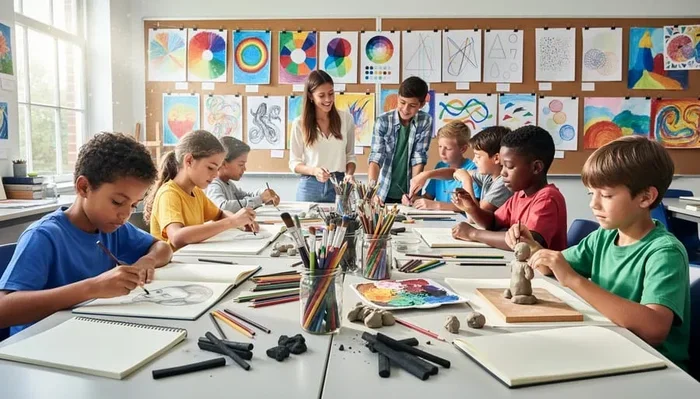
The A in STEAM education stands for Arts, adding creativity and human expression to the traditional STEM framework. STEAM education blends science, technology, engineering, math, and the arts to prepare students for real-world challenges. This approach fosters critical thinking, innovation, and holistic learning in ways that standard STEM alone cannot achieve.
Have you ever wondered what makes some learning experiences stick with students long after the class ends? The answer often comes down to one simple ingredient: creativity. That is exactly what the A in STEAM education brings to the table. STEAM stands for Science, Technology, Engineering, Arts, and Mathematics. But the “A” is not just an afterthought. It is the spark that turns dry equations into exciting discoveries.
In recent years, educators and parents have realized that technical skills alone are not enough. Students need to think creatively, communicate ideas clearly, and approach problems from every angle. That is where STEAM education shines. It combines the rigor of STEM subjects with the expressive power of the arts. The result is a learning approach that feels more human, more engaging, and more effective.
This article breaks down exactly what the A means, why it matters, and how schools and families can bring STEAM learning to life. Whether you are a teacher looking for fresh ideas or a curious learner, you will find plenty of practical insights here.
Key Takeaways
- The A stands for Arts: It represents the creative and expressive side of learning that complements technical subjects.
- STEAM education boosts engagement: Students stay more motivated when creativity and hands-on projects are part of the curriculum.
- It builds real-world skills: Arts integration teaches problem-solving, communication, and collaboration alongside technical knowledge.
- Schools worldwide are adopting it: More educators recognize that creativity drives innovation in every field.
- It closes learning gaps: STEAM reaches students who struggle with traditional math and science instruction by offering creative entry points.
- Career readiness improves: Employers value graduates who can think creatively and communicate ideas effectively.
- You can start small: Teachers and parents can integrate arts into any lesson without a full curriculum overhaul.
📑 Table of Contents
- What Does the A Stand For in STEAM Education?
- How STEAM Education Works in Practice
- Why the A in STEAM Education Matters So Much
- How Teachers and Parents Can Bring STEAM Into Learning
- What the Research Says About STEAM Education
- Challenges of Implementing STEAM Education
- The Future of STEAM Education
- Conclusion
What Does the A Stand For in STEAM Education?
The A in STEAM stands for Arts. This includes visual arts, music, theater, dance, design, and any form of creative expression. When schools add arts to the STEM framework, they create a more balanced approach to learning. Students are not just solving problems with numbers and formulas. They are also exploring ideas through color, sound, movement, and storytelling.
Think about it this way. A scientist who understands design can present findings more clearly. An engineer who appreciates music might build more intuitive user interfaces. An artist who grasps mathematics can create stunning digital artwork. The arts give students a different lens through which to understand technical concepts.
Why Arts Belong in STEM
Some people ask why arts need to be part of STEM at all. The truth is that innovation happens at the intersection of disciplines. Some of the most groundbreaking ideas in history came from people who crossed boundaries between creative and technical fields. Leonardo da Vinci was both an artist and a scientist. Modern tech companies hire designers to make products that are not only functional but also beautiful and intuitive.
Adding arts to the mix helps students develop divergent thinking. This is the ability to generate multiple solutions to a single problem. It is a skill that employers desperately need but that traditional testing often fails to measure. When students draw, paint, sculpt, or perform, they practice thinking outside the box every single day.
How STEAM Education Works in Practice
STEAM education is not just about adding art class to the schedule. It is about integrating creative thinking into every subject. A well-designed STEAM lesson might have students build a bridge out of recycled materials while also studying the aesthetics of architectural design. Or it might ask them to create a short film explaining a scientific concept.
Here are some real-world examples of how arts integration looks in classrooms:
- Math and Visual Art: Students explore geometry by creating tessellation artwork inspired by M.C. Escher. They learn about shapes and patterns while expressing themselves creatively.
- Science and Music: Students study sound waves by building their own instruments. They learn about vibration and frequency while making something they can actually play.
- Engineering and Theater: Students design and build stage sets, learning about structural integrity and material properties in the process.
- Technology and Design: Students use coding to create digital animations, blending programming skills with artistic storytelling.
The beauty of this approach is that it meets students where they are. Not every child thrives with textbooks and lectures. But almost every child responds to creativity. STEAM education opens doors for learners who might otherwise feel left behind.
Comparing STEM vs STEAM
To understand the value of the A, it helps to compare STEM and STEAM side by side. Both approaches teach important skills, but they differ in focus and outcomes.
- STEM focuses on technical proficiency, analytical thinking, and quantitative reasoning.
- STEAM adds creative expression, emotional intelligence, and aesthetic awareness to the mix.
Neither approach is wrong. But research shows that students who learn through STEAM methods tend to be more adaptable, more collaborative, and more confident in their ability to tackle unfamiliar challenges. The arts give students a safe space to experiment and fail, which is one of the most powerful lessons in any classroom.
Why the A in STEAM Education Matters So Much
The arts are not just a nice addition to education. They are a critical component that prepares students for the complexities of modern life. Here is why the A makes such a big difference.
It Develops Whole-Brain Thinking
Traditional STEM education tends to engage the left side of the brain, which handles logic and analysis. The arts activate the right side, which handles spatial reasoning, imagination, and intuition. When students engage both sides, they develop stronger neural connections and more flexible thinking patterns. This whole-brain approach leads to deeper understanding and better retention.
It Improves Student Motivation
Let us be honest. Not every student wakes up excited about algebra or chemistry. But many students light up when they get to draw, paint, sing, or act. Arts integration taps into that natural enthusiasm and uses it as a gateway to harder subjects. When students feel connected to what they are learning, they put in more effort and achieve better results.
It Builds Communication Skills
In the real world, being able to solve problems is only half the battle. You also need to explain your ideas clearly to others. The arts teach students how to express themselves through different mediums. A student who can present a science project through a compelling story or a striking visual will always stand out. These communication skills are invaluable in every career path.
It Encourages Risk-Taking and Resilience
Creating art is inherently uncertain. You do not know if a painting will turn out the way you envisioned it. A performance might not go as planned. But through these experiences, students learn that failure is part of the creative process. They develop resilience and a growth mindset. These qualities are essential for success in any field, especially technology and engineering where experimentation is constant.
How Teachers and Parents Can Bring STEAM Into Learning
You do not need a fancy lab or a big budget to bring STEAM education into a child’s life. Small, consistent efforts can make a huge impact. Here are some practical ways to get started.
For Teachers
- Start with cross-curricular projects. Combine a science lesson with a drawing activity. Ask students to illustrate the water cycle or design a poster about ecosystems.
- Use storytelling to explain concepts. Instead of just listing facts, create a narrative around a scientific discovery. Let students imagine they are the scientists making the breakthrough.
- Encourage open-ended questions. Ask “What if?” and “How might we?” instead of always seeking a single correct answer. This opens the door to creative problem-solving.
- Collaborate with arts teachers. Team up with the music, art, or drama teacher to co-plan lessons. The results are often more engaging than either subject alone.
For Parents
- Provide creative materials at home. Keep crayons, clay, building blocks, and simple craft supplies accessible. Let children explore without strict instructions.
- Visit museums and science centers together. These places naturally blend arts and sciences in fun and inspiring ways.
- Encourage questions and curiosity. When your child asks “why,” take it seriously. Explore the answer together through books, experiments, or art projects.
- Celebrate the process, not just the product. Praise effort, creativity, and persistence rather than just the final result.
Remember, you do not need to be an expert in every subject. The goal is to create an environment where curiosity and creativity are valued just as much as getting the right answer.
Quick Tips for Integrating Arts Into Any Lesson
- Ask students to draw a diagram instead of just writing about it.
- Let students create a song or rap to memorize key facts.
- Use colored markers and visual organizers to map out ideas.
- Encourage students to act out historical events or scientific processes.
- Have students design a logo or poster for a topic they are studying.
These small shifts can transform a boring lesson into something memorable. And once students experience the joy of creative learning, they start to see education as something exciting rather than something to endure.
What the Research Says About STEAM Education
There is growing evidence that STEAM approaches lead to better learning outcomes. Studies show that students who participate in arts-integrated programs score higher on standardized tests, show improved attendance, and demonstrate stronger problem-solving abilities. The arts help students connect emotionally with the material, which deepens understanding.
Research also highlights that creative education prepares students for the modern workforce. Today’s employers look for people who can think critically, communicate well, and adapt quickly. These are exactly the skills that STEAM education develops. Students who graduate with both technical knowledge and creative confidence are ready to thrive in almost any career.
Some studies even suggest that exposure to the arts can improve mental health and reduce stress in students. Learning to express emotions through art, music, or writing gives young people healthy outlets for processing their experiences. This holistic benefit is one of the most overlooked advantages of STEAM education.
Language plays a powerful role in learning too. When students explore similes for education or use creative language to describe what they are learning, they build stronger connections between ideas. Similarly, understanding metaphors for education helps students think abstractly and make meaningful associations. And exploring idioms for education enriches their vocabulary and cultural understanding, all of which support deeper engagement with STEAM subjects.
Challenges of Implementing STEAM Education
Of course, bringing STEAM into schools is not without its hurdles. Budget constraints, lack of training, and rigid curricula can all get in the way. Some schools struggle to find time for arts integration when they are already racing to cover required standards.
But these challenges are not insurmountable. Many successful STEAM programs started small, with a single teacher who was passionate about blending subjects. Community partnerships with local artists, museums, and tech companies can provide resources and expertise without breaking the bank. And the growing body of research on STEAM education is helping policymakers understand why this investment matters.
The key is to start where you are. You do not need a perfect program. You just need a willingness to try something new and see what sparks your students’ curiosity.
The Future of STEAM Education
As the world becomes more complex and interconnected, the need for creative, interdisciplinary thinkers will only grow. Artificial intelligence, climate change, and global health challenges all demand solutions that come from diverse perspectives. STEAM education prepares the next generation to meet these challenges with confidence and imagination.
We are likely to see more schools adopt STEAM frameworks in the coming years. Technology will continue to evolve, and the arts will evolve with it. Virtual reality, digital art, and interactive media are already opening up new possibilities for creative learning. The future of education is not just about knowing facts. It is about knowing how to use those facts in meaningful, creative ways.
The A in STEAM reminds us that education is not just about training workers. It is about developing whole human beings who can think, feel, create, and contribute. That is a vision worth fighting for.
Conclusion
The A in STEAM education stands for Arts, and it represents one of the most important shifts in modern teaching. By blending creativity with technical learning, STEAM prepares students not just for tests but for life. It builds critical thinking, communication skills, resilience, and a genuine love of learning.
Whether you are a teacher, a parent, or simply someone who cares about education, you have a role to play. Start small. Add a creative element to your next lesson or project. Encourage a child to explore, imagine, and express themselves. These small steps add up to big changes. STEAM education works because it honors the whole learner. And that is something worth celebrating.
Frequently Asked Questions
What does the A stand for in STEAM education?
The A stands for Arts. It represents the creative and expressive disciplines, including visual arts, music, theater, dance, and design, that are integrated with traditional STEM subjects.
Why is arts education important in a STEM curriculum?
Arts education develops creativity, communication, and critical thinking skills that complement technical knowledge. It helps students approach problems from multiple angles and prepares them for real-world challenges where innovation matters.
How is STEAM different from STEM?
STEM focuses on science, technology, engineering, and math. STEAM adds the arts to create a more holistic learning experience that values creative expression alongside analytical thinking.
Can STEAM education be implemented on a small budget?
Yes, absolutely. Simple changes like adding drawing to a science lesson or using storytelling to explain a concept cost nothing. Many successful STEAM programs started with minimal resources and grew over time.
What age group benefits most from STEAM education?
Students of all ages benefit from STEAM education. Younger children especially thrive with hands-on, creative activities, but older students also gain valuable skills in interdisciplinary thinking and problem-solving.
How can parents support STEAM learning at home?
Parents can provide creative materials, visit museums and science centers together, encourage questions and curiosity, and celebrate effort and creativity. Even simple activities like building with blocks or cooking together involve STEAM thinking.


