
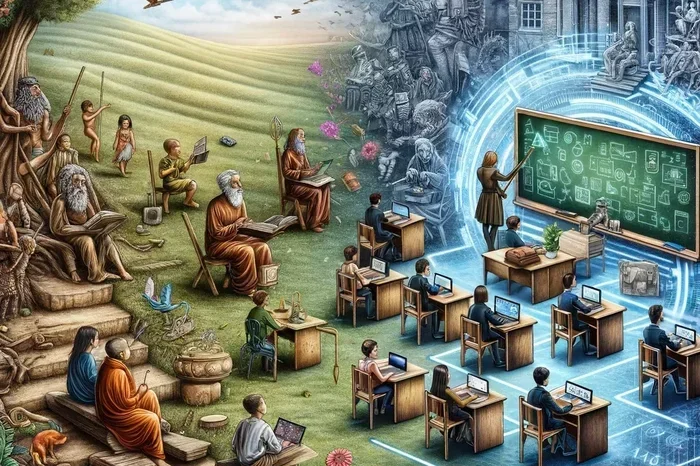
Who created education? The answer stretches back thousands of years to ancient civilizations. Early scholars, philosophers, and rulers built the first learning systems that shaped how we teach and learn today. This article explores the origins of formal education and how education creation changed the world forever.
Have you ever wondered who created education? It is a question that takes us on a journey through thousands of years of human history. From ancient temples to modern classrooms, the story of how people learned is truly fascinating.
Education did not just appear one day. It grew slowly over centuries. Early humans passed knowledge through stories and hands-on training. Then, great thinkers built formal systems to teach reading, writing, math, and philosophy. Today, we benefit from the hard work of countless educators and rulers who believed learning should be available to everyone.
In this article, we will explore the origins of education. We will look at ancient civilizations, famous educators, and how schooling changed the world. You will learn about the people and ideas that shaped the way we learn today. Whether you are a student, a teacher, or just curious, this guide has something valuable for you.
Key Takeaways
- Ancient civilizations like Greece, China, and India laid the foundation for formal education systems we use today.
- Plato and Aristotle were among the first to create structured learning environments in the Western world.
- Confucius shaped education in East Asia and his teaching methods still influence classrooms around the globe.
- The Industrial Revolution transformed education from elite privilege to a public right for all children.
- Modern education continues to evolve with technology, online learning, and new teaching methods.
- The way we describe learning through figurative language like similes for education, metaphors for education, and idioms for education reflects how deeply learning is woven into our culture.
- Understanding who created education helps us appreciate the systems we rely on every day.
📑 Table of Contents
- The Ancient Roots of Education
- Who Created Education in Different Civilizations
- How Education Spread Across the World
- The Evolution of Modern Schooling
- Education’s Impact on Society and Culture
- Common Mistakes People Make When Learning About Education History
- Quick Tips for Understanding Education History
- Expert Insights on the History of Education
- Conclusion
The Ancient Roots of Education
The story of education begins in the ancient world. Long before schools existed, people needed to pass skills and knowledge to the next generation. Early education was informal. Parents taught children how to hunt, farm, cook, and survive. This was the first form of knowledge transmission in human history.
As societies grew more complex, so did the need for structured learning. Writing systems emerged around 3500 BCE in Mesopotamia. With writing came the need for scribes. Scribes were the first formal learners. They spent years mastering hieroglyphics and cuneiform. Their training was the earliest example of formal schooling.
Education in Ancient Egypt
Ancient Egypt is one of the first places where we see organized education. The scribal schools of Egypt taught young boys how to read and write. These schools were attached to temples and government offices. Only the sons of nobles and wealthy families could attend.
The curriculum focused on reading, writing, math, and religious texts. Students used papyrus and reed pens to practice their skills. The goal was to produce capable administrators and priests. This system showed that even in ancient times, people understood the value of structured learning environments.
Education in Ancient Mesopotamia
In Mesopotamia, the first schools were called “tablet houses.” Young students learned to write on clay tablets. They copied texts and practiced math problems. The education was strict and discipline was harsh. But these schools produced the first literate workforce in history.
These early learning institutions set the stage for future education systems. They proved that organized teaching could preserve and spread knowledge across generations.
Who Created Education in Different Civilizations
When we ask who created education, we find many answers. Different civilizations developed their own systems based on unique needs and values. Let us look at some of the most influential ones.
Greece: The Birth of Western Education
Ancient Greece is often called the cradle of Western education. Philosophers like Socrates, Plato, and Aristotle created the first formal academies. Plato founded the Academy in Athens around 387 BCE. It is considered one of the first institutions of higher learning in the world.
Aristotle later founded his own school called the Lyceum. He believed in hands-on learning and observation. His teaching methods are still used in classroom learning today. Greek education focused on philosophy, logic, math, and physical training. The goal was to create well-rounded citizens.
The Greeks also believed that education should be available to free men. Women and slaves were excluded, but the idea of public learning was revolutionary. Their educational philosophy emphasized critical thinking and debate.
China: Confucius and the Spread of Knowledge
Confucius, who lived from 551 to 479 BCE, is one of the most important figures in education history. He believed that everyone deserved access to learning, regardless of social class. His teachings formed the basis of Chinese education for over two thousand years.
Confucius taught through dialogue and discussion. He encouraged students to think for themselves. His methods are very similar to modern teaching methods that focus on critical thinking and reflection.
The Chinese also developed the imperial examination system. This allowed people from any background to become government officials through merit. It was one of the first education system origin stories that linked learning to social mobility.
India: Early Centers of Learning
Ancient India also played a huge role in the history of education. The Gurukul system was a traditional form of Hindu education. Students lived with their teachers and learned a wide range of subjects. This system emphasized discipline, respect, and practical knowledge.
Nalanda University, founded in the 5th century CE, was one of the greatest centers of learning in the ancient world. It attracted students from across Asia. The university offered courses in Buddhism, logic, mathematics, and medicine. It was a true academic institution centuries before similar ones appeared in Europe.
Islamic Golden Age and Education
During the Islamic Golden Age (8th to 14th century), the Muslim world became a hub of learning. Scholars founded madrasas across the Middle East and North Africa. These schools offered free education to all students. Subjects included science, math, astronomy, and literature.
The House of Wisdom in Baghdad was one of the most famous centers of learning. Scholars translated Greek, Persian, and Indian texts. They preserved and expanded knowledge that later influenced European education. The Islamic world’s commitment to knowledge sharing was truly remarkable.
How Education Spread Across the World
Education did not stay confined to one region. Trade routes, conquests, and religious missions helped spread learning systems across continents. Let us explore how education traveled and evolved.
The Role of Religion in Education
Religion played a major role in spreading education. Christian monasteries in Europe preserved learning during the Middle Ages. Monks copied manuscripts and taught young boys in monastery schools. Similarly, Buddhist monasteries in Asia served as centers of learning.
Islamic scholars also carried education far and wide. Trade routes connected the Middle East to Africa, Europe, and Asia. Along these routes, ideas and knowledge flowed freely. The educational impact of religious institutions cannot be overstated.
The Printing Press and Literacy
The invention of the printing press in the 15th century changed everything. Johannes Gutenberg’s press made books affordable and widely available. For the first time, common people could access knowledge. Literacy rates began to climb across Europe.
This was a turning point in the history of education. Knowledge was no longer locked away in monasteries and elite schools. The printing press helped create a culture of literacy programs that eventually reached every corner of the globe.
The Evolution of Modern Schooling
The modern education system looks very different from ancient models. But it owes its existence to centuries of innovation and reform. Let us trace the path from early modern schools to today’s classrooms.
The Protestant Reformation and Public Education
In the 16th century, the Protestant Reformation pushed for universal education. Reformers like Martin Luther believed that every person should be able to read the Bible. This idea sparked the creation of public schools in Europe.
Prussia, in modern-day Germany, was one of the first countries to establish compulsory education laws. In 1763, Prussia required all children to attend school. This model inspired other nations to follow suit. The idea that education should be a right, not a privilege began to take root.
The Industrial Revolution and Mass Education
The Industrial Revolution of the 18th and 19th centuries transformed education once again. Factories needed a literate and trained workforce. Governments responded by building public school systems.
Horace Mann, often called the “Father of American Public Education,” championed free schooling for all children in the United States. He believed that education was the key to social equality. His efforts led to the creation of the modern school system development we know today.
During this period, the concept of standardized curriculum and grade levels became common. Students were grouped by age and progress. This model is still the backbone of most education systems around the world.
20th Century Educational Reform
The 20th century brought major changes to education. Progressive educators like John Dewey argued that learning should be hands-on and relevant to real life. His ideas shifted the focus from rote memorization to active learning.
Women and minority groups fought for equal access to education. Landmark laws and movements expanded opportunities for millions of people. The educational reform movements of the 20th century made schools more inclusive and diverse.
Technology and the Digital Classroom
Today, technology is reshaping education once again. Computers, tablets, and the internet have opened new doors for learning. Students can access courses from universities around the world without leaving their homes.
Online learning platforms, virtual classrooms, and educational apps are changing how we teach and learn. The COVID-19 pandemic accelerated this shift. Schools around the world quickly adapted to remote learning environments. Technology has made education more accessible than ever before.
Education’s Impact on Society and Culture
Education has shaped society in ways that go far beyond the classroom. It influences how we think, work, and interact with the world. Let us look at some of the most important impacts.
Education and Economic Growth
Studies consistently show that education drives economic growth. Countries with strong education systems tend to have higher GDP and lower poverty rates. Education equips people with the skills they need to succeed in the workforce.
When more people are educated, innovation increases. New technologies, businesses, and industries emerge. The educational impact on economic development is clear and well-documented.
Education and Social Mobility
Education has long been seen as a path to a better life. It gives people the tools to improve their circumstances. Access to quality education can break cycles of poverty and inequality.
However, not everyone has had equal access. Throughout history, marginalized groups have faced barriers to learning. The fight for educational equity continues today. Ensuring that who created education built systems that serve everyone remains an ongoing challenge.
The Language of Education
Education has also shaped the way we speak and write. We use figurative language to describe learning and teaching. For example, we say a student is “a sponge” when they absorb information quickly. We talk about “building a foundation” of knowledge. These expressions come from similes for education and metaphors for education that are deeply embedded in our culture.
We also use phrases like “the basics of the subject” or “learning the ropes” to describe education. These idioms for education show how deeply learning is woven into our everyday language. The way we talk about education reflects its central role in our lives.
Common Mistakes People Make When Learning About Education History
There are some common misconceptions about the history of education. Let us clear a few of them up.
- Mistake 1: Thinking education was invented by one person. In reality, education evolved over thousands of years across many cultures.
- Mistake 2: Believing ancient education was only for the elite. While access was limited, some systems like Confucius’s and Islamic madrasas were surprisingly inclusive.
- Mistake 3: Assuming modern schooling has always existed. Public education is a relatively recent development, only a few hundred years old.
- Mistake 4: Ignoring the role of women in education history. Many women pioneers fought for access to learning and teaching.
Quick Tips for Understanding Education History
- Start with the basics: Learn about ancient civilizations and their learning systems first.
- Compare different cultures: See how Greece, China, India, and the Islamic world each contributed unique ideas.
- Follow the timeline: Trace how education changed from ancient times to the modern era.
- Read primary sources: Look at the writings of Confucius, Plato, and Aristotle to understand their teaching philosophies.
- Connect to today: Think about how ancient ideas still influence your own classroom or learning experience.
Expert Insights on the History of Education
Historians and educators agree that education is one of humanity’s greatest achievements. Dr. Diane Ravitch, a leading education historian, notes that “education is the engine of democracy.” She emphasizes that the systems we have today are the result of centuries of effort and reform.
Professor Sugata Mitra, known for his “Hole in the Wall” experiment, shows that children can teach themselves with access to technology. His work proves that the desire to learn is a fundamental human trait. This insight connects directly to the ancient roots of education creation that we explored earlier.
These expert voices remind us that education is not static. It continues to evolve as our world changes. The people who created education laid the groundwork, but we all play a role in shaping its future.
Conclusion
So, who created education? The answer is that many people across many cultures built the systems we use today. From ancient scribes in Egypt to philosophers in Greece, from Confucius in China to scholars in the Islamic Golden Age, each civilization added something valuable to the world of learning.
Education has changed the world in profound ways. It has driven economic growth, promoted social mobility, and preserved knowledge across generations. It has given people the tools to improve their lives and their communities. The history of education is a story of human curiosity, perseverance, and the desire to share knowledge.
As we look to the future, education will continue to evolve. Technology, new teaching methods, and a growing focus on equity will shape the next chapter. But the core idea remains the same: learning changes lives. And that idea, born thousands of years ago, is as powerful today as it ever was.
Take a moment to appreciate the educators and thinkers who came before us. Their legacy lives on in every classroom, every book, and every curious mind. The story of who created education is really the story of human progress itself.
Frequently Asked Questions
Who is considered the father of education?
Horace Mann is often called the “Father of American Public Education.” He championed free, universal schooling in the United States during the 19th century. His work laid the foundation for the modern school system.
What was the first form of education?
The first form of education was informal knowledge transfer from parents to children. Early humans taught survival skills, hunting techniques, and cultural traditions through direct experience and storytelling.
How did Confucius influence education?
Confucius promoted the idea that education should be accessible to all, not just the wealthy. His teaching methods focused on dialogue, self-reflection, and moral development. His influence shaped education in East Asia for over two thousand years.
Why is the history of education important?
Understanding the history of education helps us appreciate how learning systems evolved. It shows us that education is a shared human achievement built by many cultures over thousands of years.
How has technology changed education?
Technology has made education more accessible and flexible. Online courses, digital textbooks, and virtual classrooms allow students to learn from anywhere in the world. Technology continues to reshape how we teach and learn.
What role did religion play in early education?
Religious institutions like monasteries and madrasas preserved and spread knowledge during the Middle Ages. They served as the primary centers of learning in many parts of the world and helped establish early literacy programs.


