
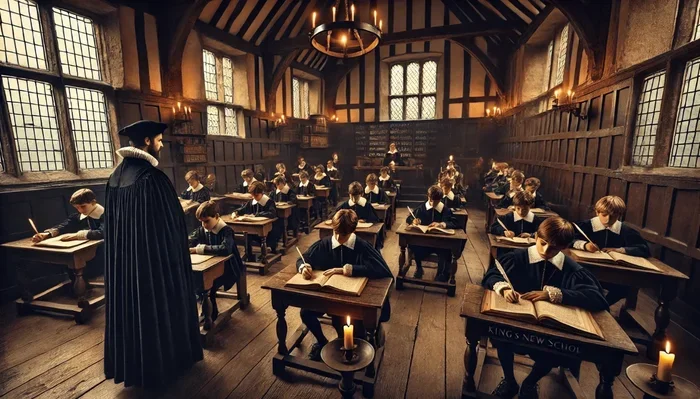
Shakespeares education was rooted in the rigorous Tudor grammar school system, where he studied Latin, classical literature, rhetoric, and logic at King’s New School in Stratford-upon-Avon. His early schooling laid the foundation for his extraordinary command of language, and his self-directed learning after formal education helped him become the most celebrated writer in the English language. Understanding how Shakespeare was educated gives us a deeper look at the man behind the masterpieces.
Key Takeaways
- Shakespeare attended King’s New School in Stratford: a free grammar school focused on Latin and classical studies.
- His curriculum was heavily classical: Latin grammar, rhetoric, logic, and ancient literature formed the backbone of his learning.
- He likely did not attend university: unlike many playwrights of his era, Shakespeare did not go to college.
- His education directly shaped his writing: the themes, language, and structures in his plays reflect his classical training.
- Self-education played a big role: Shakespeare continued learning throughout his life through reading and theatre.
- Education in Elizabethan England was class-driven: access to quality schooling depended heavily on social status and wealth.
📑 Table of Contents
How Was Shakespeares Education and What He Learned
William Shakespeare is widely regarded as the greatest writer in the English language. But have you ever wondered how Shakespeares education actually worked? What did he study? And how did his years in school shape the stories he told?
The answer might surprise you. Shakespeare grew up in a small town called Stratford-upon-Avon. He attended a local grammar school where he spent long hours studying Latin, memorizing classical texts, and learning the art of persuasion. His education was no accident. It was structured, disciplined, and deeply rooted in the traditions of the time. And it all paid off in ways the world still feels today.
In this article, we will walk through every stage of Shakespeare’s schooling years. We will look at what the curriculum was like, how Elizabethan schools worked, and why his learning matters for understanding his writing. Whether you are a student, a literature lover, or just curious about the man himself, this guide covers it all.
The World of Elizabethan Education
To understand how Shakespeare was educated, you need to understand the world he grew up in. England in the late 1500s was in the middle of the English Renaissance. This was a period of great change in art, science, and culture. But education looked very different back then compared to today.
Schools in Elizabethan England were not free for everyone. Education was a privilege, not a right. Wealthy families could afford tutors and private schooling. But for boys like Shakespeare, who came from a middle-class family, the local grammar school was the best option available.
The Tudor education system was designed to produce well-spoken men who could serve in government or the church. Latin was the language of power. Boys who mastered Latin had access to better careers and social standing. This is exactly the path young William was on.
King’s New School: Shakespeares First Classroom
Shakespeare enrolled at King’s New School in Stratford-upon-Avon when he was about seven years old. This was a free grammar school funded by the local guild. It was open to boys in the town, which made it a valuable opportunity for the Shakespeare family.
The school day was long and demanding. Classes typically ran from 6 a.m. to 5 p.m., with only a short break for lunch. Discipline was strict. Punishments for mistakes included beatings and public humiliation. Students were expected to memorize long passages of text and recite them perfectly.
The school year was also much longer than what we see today. Classes ran for nearly the entire year, with only short breaks around holidays. This intense schedule meant students absorbed a huge amount of material in a short period of time.
What Subjects Did Shakespeare Study?
The curriculum at King’s New School was built around classical education. This means students studied the languages, literature, and ideas of ancient Greece and Rome. The subjects were not just academic exercises. They trained the mind to think critically and express ideas with precision.
Here is a closer look at what Shakespeare’s learning looked like day to day:
- Latin Grammar: Students started with basic Latin grammar rules and gradually moved to translating complex texts.
- Classical Literature: They read works by Ovid, Virgil, Horace, and other Roman and Greek writers.
- Rhetoric: This was the art of persuasive speaking and writing. It taught students how to argue a point effectively.
- Logic: Students learned how to build sound arguments and identify flawed reasoning.
- English Composition: While Latin dominated, students also practiced writing in English.
- Memory Training: Reciting long passages from memory was a daily exercise.
These subjects might sound dry on paper. But they gave Shakespeare a powerful toolkit. His plays are full of references to classical myths, clever wordplay, and arguments that shift direction like a well-built legal case. All of this traces back to his schooling years.
The Role of Latin in Shakespeares Development
Latin was the single most important subject in Elizabethan education. It was not just a language class. It was a way of thinking. Students who learned Latin were exposed to the ideas of ancient philosophers, historians, and poets.
For Shakespeare, Latin opened doors to entire worlds of stories. He read about Roman heroes, Greek tragedies, and mythological adventures. These stories became raw material for his own plays. Many of his plots were inspired directly by classical sources he encountered in school.
Shakespeare’s command of language is one of his greatest gifts. And that command was built on a foundation of Latin study. He understood how words worked, how they could be twisted, combined, and reinvented. This linguistic flexibility is something that only deep study of a classical language can provide.
If you are curious about how education shapes a person’s entire life path, you might enjoy reading What Is The Purpose Of Education. It explores why education matters and how it transforms individuals over time.
Did Shakespeare Go to University?
Here is one of the most interesting facts about Shakespeare’s education: he did not attend university. This sets him apart from many of his fellow playwrights and poets of the era.
University education in Elizabethan England was expensive and reserved for the wealthy. Young men who attended university typically came from noble or affluent families. They studied subjects like philosophy, theology, and advanced rhetoric at institutions such as Oxford or Cambridge.
Shakespeare’s lack of a university degree has been the subject of much debate. Some people have even questioned whether he wrote the works attributed to him. But the evidence strongly suggests that his grammar school education and his self-directed learning were more than enough to produce his genius.
Without a formal university education, Shakespeare relied on his own curiosity and drive. He read widely. He watched the world around him carefully. And he turned everything he learned into art. This is a powerful reminder that formal schooling is just one path to knowledge and mastery.
For more on how education opens doors and creates opportunities, check out Why Education Is Important. It explains how learning at any stage can change your life.
How Shakespeares Education Shaped His Writing
It is impossible to separate Shakespeare’s education from his writing. Every play, sonnet, and poem carries the fingerprints of his schooling. His education gave him the tools to do what no one else could do.
His plays are full of classical allusions. Characters quote ancient philosophers. Plots follow structures from Greek and Roman drama. Even his jokes often rely on wordplay rooted in Latin and Greek double meanings.
But Shakespeare did not just copy what he learned. He transformed it. He took the rigid rules of classical rhetoric and bent them to his own creative will. He mixed highbrow classical references with street-smart English humor. This fusion is what made his work so powerful and so popular across all levels of society.
Consider how his education shows up in specific ways:
- Historical plays like Julius Caesar and Antony and Cleopatra draw directly from classical histories he studied in school.
- Comedies like A Midsummer Night’s Dream borrow heavily from Ovid’s Metamorphoses, a text he would have read as a student.
- His vocabulary is enormous. Scholars believe he used around 20,000 words in his works, many of which he coined himself. This linguistic creativity was fueled by his deep understanding of language structures learned through Latin study.
- His arguments and speeches often follow the patterns of classical rhetoric, showing a trained mind at work.
If you want to explore the broader idea of how different types of education influence creative work, take a look at What Is Classical Education. It breaks down the classical model and why it has shaped thinkers and artists for centuries.
The Importance of Self-Education in Shakespeares Life
Perhaps the most inspiring part of how Shakespeares education unfolded is what happened after formal schooling ended. Shakespeare did not stop learning when he left King’s New School. In fact, some of his most important learning happened on his own.
He moved to London and became involved in the theatre world. He watched plays. He met actors. He read books voraciously. He studied human nature by observing people from all walks of life. This kind of learning has no classroom and no teacher. It comes from curiosity and experience.
Shakespeare’s journey shows that education does not end at graduation. The most successful learners are those who keep asking questions and seeking answers long after they leave school. His life is proof that a strong foundation, combined with personal drive, can take you further than any degree alone.
If you are interested in how people continue learning throughout their lives, What Is Higher Education offers a great look at the many forms education can take beyond the basics.
Comparison: Shakespeares Education vs. Modern Education
It is always helpful to compare Shakespeare’s schooling years with what education looks like today. The differences are striking, but some surprising similarities remain.
| Aspect | Shakespeare’s Era | Modern Education |
|---|---|---|
| Starting Age | Around 7 years old | Around 5-6 years old |
| Primary Language of Instruction | Latin | English (or native language) |
| School Day Length | 6 a.m. to 5 p.m. | Typically 8 a.m. to 3 p.m. |
| Discipline Methods | Physical punishment common | Varied, mostly non-physical |
| Curriculum Focus | Classical literature, rhetoric, logic | Broad, including sciences, arts, tech |
| University Access | Limited to wealthy families | More accessible, with financial aid |
| Self-Directed Learning | Essential after formal schooling | Encouraged but varies by system |
Looking at this table, you can see that Shakespeare’s education was intense. But it was also focused. Students were pushed to master a few core subjects deeply rather than spreading themselves thin across many topics. There is something to be said for that kind of depth, even in today’s world.
Common Myths About Shakespeares Education
Over the years, several myths have grown up around Shakespeare’s schooling years. Let’s clear up a few of the most common ones.
Myth 1: Shakespeare did not have a real education. This is false. Grammar school education in Elizabethan England was rigorous and respected. Shakespeare would have received a solid education that prepared him for intellectual work.
Myth 2: Only university-educated writers could succeed in Shakespeare’s time. While many playwrights had university degrees, not all did. Shakespeare proved that talent, curiosity, and a strong foundation could substitute for formal higher education.
Myth 3: Shakespeare only learned about Latin in school. In reality, the grammar school curriculum covered a wide range of subjects including English composition, history, and even basic arithmetic. His education was well-rounded for its time.
Myth 4: Shakespeare’s education had no impact on his plays. This is perhaps the biggest myth of all. The evidence shows clearly that his classical training influenced everything from his plots to his language to his character development.
Quick Tips for Understanding Shakespeares Education Today
Want to get more out of studying Shakespeare’s education and its influence? Here are some quick tips:
- Read classical sources: Pick up translations of Ovid, Plutarch, or Holinshed’s Chronicles. These are the texts Shakespeare likely read.
- Study basic Latin: Even a little Latin helps you understand the wordplay and puns in his plays.
- Visit Stratford-upon-Avon: Walking through the town where Shakespeare grew up brings his education to life.
- Watch performances: Seeing his plays performed helps you understand how his education shaped the rhythm and language of his dialogue.
- Compare his works to classical originals: Look at how Shakespeare adapted stories from older sources. This shows his creative genius at work.
Expert Insights on Shakespeares Educational Legacy
Scholars and educators have long studied how Shakespeare was educated and what it means for understanding his work. Many agree that his grammar school training gave him something that university education could not: a deep connection to the language of everyday people.
Because Shakespeare studied at a local grammar school rather than an elite university, he learned Latin alongside English-speaking classmates. This meant he understood both the formal, classical world and the vibrant, messy world of real people. That dual perspective is what made his writing so universally powerful.
His education also taught him discipline. The rigorous memorization and recitation required at King’s New School trained his mind to work hard and think creatively under pressure. These skills served him well when he was writing multiple plays at once and performing in them as an actor.
Conclusion
Shakespeare’s education was the bedrock upon which one of history’s greatest literary careers was built. He attended a grammar school where he studied Latin, classical literature, rhetoric, and logic. He did not go to university, but he never stopped learning. His schooling years gave him the tools to reshape the English language and create works that still captivate audiences today.
Understanding how Shakespeare was educated helps us appreciate his genius even more. It reminds us that great achievements do not always require expensive degrees or prestigious institutions. Sometimes, all it takes is a strong foundation, a curious mind, and the determination to keep learning.
If you want to explore more about how education shapes great minds, consider reading about What Is The Philosophy Of Education. It dives into the big ideas behind how and why we learn.
Take Shakespeare as your inspiration. Keep reading. Keep asking questions. And never stop treating education as a lifelong journey.
Frequently Asked Questions
What school did Shakespeare attend as a child?
Shakespeare attended King’s New School in Stratford-upon-Avon. It was a free grammar school where boys studied Latin, classical literature, and rhetoric. The school provided the foundation for his extraordinary language skills.
Did Shakespeare go to college or university?
No, Shakespeare did not attend university. His formal education ended after grammar school. However, his self-directed learning and deep engagement with the theatre world more than made up for the lack of a degree.
What subjects did Shakespeare study in school?
Shakespeare studied Latin grammar, classical literature, rhetoric, logic, and English composition. He also trained his memory by reciting long passages of text every day as part of the school routine.
How did Shakespeares education influence his writing?
His education gave him a deep knowledge of classical stories, a mastery of language, and an understanding of persuasive structure. These elements appear throughout his plays and poems, from historical dramas to comedies to tragedies.
Was education in Shakespeare’s time available to everyone?
No, education in Elizabethan England was not available to everyone. It was largely a privilege for boys from families who could afford it. Girls and children from very poor families rarely had access to formal schooling.
Can we still learn from Shakespeares approach to education today?
Absolutely. Shakespeare’s dedication to self-education, his curiosity, and his habit of learning from the world around him are timeless lessons. His story shows that a strong start in education combined with personal drive can lead to extraordinary outcomes.


