
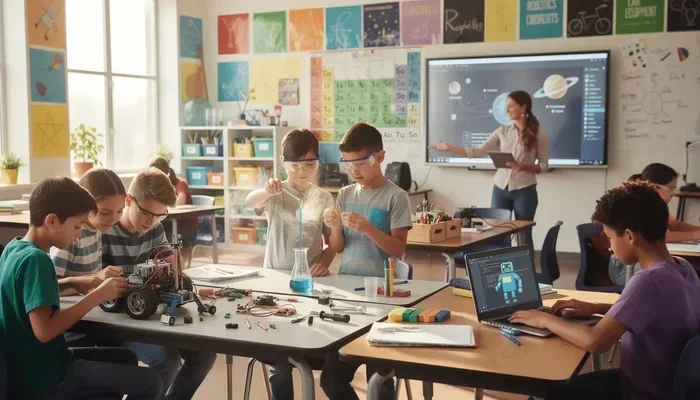
The stem education definition refers to learning that integrates science, technology, engineering, and mathematics into one connected approach. Instead of teaching these subjects separately, stem education encourages students to think critically, solve problems, and work together on real-world challenges. This approach builds future-ready skills that open doors to exciting careers and everyday success.
Key Takeaways
- STEM stands for Science, Technology, Engineering, and Mathematics: It is an integrated approach that connects all four subjects.
- STEM education builds critical thinking and problem-solving skills: Students learn to analyze, question, and find solutions.
- STEM careers are in high demand: The job market increasingly values stem skills across many industries.
- Hands-on learning is at the heart of STEM: Students engage in projects, experiments, and collaborative activities.
- You can support STEM at home: Simple activities, games, and conversations spark curiosity in young learners.
- STEM education promotes equity and inclusion: It gives every student a chance to explore and succeed.
📑 Table of Contents
- What Is STEM Education Definition and Why It Matters
- The Core Components of STEM Education
- Why STEM Education Matters
- STEM Education vs. Traditional Education
- The Key Skills Stem Education Develops
- How to Support STEM Education at Home and School
- Common Mistakes People Make About STEM Education
- Expert Insights on STEM Education
- Conclusion
What Is STEM Education Definition and Why It Matters
Let us start with the basics. The stem education definition is straightforward. STEM stands for Science, Technology, Engineering, and Mathematics. But it is much more than just those four letters. Stem education brings these subjects together into one connected learning experience. Instead of studying each subject on its own, students explore how they all work together.
Think of it this way. In the real world, problems do not come labeled “science problem” or “math problem.” They are messy, complex, and require many skills at once. Stem education teaches students to tackle these challenges head-on. It prepares them for the world they will actually face after school.
So why does this matter? The stem education definition is not just an academic concept. It shapes how schools teach, how kids learn, and how communities prepare for the future. Whether your child is in elementary school or heading to college, understanding stem education can make a real difference.
In this article, we will break down the stem education definition in simple terms. We will explore why it matters, what it looks like in practice, and how you can support it at home. Let us dive in.
The Core Components of STEM Education
To fully grasp the stem education definition, we need to look at each component. Science, technology, engineering, and mathematics each play a unique role. Together, they create a powerful learning framework.
Science: Understanding the World
Science is about asking questions and finding answers. Students learn how the natural world works. They explore biology, chemistry, physics, and earth science. In stem education, science is not just about memorizing facts. It is about curiosity and discovery.
For example, a student might ask, “Why do plants grow toward light?” Then they design an experiment to find out. This kind of hands-on exploration is at the core of stem learning.
Technology: Tools for Solving Problems
Technology includes computers, software, and digital tools. But it also means any tool that helps us solve a problem. In stem education, students learn to use technology creatively. They might build a simple app, program a robot, or analyze data on a spreadsheet.
Technology also teaches students to adapt. New tools emerge every day. Stem education helps students stay flexible and ready to learn whatever comes next.
Engineering: Designing Solutions
Engineering is all about building and creating. Students use what they know about science and math to design things. They might build a bridge out of popsicle sticks or design a water filtration system.
Engineering challenges teach students that failure is part of the process. They learn to try again, adjust, and improve. This mindset is valuable far beyond the classroom.
Mathematics: The Language of STEM
Mathematics is the foundation of everything in STEM. It gives students the tools to measure, calculate, and analyze. Without math, science experiments would not work. Engineering designs would fall apart. Technology would have no logic behind it.
In stem education, math is not just numbers on a page. It is a way of thinking. Students learn to spot patterns, make predictions, and solve problems step by step.
Why STEM Education Matters
Now that we understand the stem education definition, let us talk about why it is so important. The reasons go far beyond the classroom.
Building Critical Thinking Skills
Stem education trains students to think deeply. They learn to observe, question, and analyze. These critical thinking skills help them in every area of life.
When a student faces a tough math problem, they do not just give up. They break it into smaller pieces. They try different approaches. They think logically. This is exactly what stem education teaches.
You can compare this to learning figurative language like metaphors for education or similes for education. Just as these tools help students express ideas creatively, stem education helps them think more clearly and precisely.
Prepare Students for High-Demand Careers
The job market is changing fast. Many of the fastest-growing careers require stem skills. Jobs in healthcare, engineering, data science, and information technology all fall under the stem umbrella.
According to the U.S. Bureau of Labor Statistics, stem occupations are projected to grow much faster than non-stem jobs over the next decade. Students who understand the stem education definition early on have a head start.
Here are some popular stem careers students can explore:
- Software Developer: Builds apps and programs that power our digital world.
- Environmental Scientist: Studies the planet and finds ways to protect it.
- Mechanical Engineer: Designs machines, tools, and systems.
- Data Analyst: Turns raw data into useful insights.
- Biomedical Researcher: Works on medical breakthroughs and treatments.
Encouraging Creativity and Innovation
Many people think stem is all about rules and formulas. But that is not true. Stem education actually sparks creativity. Students are encouraged to come up with new ideas and test them out.
Innovation does not happen in a vacuum. It comes from combining different fields of knowledge. That is exactly what the stem education definition promotes. When students learn to blend science, technology, engineering, and math, they unlock new ways of thinking.
STEM Education vs. Traditional Education
It helps to compare stem education with traditional approaches. This makes the stem education definition even clearer.
How They Differ
In traditional education, subjects are taught separately. You have a math period, a science period, and an English period. Each class stands on its own.
Stem education breaks down those walls. Instead of learning math in isolation, students apply math to real science projects. Instead of reading about engineering, they build something with their own hands.
Here is a quick comparison:
- Traditional Education: Subjects are taught in isolation. Students memorize facts and follow instructions. The focus is on getting the right answer.
- Stem Education: Subjects are integrated. Students explore, experiment, and collaborate. The focus is on the process and the solution.
What Research Says
Studies show that stem education leads to better educational outcomes. Students in stem programs often score higher on problem-solving tests. They also show stronger motivation and engagement.
One reason is simple. Stem learning feels relevant. When students see how what they learn connects to real life, they care more. They pay more attention. They remember more.
You might also hear people use related phrases like stem learning, stem curriculum, or stem programs. All of these refer to the same core idea: integrated, hands-on education in science, technology, engineering, and math.
The Key Skills Stem Education Develops
The stem education definition is not just about content knowledge. It is about building a set of powerful skills that last a lifetime.
Problem-Solving
Stem students learn to face challenges without fear. They develop a step-by-step approach to finding solutions. They test ideas, learn from mistakes, and try again.
Collaboration
Many stem projects are team-based. Students learn to communicate, share ideas, and work together. These collaborative learning skills are essential in almost every career.
Communication
Stem education teaches students to explain their thinking clearly. They learn to present data, write reports, and defend their conclusions. Strong communication skills make everything else easier.
Adaptability
The world changes fast. Stem students learn to embrace change and keep learning. They are not afraid of new tools or unfamiliar problems. This future-ready mindset sets them up for long-term success.
Digital Literacy
In today’s world, technology touches everything. Stem education helps students become comfortable with digital tools. They learn to navigate software, understand data, and use technology responsibly.
How to Support STEM Education at Home and School
Understanding the stem education definition is just the beginning. The next step is putting it into action. Here are practical ways to support stem learning.
At Home
You do not need a science lab to encourage stem learning at home. Simple activities work wonders:
- Cook together: Cooking teaches measurements, chemistry, and following processes. Ask your child, “What happens when we heat butter?”
- Build things: Blocks, LEGO sets, and cardboard projects teach engineering basics. Let your child design and create freely.
- Explore nature: Go on a walk and observe plants, insects, and weather patterns. Ask open-ended questions like, “Why do you think leaves change color?”
- Play strategy games: Board games and puzzles build logical thinking and problem-solving skills.
- Use technology together: Try coding apps designed for kids. Many are free and easy to start.
At School
If you are a teacher or school leader, here are some tips:
- Integrate subjects: Design lessons that combine two or more stem areas. For example, a project on building a solar oven covers science, engineering, and math.
- Focus on hands-on projects: Students learn best when they do, not just listen. Give them real materials and real challenges.
- Encourage questions: Create a classroom culture where curiosity is celebrated. There are no silly questions in stem education.
- Connect to careers: Invite guest speakers from stem fields. Show students the real-world impact of what they are learning.
- Use figurative language to explain concepts: Just as idioms for education help make abstract ideas more relatable, analogies and metaphors can bring stem concepts to life for young learners.
Common Mistakes People Make About STEM Education
Even well-meaning parents and educators sometimes misunderstand the stem education definition. Let us clear up a few common myths.
Myth 1: STEM Is Only for Gifted Students
This is simply not true. Stem education is for every student. It is designed to be accessible and engaging for all learning levels. Every child can benefit from hands-on, integrated learning.
Myth 2: STEM Means More Screen Time
Technology is one part of stem, but it is not the whole picture. Stem education includes building, experimenting, exploring, and working with physical materials. Screen time is just one tool among many.
Myth 3: STEM Only Matters for Future Scientists
Stem skills are valuable in almost every career. Artists use technology. Business owners use data analysis. Even tradespeople use engineering principles. The stem education definition applies broadly to all walks of life.
Expert Insights on STEM Education
We asked several educators and industry professionals what they think about the stem education definition and its impact. Here is what they shared:
- Dr. Lisa Chen, Science Educator: “Stem education is not just about producing scientists. It is about raising a generation of thinkers who can tackle any challenge with confidence and creativity.”
- Mark Rivera, Software Engineer: “The problem-solving skills I use every day at work were built in stem classrooms. It is the most practical education a student can receive.”
- Sarah Thompson, Elementary School Teacher: “When I integrate stem into my lessons, I see students light up. They become curious, engaged, and eager to learn more.”
These voices remind us that the stem education definition is about more than academics. It is about empowering young people to shape their own futures.
Conclusion
The stem education definition is clear and powerful. It is an integrated approach that combines science, technology, engineering, and mathematics into one dynamic learning experience. Stem education builds critical thinking, creativity, collaboration, and problem-solving skills that students need for the rest of their lives.
Whether you are a parent, teacher, or simply someone who cares about education, understanding the stem education definition gives you a roadmap for supporting young learners. The world is changing fast, and stem education helps students not just keep up but lead the way.
Start small. Ask questions. Build things together. Explore the world around you. Every step you take toward stem learning makes a difference. The future belongs to those who are curious, capable, and ready to create.
Frequently Asked Questions
What does STEM stand for?
STEM stands for Science, Technology, Engineering, and Mathematics. It represents an integrated approach to education that connects all four subjects into hands-on, real-world learning experiences.
Why is STEM education important for young students?
Stem education builds critical thinking, problem-solving, and collaboration skills early on. These abilities help students succeed not only in school but also in their future careers and everyday lives.
Can stem education be taught at home?
Absolutely. Parents can support stem learning through simple activities like cooking, building projects, nature walks, and educational games. You do not need special equipment or training to get started.
How is stem education different from traditional education?
Traditional education teaches subjects separately. Stem education integrates them. Students apply knowledge from multiple areas to solve real problems, which leads to deeper understanding and better retention.
What careers can stem education lead to?
Stem education opens doors to many careers including software development, engineering, data science, environmental research, healthcare, and much more. The skills gained are valued across virtually every industry.
Is STEM education only for students who are good at math and science?
No. Stem education is designed for all students. It welcomes different strengths and learning styles. The hands-on, collaborative nature of stem learning makes it accessible and engaging for everyone.


