
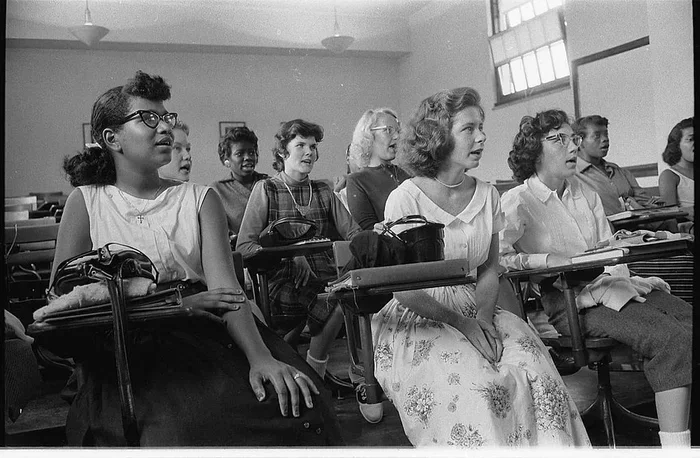
Brown v Board of Education started as a legal challenge to racial segregation in public schools, led by Oliver Brown and the NAACP. The Supreme Court’s unanimous 1954 ruling declared that separate educational facilities were inherently unequal, overturning decades of legalized discrimination. This landmark decision became a cornerstone of the civil rights movement and reshaped American education.
It all started with a simple walk to school. Every morning, a little girl named Linda Brown had to cross a dangerous railroad switchyard just to get to her elementary school. Meanwhile, a whites-only school sat just a few blocks from her home. Her father, Oliver Brown, decided enough was enough. That single act of quiet defiance sparked one of the most important legal battles in American history.
The story of how Brown v Board of Education started is a story about courage, justice, and the fight for equal rights. This case changed the way America thinks about education, race, and the meaning of equality under the law. If you want to understand the civil rights movement, you need to understand where it all began. Let us walk through the full story together.
Key Takeaways
- The case began in Topeka, Kansas: Oliver Brown sued the local school district after his daughter was forced to travel far to attend an all-Black school.
- It challenged the “separate but equal” doctrine: The previous legal standard from Plessy v Ferguson was overturned by this ruling.
- The NAACP led the legal strategy: Thurgood Marshall and his team built a powerful case using social science evidence.
- The Supreme Court ruled unanimously: All nine justices agreed that segregation in public schools violated the 14th Amendment.
- The decision sparked the modern civil rights movement: It gave momentum to further legal challenges against racial inequality.
- Implementation faced massive resistance: Many states and communities fought desegregation for years after the ruling.
- The case used figurative language to make its point: Phrases like “separate but equal” and “inherently unequal” shaped public understanding of the issue.
📑 Table of Contents
The World Before Brown v Board of Education
To understand how the case started, you need to understand the world it came from. In the late 1800s and most of the 1900s, racial segregation was the law of the land in many parts of the United States. Black Americans and white Americans were kept apart in nearly every part of daily life. This included restaurants, buses, hospitals, and especially schools.
The legal foundation for this separation came from a case called Plessy v Ferguson in 1896. The Supreme Court ruled that segregation was legal as long as the facilities were “separate but equal.” In theory, this sounded fair. In practice, it was a lie. Black schools received far less funding. Black teachers earned less money. And the facilities themselves were almost always worse than their white counterparts.
For decades, this separate but equal doctrine stood unchallenged at the highest level of the court. But by the 1940s and 1950s, a growing movement was ready to tear it down. The civil rights movement was gaining steam, and education became its most powerful battleground.
Daily Life Under Segregation
Black families living in the Jim Crow South faced humiliating rules every single day. They could not sit in certain sections of buses. They could not eat at certain restaurants. And their children had to attend separate schools that were often in terrible condition. Textbooks were hand-me-downs from white schools. Buildings leaked, had no proper heating, and lacked basic supplies.
This was the reality that made the Brown v Board of Education case so necessary. Parents knew their children deserved better. They just needed someone to help them fight for it.
How Did Brown v Board of Education Start: The Origin Story
The story of this landmark case begins in Topeka, Kansas, in the early 1950s. Topeka was not a Southern city. It was a midwestern town where segregation was not as extreme as in states like Alabama or Mississippi. But it was still very much real. Black children were required by law to attend segregated schools.
Linda Brown was a third grader. She lived on the east side of Topeka, a neighborhood where most Black families lived. Just seven blocks from her house was a whites-only elementary school. But Linda could not attend it because of the color of her skin. Instead, she had to ride a bus to a segregated school on the other side of town. The daily commute was long, exhausting, and unfair.
Oliver Brown, Linda’s father, tried to enroll her in the closer white school. The principal refused him. So Oliver joined a group of parents who had been planning a legal challenge. Together, they filed a lawsuit against the Board of Education of Topeka in 1951.
Why Topeka? The Strategic Choice
You might wonder why the NAACP chose Topeka as the front line for this fight. The answer is simple but brilliant. Topeka was a moderate city. It was not in the Deep South. The segregation laws there were less extreme, which made the case harder to dismiss as a regional issue. The NAACP legal team wanted to show that segregation was wrong everywhere, not just in the most overtly racist states.
The lawyers also chose Topeka because the case would be easier to build. In many Southern states, segregation was total and obvious. In Topeka, the inequality was more subtle but just as real. Black schools were underfunded, overcrowded, and lacked resources. The legal challenge would focus on the damage segregation did to Black children’s sense of self-worth and their educational opportunities.
Oliver Brown became the lead plaintiff simply because his name came first alphabetically. His daughter’s story became the face of the entire case. The Brown v Board of Education name stuck, and history was made.
The Legal Strategy Behind the Case
Winning this case required more than just telling a sad story. The legal team needed airtight arguments backed by evidence. They needed to prove that segregation itself caused harm, even if the physical buildings were similar.
The head of the legal team was Thurgood Marshall, a brilliant lawyer who would later become the first Black Supreme Court justice. Marshall was the head of the NAACP Legal Defense Fund. He had been fighting segregation cases for years. But this one was different. This was the case that would go all the way to the top.
Social Science Evidence
One of the most innovative parts of the Brown v Board of Education strategy was the use of social science research. The legal team brought in psychologists who studied the effects of segregation on children. They presented evidence showing that Black children in segregated schools felt inferior. This research became known as the “doll studies,” where children were asked to choose between white and Black dolls.
The results were devastating. Most Black children preferred the white dolls and associated positive traits with them. This proved that segregation damaged the psychological development of Black children. The Supreme Court would later cite this evidence in its ruling.
The legal team also argued that segregation violated the Equal Protection Clause of the 14th Amendment. This amendment guarantees that no state shall deny any person equal protection under the law. Segregated schools, they argued, could never be truly equal.
The Power of Figurative Language in the Courtroom
Language mattered enormously in this case. The phrases used by both sides shaped how Americans understood the debate. The defense for segregation used the phrase “separate but equal,” a saying that had been around for nearly 60 years. The NAACP legal team countered with the idea that “separate is inherently unequal.” These simple phrases carried enormous weight.
Think about how idioms for education shape our thinking about learning and fairness. Words and phrases have power. They frame how we see the world. In the courtroom, the right phrase at the right time can change the course of history. The Brown v Board of Education case proved that language is not just decoration. It is a weapon for justice.
Similarly, the way we describe educational inequality matters. Comparing segregation to a barrier or a wall helped people visualize the problem. Using metaphors for education helped the public understand that separate systems were not just inconvenient. They were deeply unfair.
The Supreme Court Decision
On May 17, 1954, the United States Supreme Court issued its ruling in Brown v Board of Education. Chief Justice Earl Warren delivered the unanimous opinion. The Court declared that “separate educational facilities are inherently unequal.” The separate but equal doctrine from Plessy v Ferguson was officially overturned.
The ruling stated that segregation in public schools violated the 14th Amendment’s Equal Protection Clause. The Court acknowledged the social science evidence presented by the legal team. It recognized that segregation caused real psychological harm to Black children. This was not just a legal argument. It was a moral one.
What the Ruling Meant
The decision was groundbreaking. For the first time, the highest court in the land had declared that racial segregation in schools was unconstitutional. This was not a small technical ruling. It was a seismic shift in American law and culture.
The ruling did not immediately end segregation. It ordered schools to desegregate “with all deliberate speed.” This vague language would cause problems later. Many states used the phrase to delay integration for years. But the principle was set. The foundation had been laid for further civil rights victories.
The decision also energized the broader civil rights movement. Leaders like Martin Luther King Jr. drew strength from the ruling. It showed that the legal system could be used to fight injustice. It gave activists hope that change was possible through the courts.
Resistance and the Long Road to Desegregation
The ruling did not end the story. In many parts of the country, the backlash was fierce. Southern states formed organizations like the White Citizens Councils to resist integration. Some school districts simply closed their public schools rather than integrate them. Politicians declared “massive resistance” to the court’s order.
In Little Rock, Arkansas, in 1957, Governor Orval Faubus called the National Guard to prevent Black students from entering Central High School. President Eisenhower had to send federal troops to enforce the ruling. The image of soldiers escorting young Black students into a school became one of the most powerful symbols of the civil rights era.
Desegregation happened slowly. It took years of legal battles, protests, and social pressure to make the Brown v Board of Education ruling a reality in practice. Even today, many American schools remain deeply segregated by race and income. The promise of the ruling has not been fully realized.
The Legacy of Oliver Brown
Oliver Brown never sought fame or glory. He just wanted his daughter to have a fair chance at a good education. His courage in joining the lawsuit changed the course of American history. After the ruling, Brown continued to work for civil rights in Topeka. He became a pastor and a community leader.
In 1979, Brown was involved in another legal case seeking to continue the work of desegregation. He passed away in 1961, never seeing the full impact of his actions. But his name remains synonymous with the fight for educational equality.
Why Brown v Board of Education Still Matters Today
The Brown v Board of Education case is not just a historical event. It is a living lesson about justice, equality, and the power of ordinary people to create change. Every time we talk about educational fairness, we are walking in the footsteps of Oliver Brown and the families who joined his lawsuit.
Today, debates about school funding, school choice, and racial equity in education all trace back to the principles established by this ruling. The idea that every child deserves access to quality education regardless of race is not just a nice idea. It is a constitutional promise.
When we use similes for education to describe learning journeys, we are drawing on a tradition of figurative language that helps people understand complex ideas. When we use metaphors for education to talk about building futures or breaking barriers, we are continuing the same tradition of powerful communication that helped win the Brown case.
The fight for equal education is not over. But thanks to the courage of the Brown family and the NAACP legal team, we have a legal and moral foundation to build on. Understanding where this fight started is the first step toward appreciating how far we have come and how far we still need to go.
Key Lessons from the Brown Case
There are several important lessons we can draw from the story of how Brown v Board of Education started:
- Ordinary people can change history. Oliver Brown was not a famous politician or a powerful lawyer. He was a father who wanted his daughter to have a fair chance.
- Legal challenges matter. The courts can be a powerful tool for justice when used strategically and with strong evidence.
- Language shapes perception. The way we frame an argument can make or break its success. Words like “inherently unequal” carry moral weight.
- Progress takes time. The ruling was a victory, but the work of desegregation continued for decades and continues today.
- Education is a civil right. Access to quality schooling is not a privilege. It is a fundamental promise of American democracy.
The story of how Brown v Board of Education started reminds us that justice often begins with a single person willing to stand up. Oliver Brown’s simple act of trying to enroll his daughter in a neighborhood school set off a chain of events that transformed the nation.
When we talk about figurative language in education, we sometimes forget that words have power beyond the classroom. The phrases “separate but equal” and “inherently unequal” did not just describe legal doctrines. They shaped how millions of Americans understood right and wrong. They framed a national conversation about race, fairness, and the meaning of equality.
The Brown v Board of Education case teaches us that education is not just about reading, writing, and arithmetic. It is about building a society where every child has the opportunity to learn and grow. It is about recognizing that inequality in any form damages us all. And it is about having the courage to fight for what is right, even when the odds seem impossible.
So the next time you hear the name Brown v Board of Education, remember Linda Brown. Remember Oliver Brown. Remember the parents, lawyers, and activists who dared to challenge an unjust system. Their story is America’s story. And it is a story that is still being written.
Frequently Asked Questions
What was the original name of the Brown v Board of Education case?
The case was originally called Oliver Brown et al. v. the Board of Education of Topeka, Kansas. It was named after Oliver Brown, who became the lead plaintiff because his name appeared first alphabetically among the group of parents who filed the lawsuit.
Why was the Brown v Board of Education ruling so important?
The ruling was important because it overturned the “separate but equal” doctrine that had allowed racial segregation in schools for nearly 60 years. The Supreme Court declared that segregation in public schools was unconstitutional, laying the groundwork for the broader civil rights movement.
Who was the lawyer for the plaintiffs in Brown v Board of Education?
Thurgood Marshall led the legal team for the plaintiffs. He was the head of the NAACP Legal Defense Fund and later became the first Black justice on the United States Supreme Court. His legal strategy and courtroom arguments were instrumental in winning the case.
Did the Brown v Board of Education ruling immediately end school segregation?
No, the ruling did not immediately end segregation. The Court ordered desegregation “with all deliberate speed,” which was vague and allowed many states to delay integration for years. Resistance was fierce, and it took decades of additional legal action and social pressure to make desegregation a reality in many areas.
How did the Brown case use social science evidence?
The legal team presented psychological research showing that segregation harmed Black children’s self-esteem and development. The famous “doll studies” demonstrated that Black children in segregated schools internalized feelings of inferiority. This evidence helped the Court understand that segregation was not just a physical separation but a psychological harm.
What is the connection between Brown v Board of Education and modern education debates?
The Brown ruling established the principle that education is a fundamental right and that racial segregation in schools is unconstitutional. Modern debates about school funding, school choice, racial equity, and desegregation all trace back to the legal and moral foundation set by this landmark case.
=== CONCLUSION ===
The story of how Brown v Board of Education started is one of the most inspiring chapters in American history. It began with a father’s love for his daughter, a long walk to school, and a refusal to accept injustice quietly. From that simple beginning grew a legal revolution that transformed the nation.
The ruling proved that the courts can be a force for good. It showed that evidence, argument, and moral clarity can overcome even the deepest systems of inequality. And it reminded us that education is not just a personal matter. It is a public good and a constitutional right.
As we continue to face challenges in education today, the lessons of Brown v Board of Education remain as relevant as ever. Every child deserves a fair chance. Every classroom should be a place of equality and opportunity. And every citizen has a role to play in defending those principles.
The fight started with Oliver Brown. It continues with all of us. Let us honor that legacy by never stopping the work of building a more just and equal society.


