
So where does Texas rank in public education? Texas typically lands in the middle of the pack nationally, with mixed results in student achievement, funding, and graduation rates. This article breaks down the latest rankings, key factors, and what they mean for Texas families.
If you have kids in school or are thinking about moving to Texas, you have probably wondered, where does Texas rank in public education? It is a question that matters a lot to families, educators, and policymakers alike. The answer is not as simple as a single number, but this guide will walk you through the latest data, the biggest factors, and what it all means for Texas students.
Texas is the second-largest state by population and has one of the most diverse school systems in the country. With over 5 million students enrolled in public schools, the Texas public education system is a massive operation. Understanding how it performs nationally helps families make informed decisions and gives educators a benchmark for improvement.
Key Takeaways
- Texas ranks around the middle nationally: The state often falls in the 25th to 35th range in overall public education rankings depending on the metric.
- Funding plays a big role: Per-pupil spending in Texas has historically lagged behind the national average, affecting resources and outcomes.
- Graduation rates are improving: Texas has made steady gains in high school graduation rates over the past decade.
- Standardized test scores tell a mixed story: NAEP and SAT results show both strengths and gaps across student groups.
- Teacher shortages are a growing concern: Texas faces ongoing challenges in recruiting and retaining qualified educators.
- Local district variation is huge: Rankings can differ dramatically between wealthy suburban and rural or urban districts.
📑 Table of Contents
Where Texas Ranks in National Education Comparisons
When experts look at Texas education rankings, they use several major reports and datasets. The most common sources include the National Assessment of Educational Progress (NAEP), U.S. News & World Report rankings, and WalletHub education studies. Each one weighs different factors, so the exact rank shifts depending on the source.
Generally speaking, Texas tends to land somewhere in the middle of the national pack. It is rarely at the top, but it is also not at the bottom. Most recent analyses place Texas in the 25th to 35th range for overall public education quality. This middle-of-the-road position reflects both strengths and areas that need work.
What the NAEP Scores Show
The NAEP, often called the Nation’s Report Card, is one of the most trusted measures of student performance. In recent years, Texas fourth and eighth graders have scored close to the national average in both math and reading. However, there are gaps. Texas student outcomes vary widely by ethnicity, income level, and district. Some student groups perform well above average, while others trail behind.
For example, Texas white and Asian students often score above the national average on NAEP assessments. Black and Hispanic students, who make up a large share of the Texas student population, tend to score closer to or below the national average. These gaps highlight the education quality Texas needs to address to serve all students equally.
U.S. News and Other Ranking Systems
U.S. News & World Report ranks states based on factors like preschool enrollment, high school graduation rates, and college readiness. In their latest reports, Texas usually lands in the bottom half of states. The Texas school accountability system, run by the Texas Education Agency (TEA), gives districts letter grades from A to F. While some districts earn top marks, many struggle with C and D ratings, which pulls the state average down.
How Texas Education Funding Compares
One of the biggest drivers of education quality is funding. So how does Texas stack up when it comes to money spent on public schools?
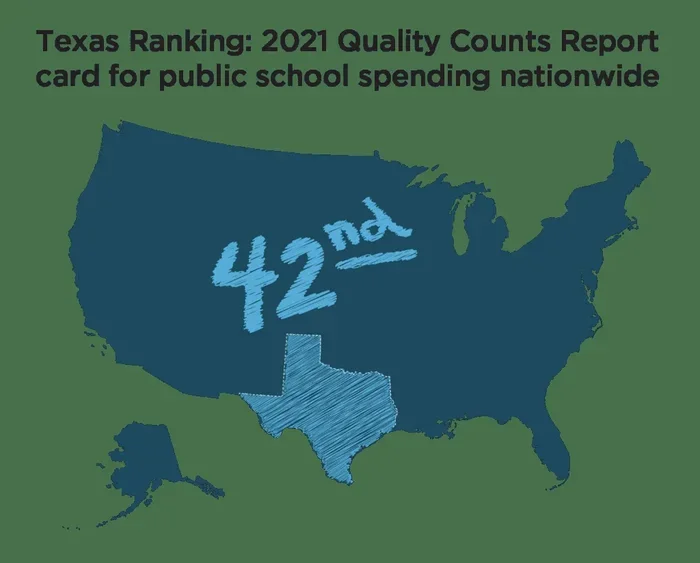
Texas per-pupil spending has historically been below the national average. As of recent data, the state spends roughly $10,000 to $11,000 per student per year. The national average typically hovers around $13,000 to $14,000. That gap matters because funding affects teacher salaries, classroom resources, extracurricular programs, and facility maintenance.
However, Texas does have a dedicated funding formula through the Foundation School Program. This formula aims to distribute money more fairly across districts. Wealthy property-rich districts generate more local revenue, while poorer districts receive more state support. Despite this, debates about education funding Texas continue to be a hot topic in the legislature every session.
Why Funding Gaps Matter
When schools lack funding, the effects show up quickly. Class sizes grow. Teachers leave for better-paying jobs. Programs like art, music, and advanced placement courses get cut. School improvement Texas efforts often focus on directing more resources to underfunded districts. Research consistently shows that adequate funding is linked to better student outcomes, especially in low-income communities.
Graduation Rates and College Readiness
On the positive side, Texas has made real progress in graduation rates. The state’s four-year high school graduation rate has climbed steadily over the past decade. Today, Texas graduates about 89% of its students on time, which is close to the national average and a significant improvement from a decade ago.
But graduation is only one piece of the puzzle. College readiness Texas is a growing concern. Many graduates need remedial coursework in college, which suggests they were not fully prepared for higher education. The Texas Success Initiative (TSI) measures college readiness, and a notable percentage of incoming community college students fail to meet benchmarks in math and reading.
SAT and ACT Performance
Texas students take the SAT and ACT at solid rates compared to other states. However, average scores have remained relatively flat in recent years. The SAT scores Texas average typically falls around 1050 to 1080, which is slightly below the national average. ACT scores follow a similar pattern. These scores suggest that while more students are graduating, a significant portion may not be academically ready for competitive colleges.
Teacher Shortages and Workforce Challenges
Any honest look at where does Texas rank in public education has to address the teacher workforce. Texas, like many states, faces a growing teacher shortage. Low pay, high cost of living in major metro areas, and growing class sizes all contribute to the problem.
The Texas Education Agency reports thousands of teacher vacancies each year, particularly in math, science, and special education. Many districts resort to hiring long-term substitutes or teachers with emergency certifications. This affects the quality of instruction students receive every day.
What the State Is Doing
In recent legislative sessions, Texas has passed bills aimed at raising teacher pay and offering signing bonuses. Some districts have also increased local property taxes to fund higher salaries. Despite these efforts, many teachers still leave the profession within the first five years. Texas education agency data shows that retention remains one of the biggest challenges for the state’s public school system.
Quick Tip: If you are a teacher considering Texas, look into districts with strong mentorship programs and competitive starting salaries. Districts in the Dallas-Fort Worth and Austin areas often have more openings but also more support structures for new educators.
Student Diversity and Achievement Gaps
Texas has one of the most diverse student populations in the nation. Roughly 53% of Texas students identify as Hispanic, 30% as white, 13% as Black, and smaller percentages as Asian or other groups. English language learners make up a significant share as well, at around 19% of the student body.
This diversity is a strength, but it also means that academic performance Texas looks very different depending on which student group you examine. Achievement gaps between white students and students of color persist across most measures. Closing these gaps is a central goal of education reform Texas advocates and policymakers.
English Language Learners in Texas
Texas has one of the largest populations of English language learners (ELLs) in the country. These students face the double challenge of learning academic content while also mastering a new language. Districts with strong bilingual and ESL programs tend to see better outcomes for ELL students. Research shows that bilingual education models often outperform English-only approaches for these learners.
Common Mistakes: Do not assume that a district’s overall ranking tells the full story. A district might rank well on paper while leaving significant gaps for ELL, low-income, or special education students. Always dig into subgroup data when evaluating schools.
What Parents and Families Can Do
Understanding education statistics Texas is helpful, but what can families actually do with this information? Here are some practical steps.
First, look beyond the state average. Texas school districts vary enormously. A wealthy suburb might have schools that rival the best in the country, while a rural district might struggle with basic resources. Use the TEA’s district report cards to compare schools in your area.
Second, get involved. Parent involvement is one of the strongest predictors of student success. Attend school board meetings, volunteer, and stay in communication with teachers. Third, advocate for equitable funding. Support local and state policies that direct resources to the students who need them most.
Expert Insight: Education researcher Dr. Morgan Polikoff notes that state rankings are useful for broad comparisons but should not be the sole factor in evaluating a school or district. “The most meaningful data is often at the campus level, where you can see how specific groups of students are performing,” he says.
Quick Tip: Use the TEA’s online portal to look up your child’s school. You can find accountability ratings, graduation rates, and demographic breakdowns all in one place. This gives you a much clearer picture than any national ranking alone.
The Big Picture: Why Rankings Matter
So why does it matter where Texas ranks in public education? Because rankings shape policy, funding decisions, and public perception. When a state performs well, it attracts families and businesses. When it performs poorly, it signals systemic issues that need attention.
For Texas, the middle-of-the-pack ranking is both encouraging and concerning. It shows the state is not failing, but it also shows there is significant room for growth. Texas public education has real strengths, including diverse student communities and improving graduation rates. But it also faces serious challenges in funding, equity, and workforce stability.
The conversation around where does Texas rank in public education should not end with a single number. It should spark action. Families, educators, and policymakers all have roles to play in pushing Texas toward the top tier of states.
Think about it this way. When you compare similes for education, you see how language shapes our understanding of learning. Similarly, rankings and data shape how we talk about and invest in schools. The words we use and the numbers we focus on matter. They drive decisions that affect real classrooms and real children every day.
Just as metaphors for education can inspire deeper thinking about teaching and learning, data on Texas education can inspire deeper thinking about what works and what does not. And just as idioms for education capture common wisdom about learning, the trends in Texas education reflect both progress and persistent challenges that the state must address.
The bottom line is clear. Texas has work to do, but it also has real potential. With better funding, smarter policies, and stronger support for teachers and students, the state can climb higher in national rankings and, more importantly, deliver better outcomes for every child who walks through its school doors.
Final Thoughts
Where Texas ranks in public education is a story of progress and promise mixed with real challenges. The state sits in the middle nationally, with strong graduation trends but persistent gaps in funding, equity, and teacher retention. For families, the most important takeaway is this: look at the local data, get involved, and advocate for the resources your child deserves.
Education is not just a numbers game. It is about people, communities, and futures. Texas has the size, the diversity, and the determination to keep improving. The question is whether the state and its leaders will match that potential with action.
Frequently Asked Questions
What is the current ranking of Texas in public education nationally?
Texas typically ranks between 25th and 35th nationally in overall public education quality, depending on the ranking system used. Sources like U.S. News, WalletHub, and NAEP data all place the state in the middle of the pack, reflecting both strengths and areas that need improvement.
How does Texas education funding compare to other states?
Texas per-pupil spending is below the national average, usually coming in at around $10,000 to $11,000 per student. The national average is closer to $13,000 to $14,000. This funding gap affects teacher pay, classroom resources, and the overall quality of education in many districts.
Are Texas graduation rates improving?
Yes, Texas has seen steady improvements in high school graduation rates over the past decade. The state now graduates about 89% of students on time, which is close to the national average and a significant increase from previous years.
Why are teacher shortages a problem in Texas?
Texas faces thousands of teacher vacancies each year, especially in math, science, and special education. Low pay, high living costs, and large class sizes drive many educators to leave the profession or avoid entering it in the first place. This shortage directly impacts the quality of instruction students receive.
How can parents check their child’s school performance?
Parents can use the Texas Education Agency’s online portal to access district and campus report cards. These reports include accountability ratings, graduation rates, test scores, and demographic breakdowns that give a detailed picture of how a school is performing.
What can be done to improve Texas education rankings?
Key steps include increasing per-pupil funding, addressing teacher pay and retention, closing achievement gaps for underserved student groups, and expanding early childhood education programs. Sustained investment and policy focus are essential for moving Texas up in national rankings.


