
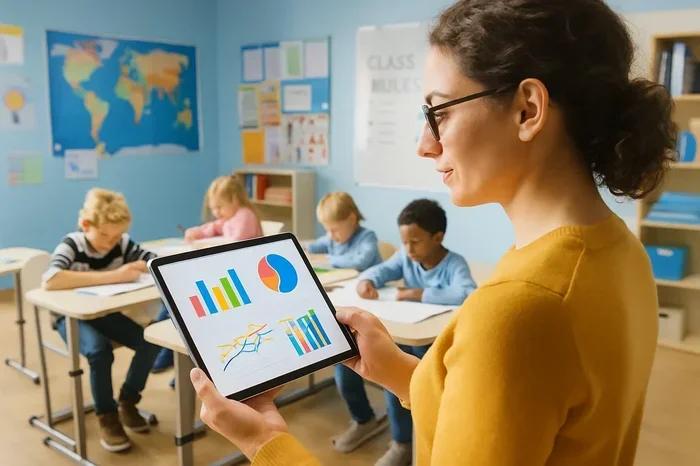
Progress monitoring in education is a systematic approach to tracking student learning and academic growth over time. It helps teachers make data-driven instructional decisions, identify struggling students early, and adjust teaching strategies to meet individual needs. This practice is essential for improving educational outcomes and ensuring every student reaches their full potential.
Key Takeaways
- Progress monitoring in education is a continuous process of assessing student performance to guide instruction and support learning.
- It uses formative assessment data to track academic growth and identify areas where students need help.
- Teachers benefit from data-driven instruction that helps them tailor lessons to individual student needs.
- There are several progress monitoring tools, including curriculum-based measurement, running records, and skill probes.
- Regular monitoring helps close achievement gaps and supports differentiated instruction for all learners.
- Parents and educators can use progress monitoring to set realistic learning goals and measure educational outcomes.
- Implementing best practices ensures that progress monitoring remains effective and sustainable in any classroom.
📑 Table of Contents
- What Is Progress Monitoring in Education?
- How Does Progress Monitoring Work in Practice?
- Why Progress Monitoring Matters for Students and Teachers
- Types of Progress Monitoring Tools and Methods
- Common Challenges in Progress Monitoring and How to Overcome Them
- Best Practices for Effective Progress Monitoring
- Quick Tips for Getting Started with Progress Monitoring
- Conclusion
What Is Progress Monitoring in Education?
Have you ever wondered how teachers know if their students are actually learning? It is not just about giving a test at the end of the year. Progress monitoring in education is a structured, ongoing process that helps educators track how well students are picking up new skills and knowledge over time.
Think of it like keeping a fitness journal. You weigh yourself, measure your stamina, and check your progress week by week. Progress monitoring does the same thing for learning. Teachers collect data on student performance at regular intervals. Then they use that data to adjust their teaching and help students grow.
At its core, progress monitoring is about making sure no student falls through the cracks. It gives teachers a clear picture of where each student stands. And it helps them decide what to teach next. This approach is a cornerstone of modern data-driven instruction and plays a big role in improving educational outcomes for all kids.
Why Is It Different From Regular Testing?
Standardized tests give you a snapshot. They show what a student knows at one point in time. Progress monitoring, on the other hand, is like a movie. It captures learning as it happens. Teachers check in frequently, sometimes weekly or even daily. This constant feedback loop makes it much easier to spot problems early and celebrate wins along the way.
When we talk about student assessment in general, progress monitoring sits inside the broader category of formative assessment. It is ongoing, instructional, and deeply personal. That is what makes it so powerful.
How Does Progress Monitoring Work in Practice?
Now that you understand the basics, let us look at how progress monitoring actually works inside a classroom. The process follows a clear cycle that any teacher can adopt.
Step 1: Set Clear Learning Goals
Every journey needs a destination. Before monitoring anything, teachers establish specific learning goals for each student or student group. These goals are measurable and tied to curriculum standards. For example, a reading goal might be: “The student will read 80 words per minute with 95% accuracy by the end of the quarter.”
These goals act as benchmarks. They give both the teacher and the student something concrete to aim for. Without clear targets, progress monitoring would be like sailing without a compass.
Step 2: Collect Data Regularly
Next, the teacher gathers performance data at set intervals. This could involve short quizzes, oral reading fluency checks, math fact probes, or writing samples. The key is consistency. Data collection happens frequently enough to show trends, not just one-off results.
Common methods include:
- Curriculum-Based Measurement (CBM) — standardized short tests tied directly to what is being taught.
- Running Records — used mostly in early reading to track decoding and comprehension.
- Skill Probes — quick checks on specific skills like multiplication facts or spelling words.
- Observation Checklists — teachers note behaviors and skill demonstrations during class activities.
Step 3: Analyze the Data
Once the data is collected, the teacher reviews it carefully. Is the student making adequate progress? Are they hitting their targets? Or do they need a different approach? This analysis drives the next big decision: what to do next.
Teachers often plot this data on graphs or charts. Visualizing academic growth makes it easy to see trends at a glance. A steady upward line means things are working. A flat or declining line is a signal to change course.
Step 4: Adjust Instruction
This is where the magic happens. Based on what the data reveals, the teacher adjusts their instructional decisions. They might change the pace of a lesson, introduce a new intervention strategy, or provide more practice on a tricky skill. The goal is always to keep the student moving forward.
Sometimes this means pulling a small group for extra support. Other times, it means offering enrichment activities to students who are already excelling. Progress monitoring ensures that every instructional decision is backed by evidence, not guesswork.
Why Progress Monitoring Matters for Students and Teachers
The value of progress monitoring in education cannot be overstated. It benefits nearly every part of the teaching and learning experience. Let us break down why it matters so much.
It Catches Problems Early
One of the biggest advantages of progress monitoring is early detection. When teachers check student understanding regularly, they spot trouble long before a big test reveals it. A student who is quietly struggling with reading comprehension can get help right away instead of falling further behind.
Think of it this way: would you rather fix a small leak or deal with a flooded house? Early intervention saves time, effort, and frustration for everyone involved.
It Supports Differentiated Instruction
Every classroom has students at different levels. Some grasp concepts quickly. Others need more time and practice. Progress monitoring gives teachers the information they need to differentiate instruction effectively. They can tailor lessons to meet each student where they are.
This approach respects the fact that learning is not one-size-fits-all. It acknowledges that students have unique learning progressions and need different paths to reach the same destination.
It Empowers Students
Here is something people often overlook: progress monitoring helps students too. When kids can see their own growth on a graph or chart, it builds motivation. They start to take ownership of their learning. They understand what they are good at and where they need to improve.
This sense of agency is incredibly valuable. Students who track their own skill mastery often show greater engagement and persistence. They stop seeing school as something done to them and start seeing it as something they actively participate in.
It Keeps Parents in the Loop
Parents want to know how their child is doing. Progress monitoring gives teachers concrete data to share during conferences and meetings. Instead of vague comments like “doing okay,” teachers can point to specific performance tracking results. This builds trust and keeps everyone working toward the same goals.
Types of Progress Monitoring Tools and Methods
Not all progress monitoring looks the same. Different tools work better for different subjects, age groups, and learning goals. Here is a closer look at the most common approaches.
Curriculum-Based Measurement (CBM)
CBM is one of the most widely used progress monitoring methods. It involves short, standardized probes that directly match what is being taught in the classroom. For example, a first-grade teacher might give a one-minute oral reading fluency probe every Friday. The results are plotted on a graph to show growth over time.
CBM has strong research backing. It is reliable, easy to administer, and gives teachers clear, actionable data. Many schools use CBM as part of their Response to Intervention (RTI) framework.
Benchmark Assessments
Benchmark assessments are given at set points during the school year, usually three times: fall, winter, and spring. They measure student performance against grade-level standards. While they are not as frequent as daily progress monitoring, they provide a broader picture of where students stand compared to their peers.
Common benchmark tools include DIBELS, AIMSweb, and Renaissance Star. These platforms automate much of the data-driven instruction process, making it easier for teachers to act on results quickly.
Portfolio Assessment
Portfolio assessment collects student work over time. It might include writing samples, math problem-solving recordings, or art projects. Teachers review the portfolio to see how a student’s skills develop. This method is especially useful for capturing growth in areas like writing and creative thinking, where a single test score does not tell the full story.
Technology-Based Progress Monitoring
Today, many schools use digital tools to streamline progress monitoring. Platforms like Khan Academy, IXL, and Google Classroom offer real-time dashboards that track student performance automatically. These tools save teachers time and provide instant insights into educational outcomes.
Technology also makes it easier to share data with parents. Many platforms offer parent portals where families can view their child’s academic growth anytime. This transparency strengthens the home-school connection.
Comparison of Progress Monitoring Methods
| Method | Frequency | Best For | Ease of Use |
|---|---|---|---|
| CBM Probes | Weekly or biweekly | Reading and math fluency | High |
| Benchmark Assessments | Three times per year | Grade-level comparison | Medium |
| Portfolio Assessment | Ongoing | Writing and creative skills | Medium |
| Technology Platforms | Continuous | All subjects, real-time data | Very High |
| Observation Checklists | Daily | Behavior and engagement | High |
Each method has its strengths. Many effective teachers use a combination of approaches to get the fullest picture of student learning. The best choice depends on the grade level, subject area, and specific learning goals for each student.
Common Challenges in Progress Monitoring and How to Overcome Them
Even the best progress monitoring systems face obstacles. Teachers are busy. Time is limited. Data can feel overwhelming. But these challenges are manageable with the right strategies.
Challenge 1: Lack of Time
This is the number one complaint teachers have about progress monitoring. With so much on their plate, finding time for frequent assessments feels impossible. The solution is to embed monitoring into existing routines. Quick five-minute fluency checks during morning work or transition times add up over the week without adding extra burden.
Think of it like the way we use idioms for education to make complex ideas simple — you do not need a huge block of time. Small, consistent efforts yield big results.
Challenge 2: Data Overload
Collecting lots of data is great, but what do you do with it all? Teachers sometimes feel buried in spreadsheets and graphs. The fix is to focus on a few key metrics that matter most for each student. You do not need to track everything. Pick the learning goals that are most critical and monitor those closely.
Using digital tools can also help. Good software organizes data automatically and highlights trends, so teachers spend less time crunching numbers and more time teaching.
Challenge 3: Inconsistent Implementation
Progress monitoring only works when it is done regularly and consistently. It is tempting to skip checks when the schedule gets hectic. But consistency is what makes the data meaningful. Setting a predictable routine — like every Monday morning — helps build the habit.
Schools that succeed with progress monitoring often build it into their culture. It becomes part of the weekly rhythm, not an extra task added on top of everything else.
Challenge 4: Interpreting Data Correctly
Raw numbers can be confusing. A student might score low on one probe but be making strong overall progress. Teachers need training in how to interpret performance tracking data correctly. Professional development sessions and coaching can make a big difference here.
Remember, progress monitoring is not about judging students. It is about understanding where they are and how to help them grow. Keeping that mindset front and center makes all the difference.
Best Practices for Effective Progress Monitoring
Want to get the most out of progress monitoring in education? Follow these proven best practices that experienced teachers swear by.
Start with Clear, Measurable Goals
Vague goals lead to vague results. Set specific targets that you can measure objectively. Instead of “improve reading,” try “increase oral reading fluency from 60 to 80 words per minute.” Clear goals make it easy to know when a student has succeeded.
Use Multiple Data Sources
No single tool tells the whole story. Combine CBM probes with classroom observations, student portfolios, and teacher-created assessments. Using multiple sources gives you a richer, more accurate picture of each student’s academic growth. Think of each data point as a different color in a painting — together they create a complete image.
Make Data Actionable
Collecting data is only half the battle. The real value comes from what you do with it. After each monitoring cycle, ask yourself: What does this data tell me? What changes should I make to my instruction? How will I support this student next? Data-driven instruction turns numbers into meaningful action.
Involve Students in the Process
When students understand their own learning progressions, they become active participants in their growth. Share graphs and goals with them. Celebrate milestones together. Students who track their own progress often develop stronger skill mastery and a deeper love of learning.
Communicate Regularly with Families
Keep parents informed about their child’s progress. Share specific data, not just general impressions. When families understand the progress monitoring process, they can reinforce learning at home and advocate more effectively for their children.
Review and Reflect Often
Progress monitoring is not a set-it-and-forget-it system. Teachers should regularly review their monitoring practices and ask: Is this working? Are the educational outcomes improving? What adjustments do we need to make? Continuous reflection keeps the process effective and relevant.
Quick Tips for Getting Started with Progress Monitoring
- Start small. Pick one subject and one class to pilot your progress monitoring routine.
- Use what you already have. You do not need expensive tools. Simple checklists and quick quizzes work great.
- Be consistent. Set a regular schedule and stick to it, even when it feels hard.
- Focus on growth, not perfection. The goal is to see improvement over time, not flawless performance.
- Collaborate with colleagues. Share strategies and data with other teachers to build collective expertise.
- Celebrate wins. When a student hits a goal, take time to acknowledge it. Positive reinforcement goes a long way.
Just as similes for education help us compare and describe learning experiences in vivid ways, progress monitoring helps us describe and understand student growth with precision and care. And much like metaphors for education that paint a bigger picture of the learning journey, progress monitoring gives educators the full picture of where each student stands and where they need to go next.
Conclusion
Progress monitoring in education is one of the most impactful practices teachers can use to support student learning. It turns vague impressions into clear, actionable insights. It helps teachers catch struggles early, tailor instruction to individual needs, and celebrate every step of growth along the way.
For students, progress monitoring builds confidence and ownership of their learning. For parents, it provides transparency and peace of mind. And for the education system as a whole, it helps close achievement gaps and raise the bar for everyone.
The beauty of progress monitoring is its simplicity. You do not need fancy equipment or years of training to get started. You just need a commitment to checking in regularly, looking at the data honestly, and adjusting your approach with care. When done well, it transforms classrooms into places where every student has the opportunity to thrive.
So whether you are a seasoned teacher looking to refine your practice or a parent wanting to understand your child’s school experience better, progress monitoring is a powerful tool worth embracing. Start small, stay consistent, and watch the academic growth unfold.
Frequently Asked Questions
What is the main purpose of progress monitoring in education?
The main purpose is to track student learning over time so teachers can make informed instructional decisions. It helps identify struggling students early and adjust teaching strategies to support their academic growth effectively.
How often should progress monitoring be conducted?
The frequency depends on the student’s needs and the monitoring method. Students in intervention programs may be monitored weekly, while others might be checked monthly or quarterly. Consistency matters more than frequency.
Is progress monitoring the same as standardized testing?
No. Standardized tests measure performance at a single point in time. Progress monitoring is ongoing and formative. It tracks changes over time and provides real-time feedback that teachers can use to adjust instruction immediately.
Can parents use progress monitoring at home?
Absolutely. Parents can use simple tools like reading logs, math fact timed tests, or writing samples to track their child’s skill mastery. Many schools share progress monitoring data with families through online portals or progress reports.
What subjects can progress monitoring be used for?
Progress monitoring works for virtually any subject. It is most commonly used in reading and math, but it can also track progress in writing, science, and social studies. The key is having clear, measurable goals for each subject area.
How does progress monitoring support IEP goals?
For students with Individualized Education Programs, progress monitoring is essential. It provides the data needed to show whether a student is meeting their IEP goals. This data guides instructional decisions and ensures that special education services are effective and responsive to each student’s needs.


